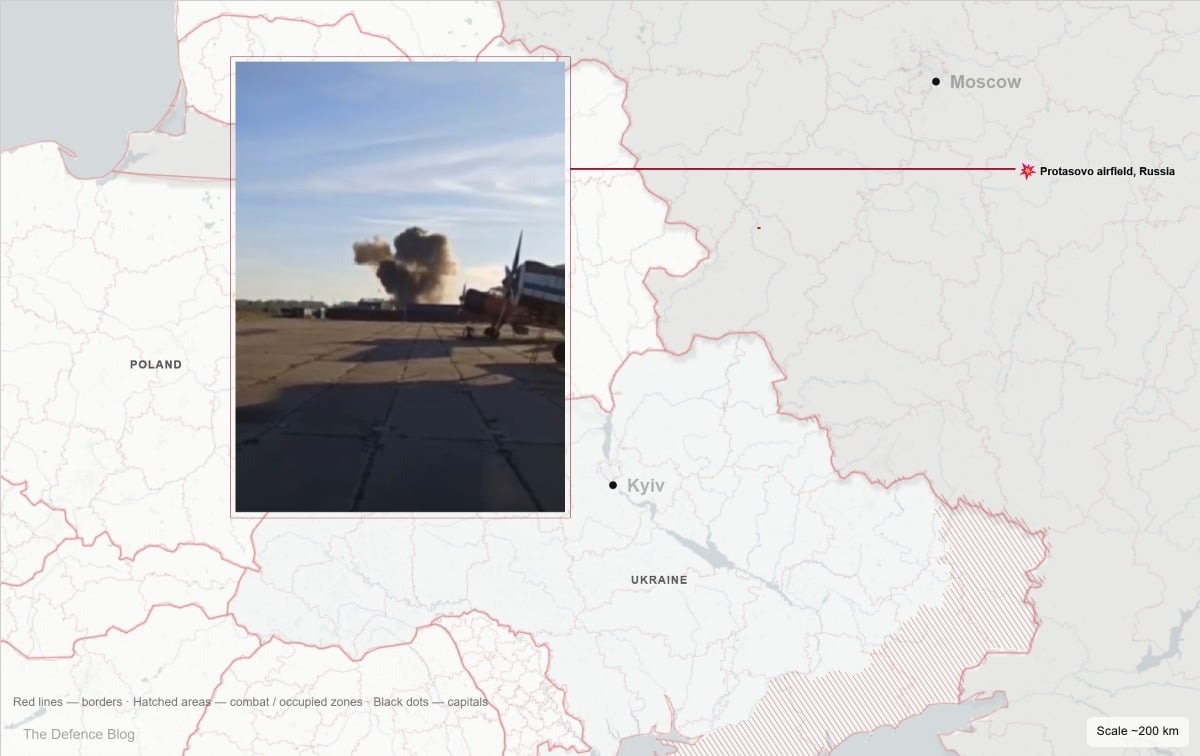
The mainstream media is drunk on cheap victory narratives. Every time a Ukrainian long-range strike hits a warehouse or an assembly line within striking distance of Moscow, the headlines follow a predictable, lazy script. They scream about "shattered sanctuaries," "deep-tier vulnerability," and the imminent collapse of the Russian military-industrial supply chain.
It is a comforting story. It is also entirely wrong.
The recent strike on a purported drone facility near Moscow did not crihesize Russia’s long-range strike capabilities. In fact, celebrating these kinetic strikes as strategic bottlenecks betrays a fundamental misunderstanding of modern, decentralized manufacturing. I have spent years analyzing defense supply chains and logistics networks. If you think blowing up a brick-and-mortar facility in 2026 stops the flow of low-cost, one-way attack drones, you are fighting a war that ended twenty years ago.
We need to stop looking at satellite imagery of smoking roofs and pretending it represents a strategic pivot point. It doesn't. Here is the brutal reality of why these high-profile strikes are failing to achieve their actual objective, and why the West's obsession with physical destruction is blinding us to the real electronic battlefield.
The Garage-Scale Fallacy of Modern Defense Production
The core mistake of the standard defense analysis is treating a drone factory like a twentieth-century tank plant.
When mainstream outlets report on a "hidden drone factory," they conjure images of massive, centralized assembly lines, specialized heavy machinery, and irreplaceable tooling. They assume that if you punch a hole in the roof with a payload, the assembly line grinds to a halt for six months.
That is obsolete thinking.
The manufacturing architecture of low-cost loitering munitions—like the Geran series or various commercial-off-the-shelf FPV adaptations—is inherently modular and highly distributed.
- Component Redundancy: The internal guidance packages, flight controllers, and fiberglass casings are not forged in a single, vulnerable foundry. They are sub-assembled in hundreds of anonymized, small-scale workshops, commercial spaces, and agricultural facilities scattered across thousands of square miles.
- The Final Assembly Illusion: The "factory" hit near Moscow was almost certainly a final integration and storage point. In modern distributed manufacturing, final assembly requires little more than basic jigs, soldering irons, and a handful of technicians.
- Rapid Relocation: If a final assembly node is compromised, the operation can be replicated in a vacant warehouse fifty miles away within 72 hours.
Imagine a scenario where a consumer electronics company loses one of its regional packaging hubs. Does the brand stop existing? Does the supply chain collapse? No. They reroute the components to three other regional facilities and absorb a minor logistical delay.
By focusing on the physical footprint of the factory, Western analysts are falling for a structural illusion. You cannot decapitate a supply chain that has no head.
The Cost-Asymmetry Math is Running Backward
Let’s talk about the cold, hard math of attrition.
To strike a target deep inside Russian territory, Ukraine must deploy sophisticated, long-range assets. Whether these are modified indigenous drones with advanced navigation systems, or covert sabotage operations, the planning, intelligence, and material costs are significant.
When those assets hit a building that contains cheap fiberglass hulls, generic internal combustion engines, and commercial-grade electronics, the economic calculus favors the defender.
+------------------------------+------------------------------+
| Attack Asset Cost            | Target Replacement Cost      |
+------------------------------+------------------------------+
| High-end long-range drone/   | Cheap industrial drywall,    |
| missile + intelligence ops:  | generic assembly tables,     |
| $150,000 - $500,000          | basic electronics: <$75,000  |
+------------------------------+------------------------------+
We are celebrating the destruction of easily replaceable inputs while ignoring the burn rate of irreplaceable offensive assets. The raw materials for these drones—imported commercial chips, simple fiberglass cloth, and mass-produced engines—continue to pour across international borders via gray-market supply chains that no physical strike can touch.
The defense community loves to cite the Royal United Services Institute (RUSI) or the Institute for the Study of War (ISW) to track map movements and strikes. But look closer at the underlying data regarding Russian defense output. Despite years of sanctions and targeted strikes, overall hull production has not plateaued; it has adapted. The bottleneck is never the physical floor space. The bottleneck is the silicon. And you don't stop silicon smuggling by blowing up a concrete structure near Moscow.
Why the "People Also Ask" Queries Are Wrong
If you look at public interest surrounding these strikes, the questions being asked expose a deeply flawed premise.
Can Ukraine stop Russian drone attacks by striking factories?
No. You can disrupt the tempo for a matter of days, but you cannot stop the output. Because the production architecture is decentralized, striking a single facility merely forces a logistical shift to backup nodes. To actually halt production, you would need to neutralize the entire domestic transport and digital coordination network—an impossibility via conventional kinetic strikes.
Why doesn't Russia protect these facilities with air defense?
They do, but air defense is a game of probability and geometry. No military on earth possesses enough point-defense systems to cover every commercial warehouse within 500 miles of a hostile border. By forcing Russia to deploy Pantsir or Tor systems around civilian industrial parks, Ukraine does achieve a tactical victory by diluting frontline air defense density. But don't confuse a successful asset-diversion strategy with the destruction of a manufacturing ecosystem.
The Real Battlefield is In the Spectrum, Not the Concrete
If blowing up buildings won't solve the problem, what will? The answer isn't satisfying to headline writers because it can't be captured in a dramatic 15-second video clip.
The real vulnerability of mass-produced drones lies in their software architecture and electronic warfare (EW) dependencies, not their physical birthplaces.
Every drone rolling off a distributed assembly line relies on a fragile web of communication protocols, satellite navigation signals, and terminal guidance mechanisms. Instead of spending millions trying to hunt down every anonymous warehouse in Russia, the strategic priority must shift toward absolute dominance of the electromagnetic spectrum.
                  [Distributed Workshop Network]
                                |
                     (Physical Relocation)
                                |
                                v
                  [Temporary Assembly Point]
                                |
     =================== THE REAL WEAK POINT ===================
                                |
                                v
       [GNSS / Communications / Terminal Guidance Spectrum]
                                |
                 (Targeted EW / Protocol Spoofing)
                                |
                                v
                       [Mission Failure]
This means moving beyond brute-force jamming. Heavy, high-power jamming signals are loud, easy to locate, and ultimately countered by a drone switching to inertial navigation or optical terrain-mapping systems.
The future belongs to protocol-level deception—intercepting the telemetry, spoofing the GNSS coordinates with high-fidelity fakes, and exploiting vulnerabilities in the commercial flight control software that these cheap platforms rely on. If you corrupt the digital brain of the drone, it doesn't matter if they build ten or ten thousand of them in their hidden warehouses. They become expensive lawn darts.
The downside to this approach is obvious: it requires constant, rapid software iteration. The moment you figure out how to spoof a specific guidance chip, the adversary patches the firmware. It is an exhausting, invisible war of algorithms. But it is the only war that actually yields a strategic return on investment.
Stop cheering for the smoke plumes near Moscow. They are a sideshow designed for public relations, masking a fundamental failure to address the decentralized reality of modern warfare. If the West continues to prioritize spectacular kinetic strikes over systemic electronic and digital denial, it will continue to lose the war of industrial attrition to an adversary that can build faster than we can bomb.