The Texas sky does nothing halfway. In the heavy, copper-colored hush of a late summer afternoon, the horizon blurs into a shimmer of heat and asphalt. Then, breaking the flat, uncompromising geometry of the suburban sprawl outside Houston, it appears.
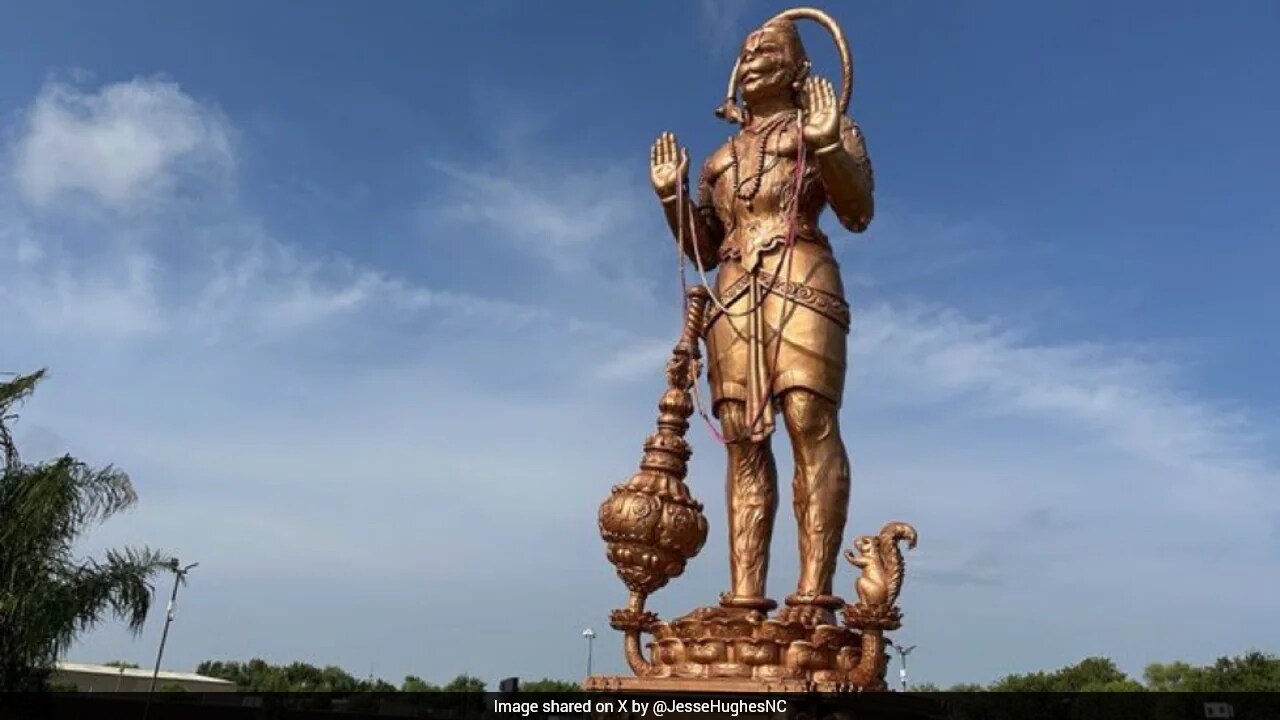
Ninety feet of bronze and stone.
This is the Statue of Union, dedicated to Hanuman, the Hindu deity of devotion, strength, and boundless courage. For the community that spent years conceiving, funding, and erecting it at the Sri Ashtalakshmi Temple in Sugar Land, Texas, the towering figure is an anchor. It is a physical manifestation of memory, an architectural prayer planted firmly in foreign soil so that children growing up thousands of miles from their ancestral homes might look up and see a piece of their heritage rendered monumental.
It is a landmark of belonging.
And then, a smartphone camera flips on.
Distance collapses. Within hours, the serene Texas meadow where the deity stands becomes a pixelated battleground. A digital creator, sitting miles away in a sterile room bathed in the blue glow of ring lights, posts a video with a provocative hook. The caption breathes defiance: Tearing This Down.
Just like that, an ancient symbol of faith is dragged headfirst into the meat grinder of modern online outrage.
The Anatomy of an Echo Chamber
To understand why a ninety-foot statue of a monkey god in a Texas suburb can detonate a digital firestorm, you have to look past the religious iconography and examine the architecture of modern attention.
Outrage is a renewable resource. It requires no fuel other than unfamiliarity and fear.
When the video dropped, it did not arrive as an invitation to understand. It arrived as an accusation. To millions of users scrolling through feeds while waiting for coffee or sitting in traffic, the statue was presented not as a work of sacred art or a community’s legal expression of religious freedom, but as an alien intrusion. A cultural threat. A flag planted by the "other" in a landscape that some believe should remain static, monochrome, and unchanged.
Consider what happens next in the lifecycle of a viral controversy.
The algorithm takes the wheel. Nuance is stripped away in the first three seconds to maximize retention. The history of Sugar Land—a remarkably diverse, thriving mosaic where cultures continually fold into one another—is flattened into a single, punchy narrative of culture-war friction. Comment sections curdle into vitriol. People who have never set foot in Texas, let alone walked the sun-baked grounds of the temple, suddenly appoint themselves arbiters of local aesthetics and national identity.
It is theater. But the actors are playing with live ammunition.
What We Build and Why We Build It
Human beings have always reached for the sky when they want to make their gods feel real.
In ancient India, artisans carved temples out of living rock at Ellora, chipping away at entire mountains until faith took the shape of columns and shrines. In medieval Europe, cathedrals pierced the clouds with spires designed to humble the mortal ego and point the soul upward. Monuments are physical arguments against transience. They are how communities say: We were here. We mattered. What we believe is permanent enough to outlast us.
When immigrant communities build massive structures, they are performing an act of psychological relocation. Moving across oceans is an amputation. You leave behind the familiar dialects, the street corners soaked in childhood memory, the smell of specific spices in the evening air, and the temples or churches whose bells have regulated the rhythm of generations.
To recreate those spaces in a Texas suburb is an act of profound vulnerability. It is saying to your new neighbors, This is who we are. We are not hiding.
Hanuman, in Hindu mythology, is famous for a specific legend: when he needed a rare medicinal herb to save the life of the fallen prince Lakshmana, he lifted an entire mountain because he could not find the single plant in time. He is a figure of impossible dedication. He represents the capacity to carry heavy things across vast distances for the sake of those you love.
There is a tragic irony in the way his statue was received online. The deity who crossed oceans in mythic tales was rejected by people whose ancestors crossed oceans to escape the very same provincial intolerance.
The Digital Inquisitor
Let us look closer at the person behind the camera.
Hypothetically, imagine the modern content creator specializing in cultural friction. Their currency is not truth; it is engagement. Every share, every angry comment, every defensive counter-post is a coin dropped into their digital tollbooth. They do not need to hate the statue. They simply need the statue to perform well on the metric dashboard.
When they stand beneath the bronze foot of Hanuman, they do not see the elders who wept when the final crane hoisted the head into place. They do not see the teenagers who felt a sudden, electric surge of pride seeing something familiar in a textbook-white suburb. They see a thumbnail. They see a hook. They see an opportunity to monetize alienation.
This is the invisible tax of the digital age. Every public monument now lives a double life. There is the physical reality—the cold metal, the pigeons resting on a shoulder, the prayers whispered in the humid Texas dusk—and there is the digital ghost, bouncing across servers, warped by filters, weaponized by talking heads who profit from division.
The former is rooted in community. The latter is rooted in algorithms.
The Weight of Stone
Back in Sugar Land, the online storm feels distant, almost unreal, once you step onto the temple grounds.
The wind moves through the oak trees. The heat radiates off the pavement. A grandmother walks slowly along the paved pathway, her fingers rolling the beads of a wooden japa mala, her lips moving in quiet repetition. She pauses beneath the gaze of the towering deity. She does not look angry. She looks at peace.
Statues do not answer back. They do not draft tweets. They do not stitch response videos or issue PR statements. They simply stand. They absorb the weather, the passing years, and the shifting moods of an anxious society.
The outrage that flared up on screens across the world has already begun to mutate, shifting like smoke toward the next shiny object of digital indignation. The creators who built their temporary empires on the controversy have moved on to new targets, new culture-war skirmishes, new ways to monetize the public's endless appetite for outrage.
The internet forgets quickly.
But the monument remains.
It stands because the people who built it understand a fundamental truth that the digital mobs miss entirely: America has never been a static painting. It is a work in progress, messy, loud, contradictory, and constantly being redrawn by the people who call it home. Every steeple, every minaret, every pagoda, and every towering bronze monkey god added to the horizon is proof of that ongoing negotiation.
Silence falls over the meadow as the sun dips below the horizon, painting the Texas sky in bruised shades of violet and gold. For a moment, the statue is just a dark, majestic silhouette against the fading light—a quiet giant holding the weight of history, faith, and the restless modern world in the palm of its stone hand.