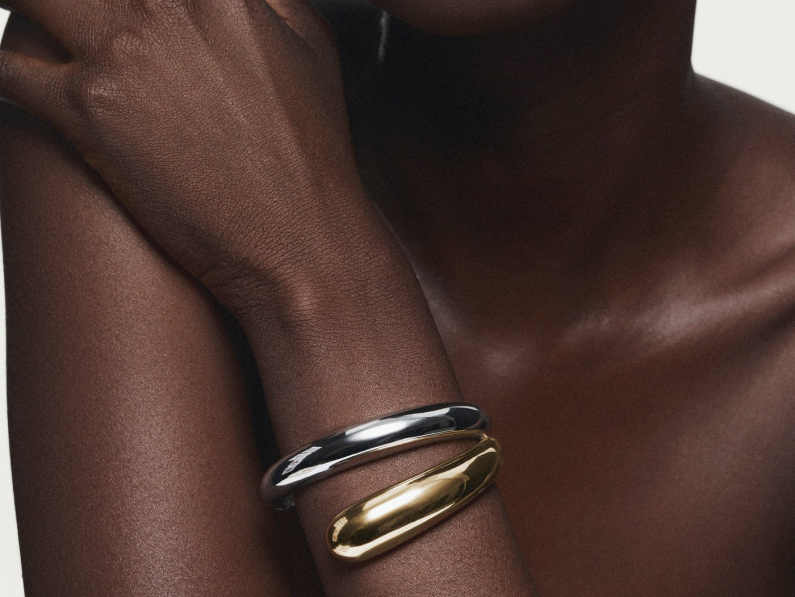
For decades, matching your metals was treated as a sacred commandment of personal style. Gold stayed with gold. Silver kept to silver. Platinum looked down upon everything else from its expensive perch. Violating this unwritten rule meant risking public shorn-shaming from conservative stylists and older relatives who believed that mixing finishes was the sartorial equivalent of wearing white after Labor Day.
That rigid era is officially dead. In related developments, read about: Why the London Design Festival Matters Right Now.
Mixed metals jewelry has completed its long, awkward evolution from a chaotic styling mistake into the defining aesthetic of modern accessorizing. This fall, consumers are actively throwing out matching sets in favor of stacked rings, tangled chains, and earrings that deliberately refuse to coordinate. But this shift is not just another fleeting seasonal whim cooked up by bored trend forecasters. It represents a much deeper cultural and economic pivot in how people consume luxury, value heirlooms, and express identity through adornment.
To understand why this rebellion happened now, we need to look past the glossy magazine spreads and examine the underlying mechanics of modern jewelry manufacturing, precious metal pricing, and consumer psychology. Cosmopolitan has analyzed this fascinating issue in extensive detail.
The Economic Realities Driving the Chaos
Precious metals have rarely been more volatile. Over the past several years, gold prices have surged to historic highs, while silver has experienced its own erratic market swings driven by industrial demand and speculative trading. Buying a complete, heavy suite of solid 14-karat yellow gold jewelry requires a financial commitment that prices out a massive segment of consumers who still want quality pieces.
Enter the strategic compromise. Mixing metals allows jewelry buyers to stretch their budgets. A consumer can invest in one or two solid gold anchor pieces—perhaps a heritage signet ring or a classic chain—and build out the rest of their daily stack with more accessible sterling silver or white gold items.
Manufacturers and independent designers caught onto this economic necessity early. Instead of fighting the budget constraints of their customer base, they weaponized creativity. Jewelry houses began releasing pre-layered necklaces and rings featuring soldered bands of contrasting tones, effectively monetizing the consumer desire for visual depth without requiring a total financial overhaul of their jewelry boxes.
This is not accidental design. It is a pragmatic response to market pressures. When raw materials become prohibitively expensive, aesthetic innovation often follows out of sheer survival. The accidental side effect of economic frugality is a far more interesting, dynamic approach to personal adornment.
The Psychology of Imperfection
For generations, high fashion worshipped uniformity. Perfection was the ultimate status symbol. Perfectly matched pearls, flawless diamonds, and identical gold links signaled wealth because they demonstrated that the wearer could afford an entire set sourced from the exact same batch of luxury goods.
That hunger for sterile perfection has faded. Modern consumers, particularly younger demographics, find hyper-matched ensembles clinical and uninspired. They want character. They want history.
Mixing metals introduces a deliberate element of tension and friction into an outfit. When a cool sterling silver cuff sits right next to a warm, buttery yellow gold bangle, the contrast creates visual energy. It tells an observer that the wearer did not simply buy a pre-packaged look off a mannequin. It implies a collection built over time—pieces picked up during travels, inherited from relatives, or bought to mark personal milestones.
We are living through an era that values authenticity over pristine curation. The scuffed leather jacket, the vintage watch with a patinaed dial, and the mixed-metal ring stack all share the same DNA. They whisper of a lived-in life rather than a staged photo shoot.
Breaking the Rules of Heritage Brands
Traditional heritage brands fought this transition tooth and nail. For a century, houses like Cartier, Tiffany, and David Yurman built multi-billion-dollar empires on the premise of the collection. You bought the Love bracelet in yellow gold, and you kept buying yellow gold so nothing clashed.
Yet, even the old guard had to adapt. Consider how Cartier’s Trinity ring—which famously interlocks yellow, white, and rose gold—has seen massive resurgences in popularity across younger markets. The piece was originally designed in 1924, but its philosophy of combining three distinct metals was decades ahead of its time. Today, consumers are taking that concept and applying it to their entire bodies, mixing brands, eras, and karat weights with absolute impunity.
Independent designers have capitalized on this freedom. Without the burden of century-old corporate guidelines, boutique jewelers are soldering sterling silver and 18-karat gold together into single components. This technical challenge requires genuine skill. Silver and gold have different melting points and expansion rates, making mixed-metal construction notoriously difficult to cast and maintain over time. The fact that contemporary artisans are mastering this craft proves that the trend is backed by real technical execution, not just clever marketing.
How to Style Mixed Metals Without Looking Messy
Freedom can be terrifying. When the old rules are burned down, people often swing too far in the opposite direction, creating an unreadable visual noise rather than a compelling look. Mastering mixed metals requires intention, proportion, and balance.
Establish a Dominant Anchor
Wearing equal parts gold, silver, and rose gold with no hierarchy usually results in visual confusion. A more effective strategy involves choosing a dominant metal that accounts for roughly seventy percent of your overall look, using the remaining thirty percent for contrast. If your watch and main chain are yellow gold, introduce silver through smaller accent rings or a secondary pendant.
Pay Attention to Scale and Texture
Contrast works best when other elements are varied. Pairing a heavy, high-polish yellow gold chain with a delicate, oxidized silver chain creates depth through both color and texture. The dark, blackened finish of oxidized silver provides a bridge that makes the transition between warm gold and bright silver look intentional rather than accidental.
Consider Skin Undertones
While modern styling rules permit breaking almost every ancient beauty norm, skin undertones still matter for how metals sit against the body. Cool undertones often pop dramatically against bright white silver and platinum, while warm skin tones naturally harmonize with yellow and rose gold. When mixing, place the metal that best complements your skin tone closest to your face—such as in earrings or a short choker—while letting the contrasting metal take over on your hands or wrists.
The Death of the Heirloom Mindset
Another major factor driving the mixed-metal movement is the changing nature of inheritance. Boomer parents spent fortunes amassing cohesive suites of fine jewelry, expecting their children to wear them intact to formal dinners. Younger generations have different ideas.
Millennials and Gen Z do not live formal dinner lives. They work from home, frequent casual coffee shops, and wear hoodies with luxury blazers. When they inherit a collection of heavy yellow gold jewelry from a grandmother, they rarely wear the pieces as a matching set. Instead, they take that heavy gold necklace, break it down, or pair it directly with their everyday white metal pieces to ground the antique aesthetic in the present day.
This modular approach to jewelry has transformed family heirlooms from museum pieces into active participants in daily wardrobe styling. Jewelry is meant to be worn, battered, lived in, and customized. Keeping pieces locked in velvet boxes for fear of mixing finishes misses the entire point of craftsmanship.
What Comes After the Metal Barrier Breaks
The collapse of the matching-metals rule opens the door to even wilder experiments in personal adornment. Once you accept that yellow and white metals can occupy the same wrist, the door swings open for non-traditional materials to enter the fine jewelry conversation.
We are already seeing an explosion of ceramic, wood, enamel, and industrial titanium integrated alongside traditional precious stones and metals. The boundaries between fine jewelry, costume pieces, and industrial design are dissolving in real-time.
The industry will continue to shift toward modularity, where components can be swapped, upgraded, and combined according to the whims of the wearer rather than the dictates of a seasonal collection calendar. The brands that survive this transition will be those that offer customizable components and modular architecture, recognizing that consumers no longer want to buy finished stories. They want the raw materials to write their own.
Stop worrying about whether your watch matches your rings. The friction is where the style actually lives.