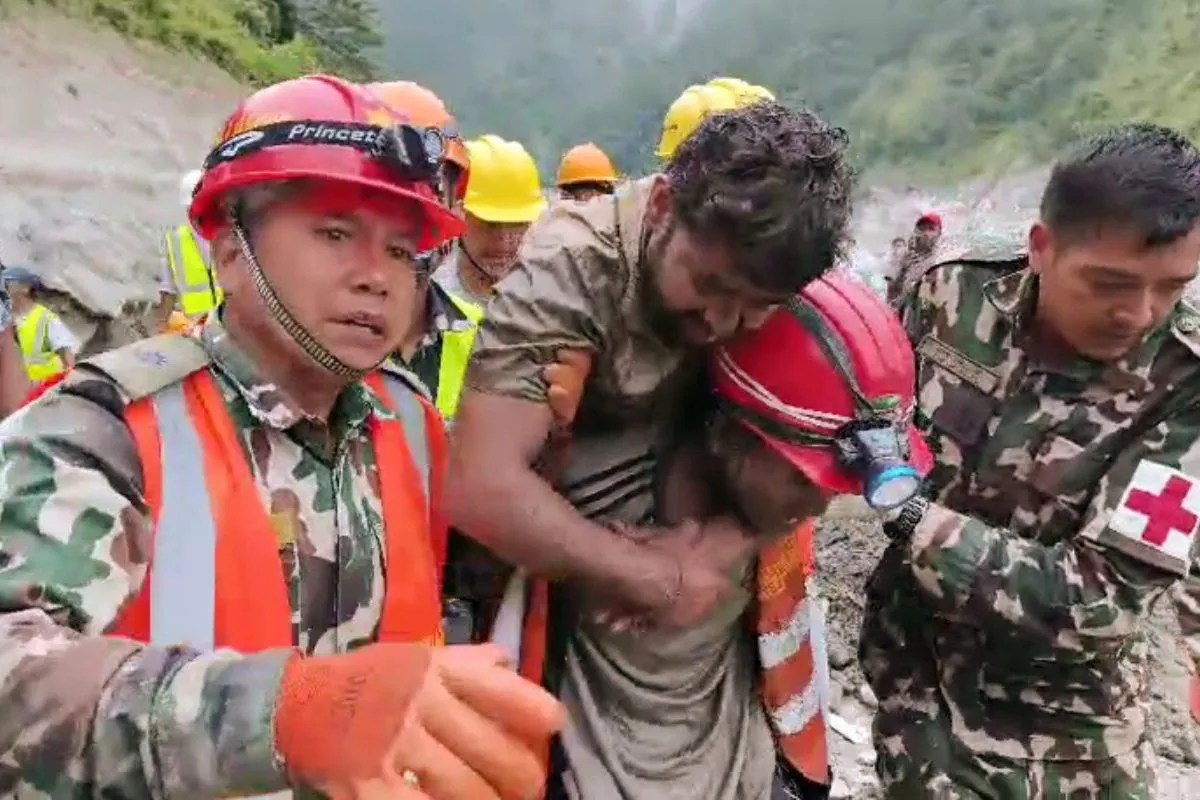
Nine days in pitch-black darkness. A wall of mud and stone sealing off the world outside. Most people would have given up, but two men and their families refused to quit.
When catastrophic flash floods tore through the Trishuli valley in Nepal on August 26, triggered by a massive mountain and glacial collapse near the border, the devastation was staggering. Entire landscapes transformed overnight. Hydropower projects turned into underground tombs.
Yet, against all odds, a breakthrough happened. Rescuers pulled two workers—30-year-old Sanjay Sah and 45-year-old Kabir Maharjan—alive from the buried debris of the Upper Trishuli 3A Hydropower Station. For their families, who had spent over a week staring at rescue updates with a mix of dread and faint hope, the news felt surreal.
When Hope Fades and Miracles Begin
Families of the missing workers endured nine agonizing days of silence. Local authorities and international tunneling experts faced a nightmare scenario. The entrance to the Trishuli 3A tunnel had completely vanished beneath massive piles of rock, heavy debris, and thick slush. Heavy machinery clawed at the blockage day and night, while engineers used improvised tools like WhatsApp networks to pull up old layout designs and coordinate rescue tracks.
For Kabir Maharjan's sister, the news of his survival arrived right after she finished her daily prayers. She had already prepared herself for the worst. Hearing that her brother was breathing, injured but alive, turned grief into an overwhelming wave of relief.
"We had once given up hope," she told reporters shortly after the rescue.
Surviving the Underground Nightmare
How did they survive nearly ten days trapped deep inside a collapsed mountain?
Sanjay Sah, a mechanical foreman with the Nepal Electricity Authority, stayed behind when the disaster struck specifically to warn his colleagues and help them escape. He never made it out before the tunnel sealed shut. Once cut off from the outside world, Sah relied on mental resilience. He later told security personnel that he spent his days chanting mantras—including the Hare Krishna mahamantra—to keep panic at bay while surviving in an air pocket about 170 meters inside the tunnel.
Sah also noted that he had been able to communicate with a few other individuals trapped nearby in the darkness. That human connection mattered. It kept the psychological weight of isolation from crushing them.
When rescue teams finally broke through on Friday, the footage captured a raw, unfiltered human triumph. Rescuers cheered as Sah and Maharjan emerged through a muddy opening. Maharjan was caked in dirt, his hands pressed together in prayer, before being carried onto a stretcher and airlifted to a military hospital in Kathmandu.
The Hard Truth About Mountain Disasters
While the survival of Sah and Maharjan has breathed new life into the ongoing operations, the broader reality remains grim. The disaster claimed over a thousand lives across the region, and thousands more remained missing as rescue teams sifted through the wreckage of multiple destroyed hydropower stations.
Experts like Arnold Dix, president of the International Tunnelling and Underground Space Association, noted that engineering teams faced unprecedented obstacles. Finding a tunnel when the surface topography has completely shifted requires a mix of satellite imagery, old blueprints, and sheer grit. Even after locating the mouth of the tunnel, workers had to carefully manage controlled blasts and water pumps to avoid destabilizing the entire structure.
The success at Trishuli 3A proves that underground survival is possible when air pockets hold and resilience outlasts despair. Rescue operations are pressing forward into other blocked chambers. Families waiting near hospital gates and riverbanks continue to watch, holding onto the proof that miracles do occasionally break through the mud.