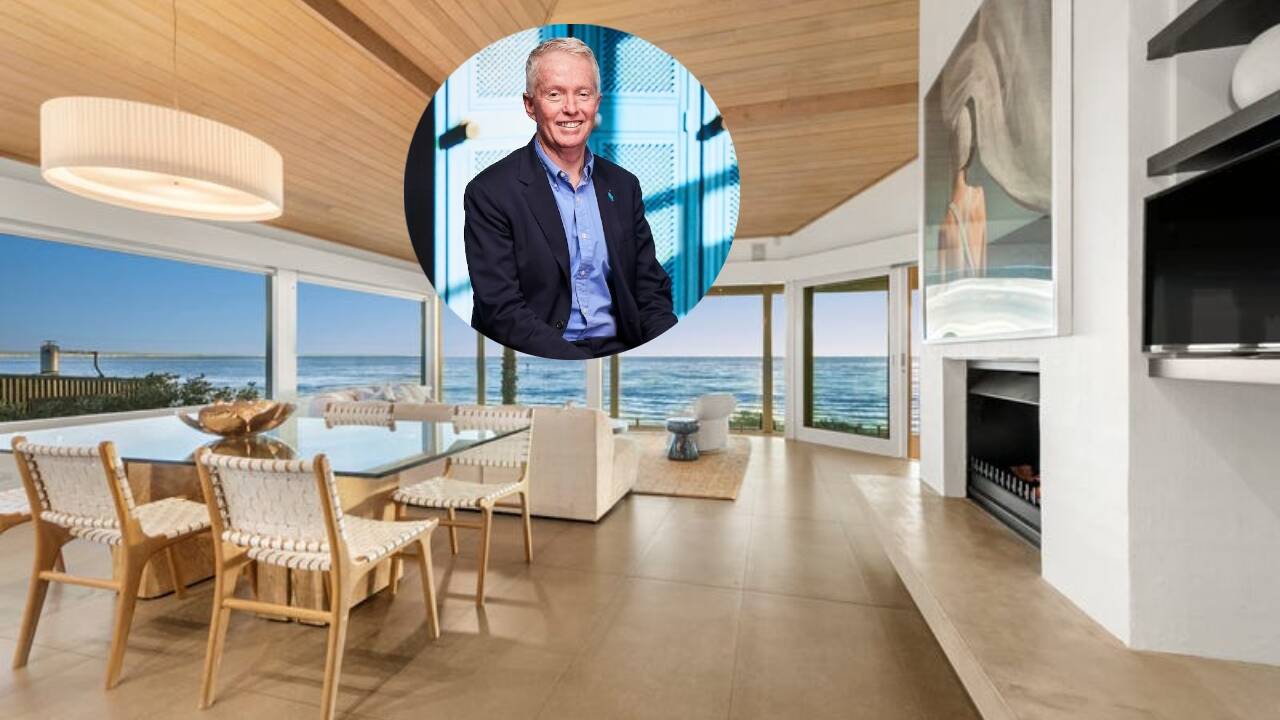
The sea does not care about your resume. It does not care about your board seats, your quarterly reports, or the millions you have accumulated in high-yield accounts while steering the administrative ship of Australian sport. It only knows how to break things against the rocks, rhythmically and without malice.
Craig Tiley stood on the balcony of his beachfront property in Portsea, watching the whitecaps tear across Port Phillip Bay. For years, this stretch of the Mornington Peninsula had served as a fortress of solitude. A sanctuary from the relentless noise of Melbourne Park, the endless international flights, the television cameras, and the crushing administrative weight of running the Australian Open through a global pandemic, border closures, and shifting political tides.
Real estate, much like tennis, is a game of timing. And sometimes, you double-fault on match point.
When the dust settled on the sale, the ledger confirmed what the market already whispered. A staggering $5.75 million loss.
To understand how a man of such strategic calculation absorbs a financial blow of that magnitude, we have to look past the cold digits on a settlement sheet. We have to look at the psychology of letting go.
Luxury coastal real estate in Victoria operates under its own microclimate of economic rules. It is a playground for high-net-worth individuals who buy on emotion and sell under pressure. When Tiley originally acquired the coastal address, the world was spinning on a different axis. Interest rates were low, optimism was high, and the horizon felt infinite.
Consider the hypothetical buyer in that echelon. They are not looking for a roof over their head; they are purchasing an identity. They are buying the whisper of salt spray against glass windows, the private access to sand, the security of a gated perimeter. But luxury has a terrible habit of becoming a liability when liquidity is required.
Tiley had poured vision, capital, and personal history into the Mornington Peninsula sanctuary. Yet, the high-end coastal market does not reward sentimentality. It rewards scarcity and immediate demand. By the time the property hit the open market, economic headwinds were howling louder than the winter gales off Bass Strait. Buyers were cautious. Offers were lowballs wrapped in polite legal jargon.
Negotiation at that level is a high-stakes poker game played in slow motion. Weeks turn into months. Every price reduction is a public confession of vulnerability. Other high-profile figures watch from their own glass houses, calculating your losses as a metric of their own net worth.
When the final contract was signed, the realization set in. The asset had bled value at a rate that would make a Wall Street trader wince.
Why does a multi-million-dollar property divestment sting beyond the balance sheet? Because a home is the physical manifestation of our ambition. We build monuments to our success, believing that brick, mortar, and panoramic views can anchor us against the chaos of our professional lives.
For over a decade, Tiley has been the face of Australian tennis governance. He navigated the sport through quarantine bubbles, Novak Djokovic visa sagas, and multi-billion-and-million-dollar broadcast negotiations. He is a man accustomed to control. He plans draws, schedules matches down to the minute, and dictates the flow of global sports entertainment.
The property market refused to take his instructions.
It is a humbling reminder that no amount of executive acumen can immunize anyone against macroeconomic shifts. Interest rate hikes, inflation, and shifting wealth demographics do not care who you are. They roll over everyone equally.
In business, we celebrate the wins. We frame the trophies, publish the press releases, and throw galas to mark the milestone. Losses, however, are treated like contagious diseases. We hide them behind corporate restructurings, portfolio optimizations, and sanitized media statements. But a five-million-dollar evaporation of equity leaves a mark. It forces a recalibration.
There is an art to walking away from a sinking asset. Many investors fall into the trap of the sunk cost fallacy, holding onto a bleeding property out of sheer pride, waiting for a market correction that might take a decade to materialize. Cutting a loss of that magnitude requires a specific kind of cold clarity. It requires admitting that the capital is better deployed elsewhere, even if the exit wound is deep.
As the keys changed hands and the new title deeds were registered, the chapter closed on one of Victoria's most expensive real estate missteps of the season.
Tiley remains at the helm of Tennis Australia, steering tournaments into future summers, dealing with the next generation of phenoms and broadcast rights. The job demands absolute presence. You cannot run a global sporting institution while looking backward at a shrinking bank account and a forfeited view of the bay.
The waves will continue to crash against Portsea. The salt will continue to corrode the brass fixtures of neighboring mansions, regardless of whose name is on the title. And somewhere out on the horizon, another buyer is getting ready to write a check, completely unaware of the ghosts they are paying for.