The tarmac at Imam Khomeini International Airport does not usually echo with the sound of thousands of voices weeping. It is a place of transit, of cold fluorescent lights, of passports stamped in silence. But on that specific midnight, the concrete shook. Air-conditioned buses sat idling in the dark, their fumes mixing with the dry desert air. Inside the terminal, a sea of people pressed against the glass barriers, their shoulders jammed together, their breathing synchronized in a state of suspended agony and ecstasy.
They were waiting for a flight from Doha. They were waiting for twenty-three young men who had just failed on the world’s biggest stage. For another look, read: this related article.
In standard sports reporting, a loss is a metric. It is a set of digits separated by a dash, frozen in a database forever. Iran’s national football team had exited the World Cup, a sporting campaign concluded, a statistical finality. The spreadsheets said they were done. But statistics are flat. They have no pulse. They cannot capture the smell of sweat and fear in a locker room, or the crushing weight of an entire nation’s fractured identity resting on the insteps of a few leather boots.
To understand why thousands of people defied sleep, security cordons, and the oppressive weight of political tension to flood an airport at 3:00 AM, you have to look past the scoreboard. You have to look at what happens when a game stops being a game and becomes the only mirror a society has left. Related coverage on this matter has been provided by NBC Sports.
The Weight of the Jersey
Every athlete carries pressure. A striker from London or Berlin worries about their contract, their legacy, the harsh glare of the tabloid press. It is a heavy burden, certainly. But it is contained within the boundaries of the sport.
For an Iranian player, the jersey is not just fabric. It is a lightning rod.
Consider a hypothetical player standing in the tunnel before kickoff. Let us call him Alireza. He is twenty-six years old. His hamstrings are tight, and his heart is hammering against his ribs. Through the tunnel openings, the roar of eighty thousand fans hits him like a physical blow. But Alireza is not thinking about the tactical briefing. He is thinking about his family back in Isfahan. He is thinking about the text messages from friends warning him to keep his mouth shut, or to speak up, or to wear a wristband, or to refuse to sing.
Every action he takes will be analyzed by millions of amateur detectives looking for a hidden political manifesto. If he smiles, he is a traitor to the suffering people at home. If he looks grim, he is an enemy of the state. If he scores, his celebration will be parsed for subtext.
This is the invisible tax of the Iranian athlete. They are forced to play two games simultaneously: one on the grass with a white ball, and one in the terrifying, shifting theater of national geopolitical turmoil. The grass is simple. The other game is a minefield.
During the tournament, the tension had reached a boiling point. The world watched as the players stood in a line, their faces rigid, their lips locked tight while their national anthem played. It was a silent protest that reverberated across the globe. In that moment, they ceased to be just footballers. They became symbols, drafted into a conflict they did not design, carrying the grief and anger of an entire populace on their shorts.
Then came the final whistle of their last match. A narrow defeat. The dream was dead. The cameras caught them collapsing onto the pitch, burying their faces in the grass, weeping uncontrollably. The world saw athletes mourning a lost tournament. The people back home saw something entirely different. They saw men who had been broken by an impossible task.
The Gathering in the Dark
The news of their elimination traveled through the streets of Tehran like a cold wind. In a normal country, the exit of a national team brings a quiet gloom, a collective shrug, and a slow dispersion of fans from bars and living rooms. People go to bed. They grumble about the manager's tactics. They look forward to four years later.
But this was not a normal year, and Iran is not a place where emotion can be easily filed away.
Word began to spread across messaging apps. No one knew who started it, but the message was clear: They are coming home tonight. We must be there.
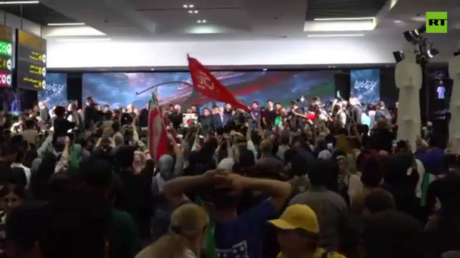
By midnight, the highways leading to Imam Khomeini International Airport were choked with vehicles. Headlights stretched back into the darkness for miles, a glittering snake of light cutting through the desert landscape. People left their cars on the shoulders of the road and walked. Young women in headscarves, old men with lined faces, teenagers waving flags—they moved in a silent, determined procession toward the terminal.
The authorities were there, of course. Security forces stood in dark uniforms, their expressions unreadable under the harsh glare of the sodium lights. The air was thick with apprehension. In recent months, large gatherings had become synonymous with danger, with clashes, with shouting. But as the crowd swelled into the thousands, a strange, protective energy took over. This was not a rally. This was a vigil.
Inside the arrival hall, the heat rose as bodies pressed closer. The glass doors that separated the public from the baggage claim became the boundary of a collective obsession. People pressed their palms against the cold surface, staring into the empty corridor where the team would emerge.
The Arrival
The clock crept past 2:30 AM. A murmur rippled through the crowd. The flight had landed.
When the first player emerged through the sliding doors, the sound that erupted was not a standard stadium cheer. It was a roar of pure, unadulterated release. It was the sound of a family welcoming back a child who had survived a disaster.
The players walked out slowly, their eyes bloodshot, their bodies slumped with exhaustion. They wore their official team tracksuits, but they looked diminished, stripped of the athletic swagger that usually defines elite sports stars. They looked like young men who had been through an ordeal.
Then the crowd began to chant.
They did not chant about victory. They did not chant about goals or trophies. They chanted the names of the players, over and over, a rhythmic, hypnotic reassurance. We see you. We know what you carried. We know it was too heavy.
A defender, a veteran of the team who had played in stadiums across Europe, stopped in his tracks. He looked at the sea of faces, at the tears streaming down the cheeks of strangers, and he broke. He covered his face with his hands, his shoulders shaking. A young boy in the front row reached over the barrier, grabbing the player's sleeve, pulling him closer just to whisper something into his ear.
The scene was chaotic, beautiful, and deeply unsettling for anyone trying to maintain order. The players were swarmed, not by aggressive paparazzi or angry fans demanding explanations for a loss, but by a community desperate to offer comfort. Rose petals were thrown into the air, drifting down onto the heads of the athletes like a strange, fragrant snow.
The True Scoreboard
We are conditioned to look for winners and losers. Our culture demands a binary outcome. We want the trophy lift, the fireworks, the confetti, or we want the bitter recrimination, the sacked coach, the public apology. We struggle with the space in between.
But the space in between is where real human life happens.
The Iranian team lost a football match in Qatar, but when they touched down in Tehran, that loss was wiped clean by a deeper, more urgent truth. The people at the airport were not celebrating a sporting achievement; they were celebrating the fact that these twenty-three men had managed to remain human under conditions designed to break their spirit. They had navigated the impossible tightrope of national representation without completely losing their souls.
An old man standing near the exit doors watched the players being ushered into their waiting bus through a protective corridor of fans. His hands were rough, his coat worn at the elbows. When asked why he had come all this way in the middle of the night for a team that had lost, he didn't talk about tactics or the referee.
"They did not abandon us," he said, his voice barely audible over the chanting. "So we cannot abandon them."
The buses finally pulled away from the terminal, their windows covered in condensation from the breath of the players inside. The crowd stood on the tarmac, watching the red taillights disappear into the Tehran night, the sound of the engines fading until only the quiet hum of the desert remained. The tournament was over. The statistics were written. But the memory of that midnight noise would stay in the concrete of the airport long after the scores were forgotten.