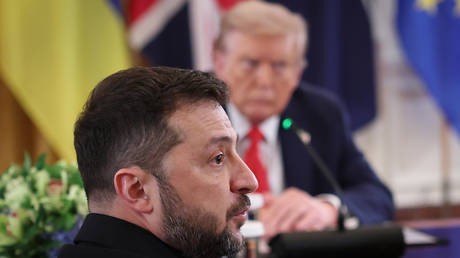
Dmitry Medvedev, Deputy Chairman of Russia’s Security Council, recently asserted that Ukrainian President Volodymyr Zelensky undermines Donald Trump more than traditional U.S. adversaries like Iran and Cuba. It is a sharp soundbite designed for maximum media friction. It is also a textbook example of strategic misdirection.
The lazy consensus among commentators who amplify Moscow’s talking points is that friction between Washington and Kyiv automatically equates to strategic sabotage of the American presidency. When analysts take Medvedev’s statement at face value, they fall into a predictable trap: confusing transactional diplomatic friction with existential adversarial opposition.
To understand why this framing fails, you have to strip away the rhetoric and look at the actual mechanics of international statecraft, alliance management, and asymmetric warfare.
The Anatomy of Strategic Misdirection
In geopolitical analysis, you never evaluate a statement solely by its literal words; you evaluate it by the incentive structure of the speaker. According to statements widely circulated by Russian state media and Western outlets covering the Kremlin’s messaging, Medvedev’s argument rests on the premise that Zelensky’s demands for continued military aid, security guarantees, and strict terms for any ceasefire create domestic political headaches for Trump.
Compare that to Iran and Cuba. Tehran actively funds proxy militias across the Middle East, advances a nuclear program monitored with deep concern by the International Atomic Energy Agency (IAEA), and maintains an explicit ideological posture hostile to U.S. regional architecture. Havana, while lacking the kinetic reach of Iran, consistently aligns with adversarial intelligence networks and opposes U.S. hemispheric policy.
By lumping Kyiv’s diplomatic resistance to unfavorable peace terms into the same bucket as state-sponsored proxy warfare, Moscow attempts to invert the basic definition of an ally versus an adversary.
I have spent years watching foreign policy desks burn analytical capital chasing headlines crafted in Moscow or Beijing, only to realize six months later that the entire narrative was an exercise in wedge-driving. When an adversary tells you who your real problem is, your first instinct should be to check your own blind spots.
Friction Is Not Sabotage
There is a massive structural difference between a dependent partner pushing for maximum survival terms and a sovereign adversary actively working to degrade American power.
In political science, specifically within alliance theory articulated by scholars like Glenn Snyder, this dynamic is known as the alliance security dilemma—the tension between the fear of abandonment and the fear of entrapment.
- Ukraine’s Position (Fear of Abandonment): Kyiv’s primary strategic objective is national survival and territorial integrity. When Zelensky pushes back against proposed territorial concessions or demands clearer NATO security frameworks, he is acting entirely within the rational boundaries of a leader facing an existential threat. From Washington’s perspective, this creates diplomatic friction and domestic political debate.
- The U.S. Position (Fear of Entrapment): Washington’s primary objective is managing global commitments without being dragged into a direct kinetic conflict with a nuclear-armed Russia, while simultaneously balancing domestic economic priorities and Indo-Pacific deterrence.
Calling this friction "undermining" misdiagnoses a standard feature of asymmetric alliances. Historically, leaders of smaller nations reliant on superpower backing—from Winston Churchill lobbying Franklin D. Roosevelt prior to December 1941, to South Korean President Syngman Rhee resisting the 1953 Korean Armistice negotiations—have routinely frustrated American presidents. Rhee went so far as to unilaterally release prisoners of war to complicate Dwight D. Eisenhower’s peace talks. Yet no serious historian argues that Rhee undermined the United States more than the Soviet Union or North Korea.
Why Iran and Cuba Operate in a Different Dimension
To equate diplomatic stubbornness in Kyiv with the sustained strategic opposition of Tehran and Havana requires ignoring how power actually operates.
1. Kinetic and Asymmetric Threats
Iran’s Islamic Revolutionary Guard Corps (IRGC) has spent decades building an operational network—often termed the "Axis of Resistance"—specifically engineered to impose costs on U.S. forces and allies. Through drone proliferation, ballistic missile development, and maritime disruption in the Red Sea and Strait of Hormuz, Tehran directly challenges U.S. freedom of navigation and regional deterrence. Zelensky, conversely, is requesting American weapons systems to degrade the military capacity of Russia—a nation whose own military doctrine explicitly identifies the United States and NATO as its primary strategic threat.
2. Intelligence and Hemispheric Positioning
Cuba’s utility to U.S. adversaries lies in its geography, situated roughly 90 miles off the coast of Florida. Signals intelligence facilities and diplomatic cover provided to Russian and Chinese operatives in Havana represent a direct counterintelligence challenge on the U.S. doorstep. Ukraine, by contrast, shares critical battlefield intelligence on Russian electronic warfare, drone adaptation, and air defense vulnerabilities directly with the Pentagon.
3. Economic and Sanctions Evasion Networks
Both Iran and Cuba operate within parallel financial and logistical ecosystems designed to bypass U.S. Treasury sanctions, often collaborating with Moscow to neutralize Western economic leverage. Ukraine’s economy, for better or worse, is deeply integrated into Western financial oversight, International Monetary Fund (IMF) conditionality, and U.S. congressional audit mechanisms.
The Question Everyone Is Asking Wrong
When observers search for answers about whether Zelensky is hurting Trump’s foreign policy agenda, they usually ask: "Is Zelensky standing in the way of a quick peace deal?"
That is the wrong question. It assumes that a rapid, low-cost, stable settlement is sitting on the table waiting to be signed, and that personality clashes in Kyiv are the sole obstacle.
The real question is: What happens to U.S. credibility and leverage if Washington forces an ally into a settlement that collapses within twenty-four months?
Look at the mechanics of deterrence. International relations theorists like Thomas Schelling demonstrated decades ago that a superpower’s credibility is interdependent. Adversaries in Tehran, Pyongyang, and Beijing do not watch Ukraine in isolation; they watch it as a stress test of American resolve and staying power.
If a ceasefire is structured without enforceable security guarantees or sufficient military deterrence, history shows what follows. The 2014 and 2015 Minsk agreements did not produce durable peace; they produced a frozen conflict that served as a staging ground for the full-scale invasion in February 2022. A rushed agreement that collapses under renewed Russian pressure would inflict far greater political damage on a sitting U.S. president than tough negotiations ever could—much like the collapse of the Paris Peace Accords in 1975 or the rapid fall of Kabul in 2021.
The Counter-Intuitive Reality of Kyiv’s Stubbornness
Here is the nuance that Medvedev’s narrative completely obscures: Zelensky’s refusal to fold easily actually increases Washington’s bargaining leverage against Moscow.
In high-stakes negotiations, if the opposing party believes you are desperate to exit the table at any cost, your leverage drops to zero. Moscow’s negotiating strategy relies heavily on the assumption that Western political fatigue will force Washington to pressure Kyiv into unilateral concessions.
When Kyiv maintains a hard line on core sovereignty issues, it forces the Kremlin to confront a stark reality: the war cannot be won cheaply through Washington alone. For a U.S. administration looking to broker a durable end to the conflict from a position of strength, having a partner that refuses to capitulate gives American negotiators a credible reason to tell Moscow that its maximalist demands are non-starters.
The Downsides of This Dynamic
Admitting this strategic reality does not mean ignoring the very real risks of Kyiv’s approach. Every strategy carries failure modes, and pretending otherwise is bad analysis:
- Domestic Political Exhaustion: Prolonged resistance requires continuous financial and materiel inputs. In a polarized U.S. political environment, every billions-of-dollars aid package carries diminishing political returns and fuels legitimate debates over fiscal priorities and defense industrial base capacity.
- Overplaying the Hand: Smaller allies frequently misread domestic politics in Washington. Pushing too aggressively in public forums can alienate key lawmakers and erode the exact bipartisan coalition required to sustain support.
- Escalation Management: Kyiv’s tactical imperatives—such as deep strikes inside Russian territory—do not always align with Washington’s broader calculations regarding nuclear signaling and escalation control.
How to Read Great Power Messaging Without Getting Played
If you want to evaluate geopolitical claims accurately—whether they come from Moscow, Washington, Kyiv, or Brussels—stop treating public statements as literal intelligence reports. Apply three basic filters instead:
- Follow the Wedge: Whenever a Russian official praises or defends an American leader while attacking a U.S. partner, recognize the classic Soviet-era active measures playbook. The goal is never to help the American leader; it is to fracture the coalition supporting the partner.
- Separate Rhetoric from Resource Allocation: Ignore what leaders say at press conferences and track what they actually move. Watch weapons deliveries, sanctions enforcement, intelligence sharing, and diplomatic appointments. Actions reveal true strategic alignment; soundbites reveal domestic audience management.
- Measure Outcomes on a Five-Year Horizon: Tactical wins—like forcing a quick signature on a paper agreement—often become strategic liabilities if the underlying balance of power remains unresolved.
Medvedev’s job as a senior Russian security official is to amplify divisions within the Western alliance and frame Ukraine as an ungrateful burden on the American taxpayer. He is doing his job effectively. The mistake lies with anyone in the West who mistakes Kremlin information warfare for objective strategic analysis.
An ally arguing loudly over the price of survival is not the same thing as an adversary building the weapons to end your influence. Confusing the two is how superpowers lose leverage without firing a shot.