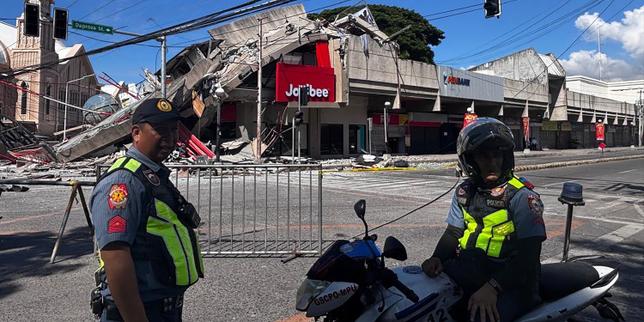
Every time a major fault line slips, the international media falls into the exact same predictable, copy-paste reporting formula. A headline flashes: three dead in a powerful Pacific earthquake, tsunami warnings triggered, widespread panic ensues. The focus immediately zeroes in on the raw Richter magnitude and the initial, chaotic casualty count.
This coverage is fundamentally lazy. It misdirects public attention, skews global aid priorities, and completely misunderstands how modern disaster resilience actually works.
Focusing on the sheer kinetic energy of an earthquake or the immediate, tragic loss of a few lives obscures the real story. In a nation of over 110 million people sitting squarely on the Pacific Ring of Fire, a massive tectonic shift resulting in single-digit casualties isn't a failure of infrastructure or a symbol of helpless vulnerability. It is a staggering triumph of modern engineering and strict building code enforcement.
The media wants you to fear the geology. You should actually be looking at the civil engineering.
The Obsession with Magnitude is Killing Real Preparedness
The public has been conditioned to think that a magnitude 7.0 earthquake is universally catastrophic, while a 5.5 is a minor inconvenience. This is a dangerous simplification.
Earthquake risk is not a function of geology alone; it is a function of vulnerability. I have spent years analyzing urban resilience frameworks and watching municipal budgets get misallocated because politicians react to sensationalized headlines rather than systemic risk.
Consider the mechanics of seismic energy dissipation. The energy released by an earthquake increases by a factor of roughly 32 for every whole number increase on the moment magnitude scale ($M_w$). A magnitude 7.0 releases over 1,000 times more energy than a 5.0. Yet, a poorly constructed concrete block building during a 5.5 event in an unregulated urban center will cause exponentially more fatalities than a highly flexible, engineered structure during an 8.0 event in Tokyo or Manila.
Seismic Energy Exponent: E ~ 10^(1.5 * M)
When mainstream outlets report solely on the magnitude and the immediate body count, they reinforce the flawed premise that natural disasters are purely acts of God that human agency cannot mitigate. They treat the hazard and the disaster as the exact same thing. They are not. A hazard is a physical event; a disaster is what happens when that hazard meets an unprepared, vulnerable population.
Why Early Tsunami Alerts are Failing Upward
The immediate aftermath of a coastal seismic event always triggers the mandatory tsunami alarm frenzy. Sirens wail, cell phones buzz with emergency alerts, and social media feeds fill with maps of projected wave propagation across the Pacific basin.
The standard narrative celebrates these alerts as flawless victories for global tech integration. The contrarian truth? The current state of regional tsunami forecasting is generating an epidemic of alarm fatigue that will eventually cost thousands of lives.
Right now, the threshold for triggering deep-ocean tsunami assessment protocols is intentionally set low to avoid liability. Deep-ocean Assessment and Reporting of Tsunamis (DART) buoys measure pressure changes on the ocean floor to detect passing waves.
The problem lies in the communication pipeline. When a regional agency issues a blanket warning for an entire coastline based on preliminary seismic data, and the resulting wave is a mere twenty centimeters, the public does not think "Thank science, we were spared." They think "The experts cried wolf again."
Imagine a scenario where a coastal community is evacuated three times in two years for non-events. On the fourth cycle, when a displacement truly threatens the upper stories of local structures, compliance drops off a cliff. By treating every minor sea-level fluctuation as an existential crisis, emergency management agencies are actively eroding the public trust required to execute a real, life-saving evacuation when the big one hits.
The Real Variable: Displaced Economics Over Direct Casualties
If you want to measure the true severity of a modern disaster, stop counting the bodies in the first twenty-four hours. Start counting the displaced small businesses, the fractured supply chains, and the long-term capital flight three months later.
The immediate deaths in localized seismic events are often tragic anomalies—a falling facade, a poorly anchored retaining wall, a localized landslide. The structural integrity of the vast majority of modern mid-rise and high-rise developments in places like the Philippines holds up remarkably well due to decades of updating structural codes to mimic Californian and Japanese standards.
The real devastation is economic stagnation.
- Infrastructure Chokepoints: A bridge closure doesn't make the international evening news, but it cuts off agricultural transport to major ports for six weeks.
- SME Bankruptcy: Small and medium enterprises rarely have the liquidity to survive more than 14 days of forced closure.
- Insurance Deserts: While multinational corporations recover via comprehensive business interruption insurance, local economies permanently contract as un-insured residents drain their life savings just to rebuild basic shelter.
By focusing purely on the visceral imagery of cracked asphalt and weeping relatives, global journalism completely ignores the slow-motion economic execution of the affected region.
Dismantling the People Also Ask Consensus
The public frequently turns to search engines with fundamental questions that reveal just how deeply the mainstream narrative has warped their understanding of seismic risk.
Are earthquakes getting worse?
No. The data shows tectonic activity remains entirely within normal historical baselines. What is increasing is human density on top of known fault lines. We are putting more expensive assets and more dense populations in harm's way, transforming routine geological venting into high-stakes economic crises.
Why can’t we predict earthquakes yet?
Because the premise of the question is wrong. We do not need to predict the exact day and hour of a fault rupture to survive it. We already know exactly where the faults are. Seeking a magical tech solution that gives a three-day warning is an excuse to avoid the hard, expensive work of retrofitting existing masonry and banning development in high-risk zones today.
Shift Capital from Response to Retaining Walls
The global humanitarian apparatus is built entirely on a reactive model. It is incredibly easy to raise millions of dollars for emergency relief funds once the drone footage of destroyed neighborhoods hits the internet. It is nearly impossible to secure a fraction of that funding to reinforce a highway hillside or upgrade water purification plants before the event occurs.
This reactive bias is a moral and financial failure. Studies from the National Institute of Building Sciences consistently demonstrate that every single dollar spent on hazard mitigation saves upwards of six dollars in future recovery costs.
Yet, we continue to applaud international aid packages that arrive days late, packed with temporary tents and bottled water, while ignoring the systemic neglect of local infrastructure that made the aid necessary in the first place.
Stop reading the sensationalized casualty tallies. Stop panicking over raw Richter numbers. The true measure of a society's resilience is not how many headlines it generates when the earth shakes, but how quietly it returns to work the next morning because the buildings did exactly what they were engineered to do.