Stop treating catastrophic flash floods like unpredictable acts of angry gods. Every time a glacial lake outburst flood tears through the Himalayas, media outlets default to lazy clichés about freak weather and tragic anomalies. The recent disaster along the Nepal-Tibet border, which pushed death tolls past 570 with thousands still missing, is being framed as an unavoidable natural surprise.
It is not. It is the predictable outcome of building infrastructure in high-risk seismic zones while ignoring hard hydrological data.
When international reports obsess over temporary rescue halts due to overflowing barrier lakes or tally missing tourists from Australia, India, and beyond, they miss the structural rot at the core of Himalayan development. The consensus narrative focuses entirely on downstream recovery and emergency extraction. This approach treats symptoms while ignoring a repeating arterial failure.
The Myth of the Unforeseen Avalanche
The lazy consensus claims that an unseasonal ice-and-rock collapse caught authorities completely off guard because no rain was recorded in the immediate valley. This argument falls apart under basic scientific scrutiny. High-altitude permafrost degradation does not require a rainy afternoon to trigger catastrophe. It requires warming temperatures, steep terrain, and structural instability that has been mapped and documented for decades.
According to data from geohazard researchers studying the Hindu Kush Himalayan region, thousands of glacial lakes now sit precariously above densely populated river basins. When an ice avalanche hits a narrow gorge like the Lhende Khola, it acts as a temporary natural dam. The resulting water accumulation behind the debris creates a ticking time bomb.
Reporting that focuses solely on the immediate body count and the subsequent lowering of water levels misses the structural failure of early warning systems. Governments in Kathmandu and Beijing react with heavy machinery and temporary evacuations only after the wall of water has already erased entire villages.
Infrastructure Blindness in the Valleys
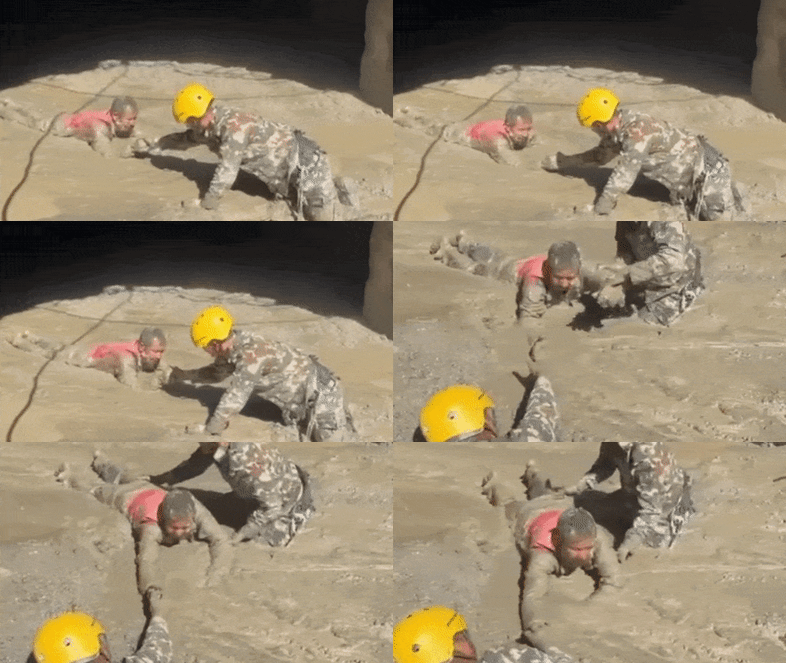
Look at the engineering choices along these transboundary corridors. Critical assets, such as the Upper Trishuli-1 Hydropower Project tunnels where workers were tragically trapped in thick mud, are routinely placed in high-risk deposition zones. Planners prioritize proximity to water flow over long-term geomorphological stability.
Imagine a scenario where civil engineering projects in the Himalayas were subjected to the same rigorous, mandatory relocation standards applied to coastal nuclear plants in earthquake zones. The economic pushback would be fierce, but it would save thousands of lives. Instead, developers rely on outdated environmental impact assessments that treat glacial lake outburst floods as statistical outliers rather than annual certainties.
Furthermore, the bureaucratic friction between neighboring nations hampers proactive mitigation. While water flows freely across borders, real-time telemetry data often gets trapped in diplomatic silos. Joint monitoring of high-altitude barrier lakes should be continuous and automated, independent of geopolitical tensions. Waiting until satellite imagery confirms a breach before sounding alarms is an institutional failure masquerading as a natural disaster.
Rethinking Disaster Response
The standard playbook for these crises relies on military deployment, helicopter airlifts, and emotional appeals for international aid. While boots on the ground are necessary when survival is on the line, celebrating the extraction of a few thousand survivors distracts from the systemic failure that put them there in the first place.
True preparedness requires shifting capital away from reactive rescue operations and pouring it into upstream sensor networks, strict zoning bans in high-risk gorges, and automated acoustic monitoring systems that can buy precious minutes for downstream communities.
Stop asking how many tourists remain unaccounted for while ignoring why multi-million dollar infrastructure projects are permitted in active debris paths. Until regional authorities stop treating climate-driven glacial hazards as sudden acts of fate, the death toll will continue to climb with every summer thaw.