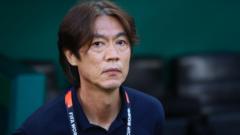
The resignation of a national team head coach following a World Cup tournament is a standard operational resetting mechanism in international football. However, when a head coach steps down concurrently with a head of state demanding a formal investigation into the governing body's financial and administrative practices, the event ceases to be a sporting failure and becomes an institutional crisis. The intersection of political oversight, public accountability, and sporting performance in South Korea’s football infrastructure reveals structural bottlenecks that go far beyond tactical decisions on the pitch. To understand the collapse of this system requires an examination of the institutional design, resource allocation models, and the friction between political authority and FIFA's strict non-interference statutes.
The exit of the national team manager following a disappointing World Cup campaign exposes three systemic vulnerabilities within the Korea Football Association (KFA): a failure in the executive appointment framework, a misalignment of capital allocation toward long-term development, and a structural vulnerability to government intervention. If you liked this article, you might want to read: this related article.
The Governance Bottleneck: Executive Discretion vs. Institutional Process
The core friction within the KFA lies in the centralized decision-making architecture. In highly optimized sporting federations, coach selection relies on a rigorous, data-driven matrix managed by an independent technical committee. This committee evaluates candidates based on quantifiable metrics: tactical flexibility, historical Expected Goals (xG) metrics, squad rotation efficiency, and alignment with the nation's youth development curriculum.
In the structural model currently deployed by the KFA, this process has historically suffered from executive bypass. When leadership overrides the technical committee's recommendations to make unilateral appointments, it disrupts the institutional accountability loop. For another angle on this story, refer to the recent coverage from The Athletic.
This creates a two-fold failure mechanism:
- Loss of Objective Benchmarks: The appointed manager is insulated from standard performance reviews because their mandate stems from executive patronage rather than a consensus of technical experts.
- Tactical and Cultural Mismatch: The senior national team operates in isolation from the domestic K-League infrastructure, failing to integrate tactical profiles that match the player pool's native strengths, specifically high-intensity pressing and rapid transitional mechanics.
When results inevitably regress toward the mean during elite international tournaments, the executive leadership lacks an institutional buffer. Because the appointment bypassed a structured process, the blame cannot be distributed across a committee; it aggregates directly at the top, triggering a crisis of legitimacy that invites external scrutiny.
The Political Friction and the FIFA Non-Interference Paradox
The call for a formal probe by the nation's presidency introduces a volatile variable into football governance: the FIFA Statues on autonomy. Under FIFA Article 14 and Article 19, member associations must manage their affairs independently without influence from third parties.
Government audits into sporting bodies are generally triggered by two catalysts: the allocation of public funds and public dissatisfaction regarding national prestige. When a government launches an investigation into an association's internal operations—such as the selection process of a coach or the distribution of corporate sponsorships—it sets off a predictable chain reaction.
[State-Sponsored Investigation] -> [Violation of FIFA Article 14/19] -> [Institutional Sanctions/Suspension] -> [Exclusion from International Competition]
The structural limitation of state intervention is that while it satisfies immediate public demands for accountability, it jeopardizes the entire football ecosystem. A formal suspension by FIFA halts all international player transfers, freezes development grants, and disqualifies national teams from participating in continental qualifiers and future World Cup cycles. Therefore, the presidency's call for an investigation represents a high-risk leverage play. It attempts to force internal reform within the KFA via political pressure without crossing the threshold into direct administrative takeover, which would trigger immediate international sanctions.
The Capital Allocation Problem: Elite Outlays vs. Systemic Infrastructure
A precise analysis of the KFA’s financial model reveals an over-indexing on short-term elite outcomes at the expense of grassroots and structural stability. A football association’s primary financial objective should be the optimization of its domestic talent pipeline. This requires balancing expenditures across three core areas:
- The Elite Tier: National team staff compensation, international travel logistical optimization, and premium training facilities.
- The Elite Pipeline: Youth national academies (U-17, U-20, U-23), scouting networks, and high-performance sports science departments.
- The Domestic Foundation: Coaching education standards, referee modernization, and infrastructure subsidies for semi-professional and youth leagues.
The structural failure in South Korea's model occurs when elite-tier expenditures consume a disproportionate percentage of the revenue generated by commercial sponsorships and broadcasting rights. High managerial salaries and expensive contract termination clauses act as sunken capital when the appointment fails. This concentration of capital creates an infrastructure bottleneck.
When youth development budgets are squeezed, the quality of coaching at the grassroots level degrades. South Korean youth development often prioritizes immediate tournament results over individual technical proficiency, a direct byproduct of a university admissions system tied to high school tournament placements. The lack of KFA intervention to decouple youth football from traditional academic advancement structures restricts the talent pool, forcing national team coaches to rely on an aging cohort of European-based stars rather than a continuous stream of elite domestic talent.
The Asymmetry of Public and Corporate Accountability
The governance of South Korean football is uniquely intertwined with the nation's corporate landscape. Historically, senior executive positions within the KFA have been occupied by leaders from major industrial conglomerates (chaebols). This model provides the federation with significant financial backing and corporate management expertise, but it introduces an asymmetry in accountability.
In a standard corporate framework, executives answer to a board of directors and shareholders based on clear financial returns. In a sporting federation, the "shareholders" are the fans, the players, and the broader public, whose metrics of success are emotional and performance-based rather than financial.
This dynamic creates a distinct breakdown in communication:
- The Insular Executive Approach: The leadership applies corporate crisis-management strategies—silence, internal reassignments, and deferred statements—which the public interprets as a lack of transparency and institutional arrogance.
- The Escalation Loop: Because the public has no direct mechanism to vote out federation leadership, their grievances are directed toward political representatives. This transforms a sporting performance deficit into a political liability, forcing the government to intervene to absorb public anger.
The resignation of the coach is merely a superficial symptom of this structural mismatch. Removing the manager changes the tactical configuration on the pitch, but it leaves the closed-loop executive decision-making architecture completely intact.
Operational Blueprint for Institutional Restructuring
To resolve this systemic crisis and insulate the federation from both performance collapse and political intervention, the KFA must execute a fundamental restructuring of its operational model. This requires moving away from centralized executive fiat and implementing an institutional framework based on international best practices.
Deconstruct and Insulate the Technical Committee
The Technical Committee must be granted absolute, legally binding autonomy over the sporting department. The executive board's role must be restricted to approving the budgetary limits set by the financial department, with zero input into individual candidate selection.
The recruitment matrix for future national team managers must be fully transparent, utilizing clear performance indicators:
- PPDA (Passes Per Defensive Action): Ensuring the candidate's defensive pressing intensity matches the physical profile of South Korean domestic players.
- Field Tilt and Positional Fluidity: Selecting profiles that maximize the offensive output of elite transition wingers without exposing the central defensive spine.
- Historical Youth Integration Rate: Prioritizing managers with a documented history of transitioning U-23 players into senior international squads.
Reconfigure the Youth Development Funding Formula
The KFA must reallocate a mandatory minimum of 35% of all senior national team commercial revenues directly into domestic coaching education and the structural overhaul of youth leagues. The current system, which incentivizes youth coaches to play conservative, result-oriented football to secure university slots for players, must be replaced by a centralized club academy model. By subsidizing K-League youth academies directly, the KFA can eliminate the reliance on the school system, shifting the development focus from team victories to individual technical mastery and physical optimization.
Implement a Dual-Report Audit System
To satisfy the government's demands for financial accountability without triggering FIFA sanctions, the KFA must establish an independent, third-party oversight board consisting of international sports auditors and legal experts. This board will publish annual, public reports detailing every financial transaction, contract negotiation, and agent fee allocation. This creates a transparent layer that satisfies domestic political requirements for fiscal responsibility while ensuring that the administrative and sporting decisions remain entirely free from direct state control.
The future viability of South Korean football depends on whether the current crisis is treated as a personnel issue or an architectural defect. Changing the individual in the dugout yields zero long-term return if the system that selected them remains broken. True optimization requires shifting from an era of executive patronage to an era of institutional process.