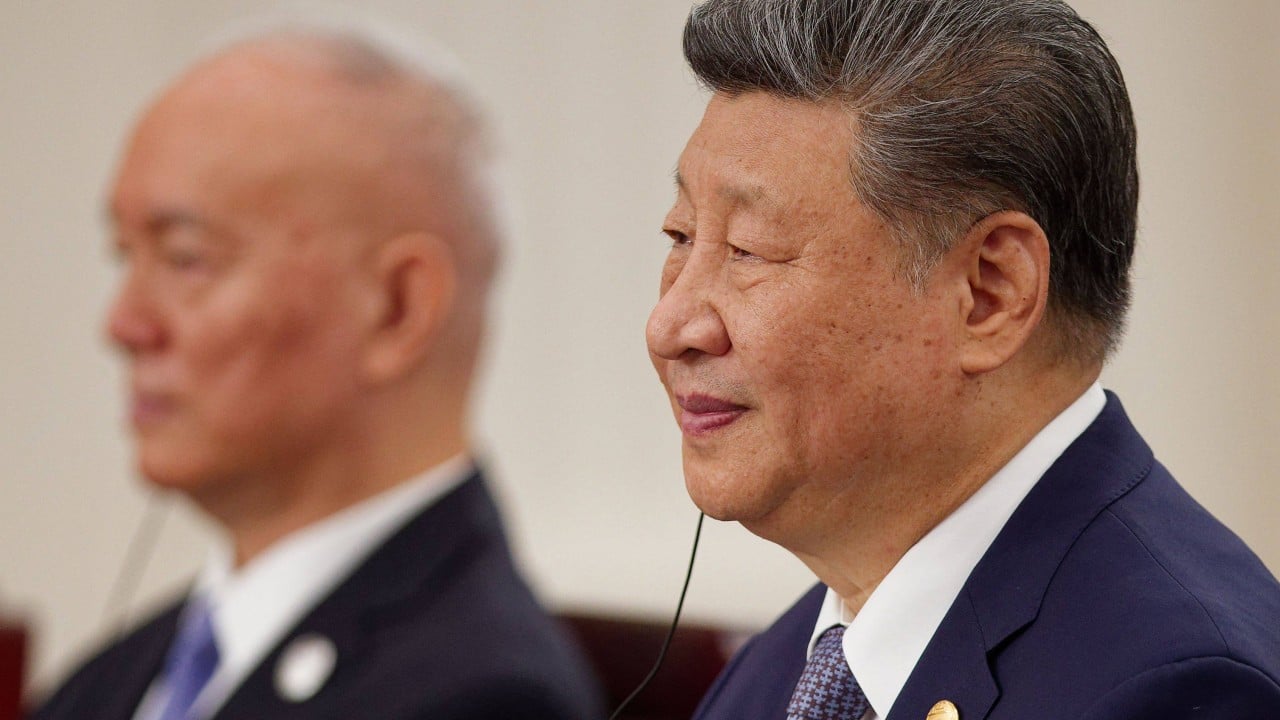
Diplomatic metaphors obscure structural realities. When Beijing deploys the imagery of butterflies flying better to describe the desired trajectory of Sino-US relations, it signals a preference for tactical stabilization over systemic resolution. The underlying objective is straightforward: arrest the downward spiral in bilateral ties without conceding core strategic interests. Evaluating whether this stabilization holds requires stripping away diplomatic rhetoric and analyzing the relationship through three governing variables: macroeconomic interdependence, technological decoupling, and geopolitical deterrence.
Bilateral relations between the world's two largest economies do not operate on sentiment or rhetorical goodwill. They operate as a complex adaptive system constrained by domestic political incentives and asymmetric security imperatives. Understanding the trajectory of this system demands mapping the exact friction points where diplomatic aspirations collide with structural bottlenecks. Learn more on a related topic: this related article.
The Architecture of Managed Competition
Standard diplomatic commentary treats bilateral summits and rhetorical olive branches as leading indicators of peace. In practice, these events function as pressure-relief valves within an entrenched framework of strategic competition. Both Washington and Beijing recognize that an unmanaged rupture carries catastrophic economic costs, yet neither capital possesses the domestic political room to make unilateral concessions.
This dynamic produces what analysts define as managed competition—a state where high-level communication channels are maintained specifically to prevent accidental escalation while structural rivalry intensifies underneath. The "butterfly" metaphor, rooted in traditional Chinese diplomatic framing of fragile yet potentially resilient ties, reflects Beijing's desire to insulate economic and people-to-people exchanges from national security disputes. Further reporting by NBC News highlights comparable perspectives on this issue.
The primary flaw in this approach lies in the integration of modern statecraft. Economic policy, technological innovation, and military capability are no longer separable domains. A semiconductor fab produces both consumer electronics and missile guidance components. A commercial telecommunications network carries both civilian data and state intelligence. Because dual-use technologies dominate modern economic growth, Beijing's attempt to compartmentalize cooperation from security competition runs directly into Washington's "small yard, high fence" doctrine.
The Three Pillars of Bilateral Friction
To measure the actual health of the relationship, observers must track three foundational pillars rather than summit communiques:
- Trade and Tariff Asymmetry: The bilateral trade relationship remains massive in nominal volume, yet its composition is shifting rapidly. Direct Chinese exports to the United States face persistent tariff barriers, driving a rerouting of supply chains through intermediary nations such as Vietnam and Mexico. This trade diversion preserves surface-level interdependence while systematically reducing direct bilateral reliance.
- Technological Chokepoints: Control over foundational technologies—specifically advanced semiconductors, artificial intelligence compute clusters, and biotechnology—represents the central theater of competition. Export controls enacted by the United States and its allies target the upstream supply chain, limiting China's access to extreme ultraviolet lithography and high-end graphic processing units. Beijing responds with state-directed capital allocation to achieve indigenous self-reliance, creating a parallel technological ecosystem.
- Regional Security Deterrence: Flashpoints in the Taiwan Strait and the South China Sea introduce non-linear risk into the bilateral equation. Military modernization by the People's Liberation Army alters the regional balance of power, prompting the United States to reinforce alliance architectures across the Indo-Pacific, including AUKUS and trilateral frameworks with Japan and South Korea.
The Cost Function of Economic Decoupling
A critical error in surface-level geopolitical analysis is assuming that economic interdependence automatically prevents conflict. While high trade volumes increase the opportunity cost of war, asymmetric interdependence creates weaponizable vulnerabilities. Both capitals are actively restructuring their economies to minimize exposure to coercion by the other, effectively paying an efficiency tax today to purchase strategic autonomy tomorrow.
For Beijing, the domestic economic calculus is acute. Facing structural headwinds—including a prolonged real estate contraction, local government debt overhangs, and demographic aging—China relies heavily on manufacturing exports to sustain gross domestic product growth. An immediate, severe deterioration in trade relations with the United States and the European Union would choke off vital external demand at a moment when domestic consumption remains sluggish. Therefore, Beijing's desire for stable ties is driven by macroeconomic necessity rather than ideological shift.
Washington faces a different set of constraints. Inflationary pressures and corporate lobbying temper the pace of complete decoupling, as American multinational corporations still derive substantial revenue from the Chinese market and rely on Chinese manufacturing scale. However, bipartisan consensus in Congress views economic reliance on a strategic competitor as an unacceptable national security vulnerability. The resulting policy mix combines targeted tariffs, outbound investment screening, and industrial subsidies designed to reshore critical manufacturing.
Supply Chain Reconfiguration Mechanics
The physical movement of supply chains illustrates the limits of diplomatic rhetoric. Even when political leaders express a desire for smoother relations, corporate risk officers execute diversification strategies based on regulatory trajectory rather than press conferences. This "China Plus One" strategy operates through distinct phases:
- Final Assembly Migration: Labor-intensive assembly operations move to Southeast Asia or Latin America to bypass direct Section 301 tariffs.
- Component Localization: Tier-one and tier-two suppliers follow assembly plants to reduce logistics friction, gradually hollowing out mid-tier manufacturing clusters in coastal China.
- Data and IP Bifurcation: Multinational firms establish isolated digital infrastructures—separate cloud environments, localized codebases, and ring-fenced research teams—to comply with conflicting data localization laws in both jurisdictions.
Once capital expenditure is committed to new facilities in Monterrey or Ho Chi Minh City, that capacity does not return to Shenzhen regardless of how warm diplomatic rhetoric becomes.
People-to-People Exchanges as a Stabilizing Mechanism
Diplomatic initiatives frequently emphasize cultural, educational, and sub-national exchanges—such as sister-city partnerships, academic fellowships, and tourism—as foundational elements of bilateral stability. The underlying hypothesis is that dense interpersonal networks create domestic constituencies that lobby against hostile policies and reduce mutual misperception.
While historically valid during the post-1979 normalization era, the efficacy of people-to-people exchanges has degraded significantly due to structural barriers:
- Visa and Mobility Friction: Direct flight capacity between the United States and China remains a fraction of pre-pandemic levels, constrained by airspace restrictions and bilateral aviation agreements.
- Security Vetting and Suspicion: Heightened counter-espionage laws in China and rigorous visa screening for STEM researchers in the United States create a chilling effect on academic collaboration. Universities and corporate researchers increasingly view cross-border partnerships as compliance liabilities.
- Information Asymmetry: Divergent media ecosystems and strict digital firewalls limit the organic flow of information between the two populations, reinforcing state-approved narratives and hardening nationalist sentiment on both sides.
Relying on cultural exchanges to stabilize the relationship mistakes a lagging indicator for a leading driver. Exchanges flourish when the overarching geopolitical framework is stable; they cannot independently generate stability when core security interests collide.
The Game Theory of Tactical De-escalation
To understand why Beijing pushes for improved bilateral atmospherics while simultaneously expanding its military footprint and industrial subsidies, one must apply basic game theory. In an iterated prisoner's dilemma where both players anticipate long-term competition, signaling a willingness to cooperate serves a specific tactical purpose: it buys time and lowers the immediate cost of rivalry.
Beijing's strategic objective is to reach a threshold of technological self-sufficiency and military deterrence where external pressure loses its coercive power. During the transition period before that threshold is reached, minimizing external shocks is vital. A period of relative calm with Washington prevents the formation of a unified Western containment coalition, reassures foreign investors, and allows Chinese firms to continue acquiring non-restricted technology and market share globally.
Washington engages in this tactical stabilization for parallel reasons. Managing the relationship prevents the opening of a simultaneous crisis in the Indo-Pacific while American diplomatic and military bandwidth is stretched across Eastern Europe and the Middle East. Re-establishing military-to-military communication channels—such as the Maritime Military Consultative Agreement—reduces the probability that an accidental collision between naval vessels or aircraft triggers an unintended war.
Why Diplomatic Guardrails Remain Fragile
Establishing communication channels and working groups on issues like counternarcotics, artificial intelligence safety, and climate change creates functional guardrails. Yet these guardrails do not alter the underlying collision course. Three specific vulnerabilities threaten to overwhelm tactical stabilization at any moment:
- Domestic Political Cycles: In the United States, electoral politics incentivize candidates to demonstrate toughness toward Beijing, leaving little political capital for negotiating compromises. In China, the centralization of power around national security priorities means domestic economic distress is increasingly framed as the result of external containment, limiting Beijing's flexibility to offer concessions that could appear weak to domestic audiences.
- Third-Party Triggers: Bilateral stability is heavily exposed to exogenous shocks. Actions by regional actors—whether political developments in Taiwan, maritime confrontations involving the Philippines at Second Thomas Shoal, or escalations on the Korean Peninsula—can force Washington and Beijing into direct confrontation regardless of their bilateral preferences.
- Industrial Overcapacity Disputes: As China channels massive state investment into green energy technologies—electric vehicles, lithium-ion batteries, and solar panels—to offset its domestic real estate slump, global markets face a wave of low-cost exports. The United States and the European Union view this as state-subsidized dumping that threatens their domestic industrial bases, guaranteeing a new wave of protectionist tariffs that will directly undermine diplomatic goodwill.
Measuring Real Stabilization Versus Rhetorical Posturing
Decision-makers, investors, and policy analysts must filter out diplomatic metaphors and track concrete operational metrics to assess the true trajectory of Sino-US relations. Rhetorical shifts are easily reversed; institutional and capital commitments are sticky.
True stabilization requires verifiable movement across specific indicators:
- Regulatory Predictability: A measurable slowdown in the addition of entities to the US Department of Commerce Entity List and a corresponding halt to retaliatory investigations or exit bans on foreign executives in China.
- Capital Flow Normalization: A reversal in the net outflow of foreign direct investment from China and a stabilization in bilateral venture capital cross-border deals outside strictly defined national security sectors.
- Operational Military Restraint: A quantifiable reduction in unsafe intercepts by naval and air assets in the South China Sea and East China Sea, backed by consistent, mid-level operational dialogue between theater commanders.
- Aviation and Visa Parity: The full restoration of pre-2020 commercial flight frequencies and streamlined visa processing for journalists, students, and business travelers.
Absent movement on these hard metrics, metaphors about butterflies flying better remain purely aspirational.
Strategic Imperatives for Operating in a Bifurcated System
Organizations and policymakers cannot build strategies based on the hope of a return to the pre-2018 era of globalization. The structural drivers of Sino-US competition are permanent features of the global operating environment for the foreseeable future.
Multinational enterprises must execute a dual-track operational model. First, ring-fence supply chains and data architectures to ensure compliance with both US export controls and Chinese data security laws, accepting higher operational redundancy as a fixed cost of doing business. Second, stress-test revenue exposure against sudden tariff escalations or sanctions triggered by third-party geopolitical crises in the Indo-Pacific.
For policymakers in Washington, maintaining open diplomatic channels and encouraging non-sensitive exchanges is necessary to manage escalation risk, provided these talks do not delay the execution of domestic industrial policy and alliance coordination. Tactical stabilization should be treated strictly as a risk-management tool to prevent accidental conflict, never as a substitute for building resilient supply chains and credible regional deterrence. The bilateral relationship will not return to harmonious integration; the optimal achievable outcome is a cold, predictable equilibrium where competition is bounded by clear rules of engagement rather than poetic metaphors.