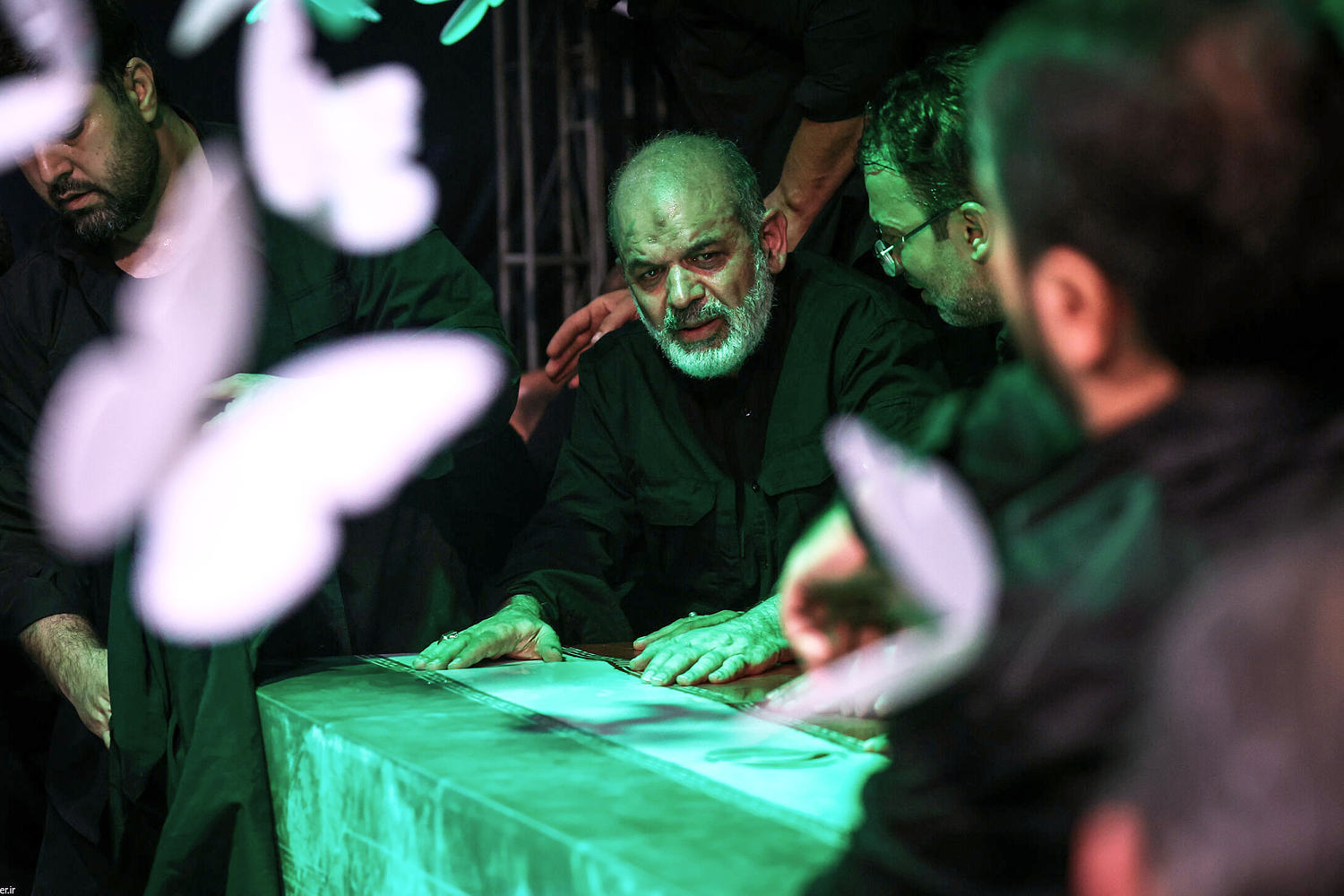
The public appearance of high-ranking military commanders during periods of state transition serves as a calculated mechanism of domestic stabilization and external deterrence, rather than a mere coincidence of state protocol. In highly centralized security architectures, the visibility of key defense personnel signals the alignment of coercive force behind institutional continuity. When a state structures its succession framework around a mixture of clerical authority and military enforcement, the physical presence of top-tier generals during funeral preparations for leadership figures provides a quantitative index of institutional consolidation.
Understanding these dynamics requires moving past superficial media narratives of internal panic. Instead, we must map the precise operational variables that govern how a regime projects stability when its highest office faces an imminent or ongoing vacancy.
The Three Pillars of Continuity Signaling
Regime survival during a leadership vacuum relies on the synchronized execution of three distinct forms of public signaling. Each pillar targets a specific audience and relies on distinct visual and logistical inputs to achieve its objective.
1. Coercive Alignment
The first pillar establishes that the state apparatus retains full control over its internal security infrastructure. When senior commanders from the Islamic Revolutionary Guard Corps (IRGC) or the regular armed forces appear in public spaces associated with state transitions, they demonstrate that the armed wing of the state is not fractured. This minimizes the risk of opportunistic internal dissent or factional fracturing within the security bureaucracy.
2. Bureaucratic Endorsement
The second pillar involves mapping military figures to the bureaucratic organs responsible for choosing a successor, such as the Assembly of Experts. The visible integration of military elites into the administrative processes of transition communicates to lower-tier bureaucrats and regional governors that any change in executive leadership carries the full backing of the defense establishment. This reduces administrative paralysis and ensures the continuous flow of state directives.
3. Geopolitical Deterrence
The third pillar addresses external state actors. A visible, organized, and functioning chain of command during a major state funeral or transition phase signals to foreign intelligence services and military adversaries that the state’s defense readiness has not decayed. It removes the perception of a window of vulnerability that external actors might otherwise exploit through kinetic or cyber means.
[Institutional Continuity Matrix]
├── Coercive Alignment   --> Domestic Security Consolidation
├── Bureaucratic Endorsement --> Administrative Stability
└── Geopolitical Deterrence  --> External Adversary Containment
The Cost Function of Visible Leadership
Deploying high-value military assets into public spaces during a period of national transition introduces a complex risk-reward calculation. While visibility reinforces the perception of stability, it simultaneously creates distinct vulnerabilities across two main operational vectors.
The Security Vulnerability Variable
Concentrating top-tier military leadership in known public venues—such as major mosques, state plazas, or funeral procession routes—creates a high-density target environment for asymmetric actors or foreign intelligence assets. The logistical cost of securing these areas requires diverting elite counter-terrorism units away from broader border defense and internal surveillance duties. This creates a temporary security deficit in peripheral provinces.
The Fractional Signaling Risk
If a specific general or faction within the security apparatus appears overly dominant during transition events, it can inadvertently signal internal jockeying for power rather than unified continuity. The presence of one commander over another is scrutinized by internal regime factions as a leading indicator of who will hold influence under the next executive authority. Therefore, the choreography of these appearances must achieve strict parity to avoid triggering factional paranoia.
Succession Mechanics and the Role of Coercive Power
The structural reality of governance within highly centralized states means that succession is never purely a constitutional or legislative process. The statutory mechanism—such as a council managing executive affairs pending an election or selection—is only valid if enforced by the state's monopoly on violence.
During a transition, the primary objective of the military high command is to freeze the existing domestic balance of power. This stabilization process occurs via three sequential phases:
- The Containment Phase: Deploying specialized security units to critical infrastructure nodes, communication hubs, and transport links to prevent spontaneous mobilization by opposition groups.
- The Procedural Shielding Phase: Providing physical and cyber security to the political assemblies tasked with finalizing the succession, ensuring their deliberations occur free from external disruption or domestic pressure.
- The Legitimization Phase: Publicly pledging allegiance to the newly selected leader immediately upon appointment, thereby transferring the military's institutional authority to the new executive.
Structural Bottlenecks in Transition Logistics
Executing a massive state funeral while simultaneously managing a leadership transition introduces severe logistical bottlenecks that can threaten regime optics if mismanaged.
The first bottleneck is informational. The state must control the narrative regarding the health, status, and funeral arrangements of the leadership figure without creating an information vacuum that rumors can fill. The physical presence of a trusted military commander acts as a stabilizing anchor in the news space, dampening market volatility and reducing public anxiety.
The second bottleneck is crowd management and municipal control. A large-scale public funeral attracts millions of mourners and onlookers to urban centers. Managing this volume of human capital requires an integrated command structure where civilian police, municipal services, and paramilitary organizations operate under a unified authority. If structural failure occurs during the procession—such as crowd crushes or security breaches—the image of absolute competence that the regime seeks to project is compromised.
Strategic Matrix for Analyzing Transition Outcomes
To evaluate whether a regime's public signaling during a transition is successful, analysts must measure specific operational indicators rather than relying on qualitative political rhetoric.
| Indicator | Optimal State (Stability) | Critical State (Instability) |
|---|---|---|
| Command Visibility | Unified appearances across all military branches. | Isolated appearances by a single faction or branch. |
| Deployment Patterns | Proactive positioning at key state institutions. | Reactive deployment to contain localized riots or protests. |
| Information Flow | Centralized, synchronized updates via state media. | Conflicting statements from divergent ministry spokespersons. |
| Foreign Policy Stance | Continuity of ongoing external operations. | Sudden retrenchment or unplanned withdrawal of forward forces. |
The ultimate trajectory of a transition depends on the duration of the vacancy. Short transition windows favor the existing institutional elite, as they leave little time for alternative power centers to coordinate. Conversely, prolonged transition periods increase the probability that economic shocks, external pressure, or internal factional disputes will erode the carefully curated image of absolute continuity displayed by the military high command. The appearance of the general is not a sign that the transition is complete; it is the opening gambit to ensure the transition occurs on the regime's explicit terms.


