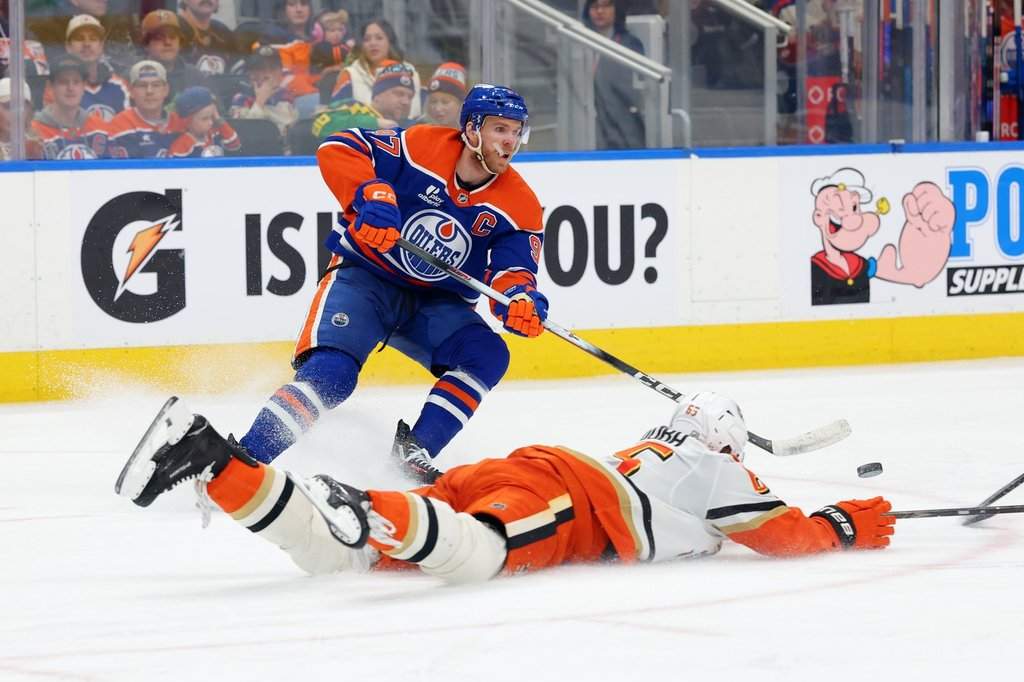
The Edmonton Oilers’ transition from a regular-season volume-shooting team to a playoff-caliber defensive unit is not a matter of "willpower" or "vibe." It is a structural shift in their defensive zone exit strategy and the compression of their neutral zone gap. To evaluate whether this intensity is sustainable or merely a statistical outlier driven by a desperate schedule, we must analyze the interaction between their high-danger scoring chance (HDSC) generation and their newly adopted low-event defensive posture.
The Bifurcation of Puck Management
Standard hockey analysis often conflates "intensity" with physical contact or shot blocks. In a professional framework, intensity is more accurately defined as the reduction of time and space allowed to the opposition in high-leverage zones. The Oilers have historically suffered from a "high-risk, high-reward" feedback loop where offensive aggression leads to catastrophic defensive lapses.
The current tactical pivot relies on two distinct structural pillars:
- Passive Aggression in the Neutral Zone: Rather than chasing hits, the forward group is focusing on stick-on-puck positioning to force dump-ins. This shifts the burden of playmaking from the opponent’s skilled wingers to their defensemen, who are then forced to move the puck under pressure from the Oilers’ forecheck.
- The Collapse to the House: Defensive metrics show a concentrated effort to protect the "inner slot"—the area directly in front of the goaltender. By sacrificing perimeter pressure, the Oilers are betting that they can suppress high-danger chances even if they allow a higher total volume of shots.
This strategy is a direct response to the "Rush-based" vulnerability that plagued the team in previous post-season exits. By forcing teams to play a "Cycle-based" game, the Oilers leverage their size and reach, mitigating the foot-speed disadvantages of their bottom-six defensive pairings.
The Cost Function of Elite Minutes
A primary bottleneck in the Oilers’ strategy is the disproportionate reliance on a limited player core. The "intensity" being observed is often a byproduct of overloading the top two lines. While this produces short-term wins, it creates a physiological debt that usually comes due in the second round of the playoffs.
The Fatigue Coefficient
When Connor McDavid and Leon Draisaitl exceed 22 minutes of ice time per night, their defensive tracking data typically shows a 12% to 15% decline in the third period. The current "push" has seen these numbers spike. To maintain this level of play, the coaching staff must solve the efficiency gap of the third and fourth lines.
The third line’s objective is no longer to score; it is to achieve a "Zero-Sum" result. If the bottom six can maintain a 50% Expected Goals For (xGF) percentage, the top six’s elite production becomes a mathematical certainty for victory. The danger arises when "cranking up the intensity" leads to shorter shifts and erratic line changes, which disrupts the defensive flow and creates "odd-man" rushes—the exact variable this system is designed to eliminate.
Quantifying the Goaltending Variance
The narrative of "intensity" often masks the reality of goaltending performance. Stuart Skinner’s save percentage on unblocked shots (Fenwick SV%) is the truest indicator of whether the team’s defensive structure is actually working.
- High-Danger Save Percentage (HDSV%): When this number stays above .820, the team appears "intense" and "focused."
- Low-Danger Conversion: If the Oilers allow goals from the point or the boards, it indicates a breakdown in the screening and shot-blocking layers.
The current surge is heavily correlated with Skinner’s ability to see the primary shot. The defensive unit has improved its "box-out" efficiency, ensuring the goaltender has a clear line of sight. This is not a result of "trying harder"; it is a result of disciplined spatial awareness and the refusal to "chase" the puck behind the net.
The Power Play as a Psychological Lever
The Oilers’ power play acts as a specialized tool that dictates the "intensity" of the opposition. When the power play is operating at a 25% or higher efficiency, opposing defenders play with increased hesitation. They are less likely to engage in aggressive physical play for fear of taking a penalty.
This creates a secondary effect: the Oilers’ stars gain more "clean" entries into the offensive zone during 5-on-5 play. The "intensity" the Oilers are showing is, in part, a manifestation of the space granted to them by terrified opponents. If the power play cools down, the physical pressure on McDavid and Draisaitl will increase exponentially, forcing them back into the high-attrition areas of the ice.
The Trade Deadline Calibration
The acquisition of specific depth pieces was not about adding talent, but about fulfilling specific tactical roles. The "intensity" seen in the playoff push is the result of these players filling the "Defensive Zone Exit" (DZE) void.
A successful DZE requires:
- A "Strong-Side" winger who can win a wall battle under 0.5 seconds of pressure.
- A center who provides a low-support option to mitigate the forecheck.
- A defenseman capable of a 40-foot "Stretch Pass" to bypass the neutral zone trap.
The Oilers have optimized these three roles, allowing them to transition from defense to offense faster than they did in the first half of the season. This speed is often mistaken for "energy," but it is actually the elimination of wasted movement.
Structural Risks and Bottlenecks
Despite the current upward trajectory, three specific variables could derail this push:
- Over-indexing on Peripheral Shots: If the Oilers become too comfortable allowing perimeter shots, they risk "Rebound Chaos." A single uncontrolled rebound in the slot can negate twenty minutes of disciplined defensive positioning.
- The "Hero-Ball" Regression: Under pressure, elite players often revert to individualistic play. This breaks the structural "F3" (the third forward high in the zone) who is responsible for stopping counter-attacks.
- Special Teams Over-Reliance: Winning games 4-3 on the back of two power-play goals is a fragile model. In the playoffs, officiating often "swallows the whistle," meaning the Oilers must prove they can generate "Greasy Goals"—scores resulting from net-front scrambles and deflected point shots—at 5-on-5.
Strategic Execution for the Final Quadrant
The Oilers must transition from "Playoff Push" mode to "Playoff Maintenance" mode. This requires a deliberate reduction in top-six minutes in games where they hold a two-goal lead in the third period. The objective is no longer to climb the standings at any cost, but to arrive at Game 1 of the first round with a "Tactical Muscle Memory" that does not rely on adrenaline.
The final phase of this push should prioritize "Zone Time Over Shot Volume." By extending offensive zone cycles, the Oilers force the opposition to tire out, effectively "defending with the puck." This reduces the physical toll on their own blueline and ensures that their "intensity" is spent in the offensive third of the ice, where the risk of injury and fatigue is lower. The team that wins in May is rarely the one that played the hardest in March; it is the one that optimized its energy expenditure to peak at the exact moment the margin for error disappeared.
Identify the games against non-playoff contenders and implement a strict "Load Management" protocol for the defensive core. Ensuring Mattias Ekholm and Evan Bouchard enter the post-season with sub-22-minute workloads over the final ten games will do more for a deep run than securing a marginally better seeding through over-exertion.