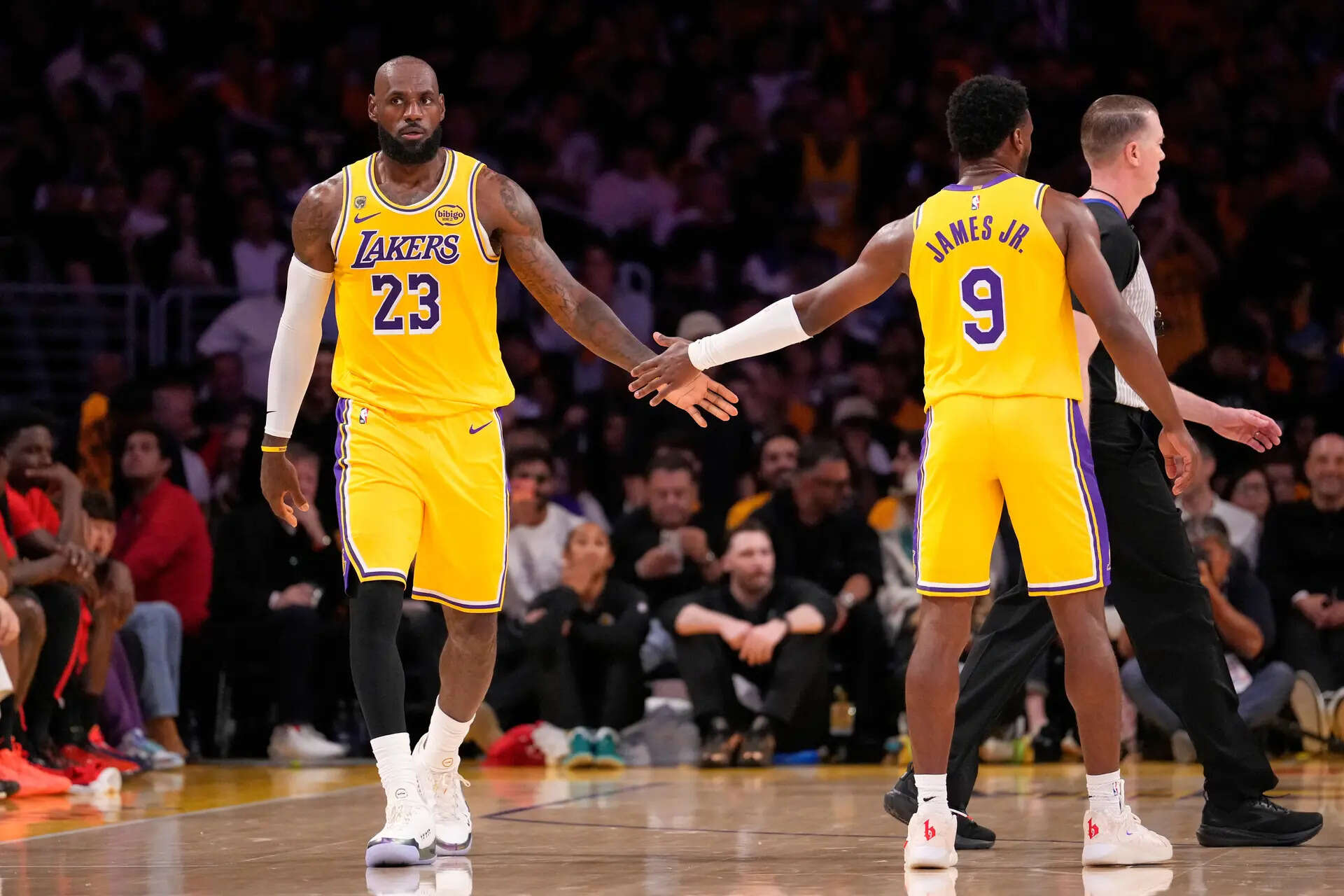
The alignment of LeBron and Bronny James within an active NBA rotation is not a matter of sentimentality or marketing. It is a clinical demonstration of extreme biological maintenance, institutional power, and long-term strategic planning. When the two players connected for an alley-oop, the broadcast media focused on the emotional narrative of the father-son bond. From an analytical perspective, however, this sequence serves as a case study in the intersection of veteran spatial awareness and the rare preservation of elite athletic capacity over a twenty-year period.
The alley-oop itself is a high-variance play. It requires a specific set of variables to converge in a span of less than two seconds: defensive misalignment, precise trajectory estimation, and the absolute trust of the passer in the receiver’s vertical capability.
The Geometry of the James Alley-Oop
In the standard NBA offensive set, the alley-oop acts as a pressure release valve. It punishes defenses that over-rotate toward the perimeter or fail to communicate on back-side help. When LeBron James initiates this play, he is not reacting to a static situation. He is exploiting a defensive error by measuring the secondary defender’s depth.
The play hinges on three technical components:
- Velocity of the Feed: The ball must arrive at the apex of the receiver’s jump. If the pass is too high, the receiver cannot control the catch; too low, and the defense disrupts the path. The specific trajectory used in this instance demonstrates a mastery of lob mechanics honed over decades.
- Spatial Geometry: The spacing between the primary defender and the rim dictates the window of opportunity. The James duo utilized a clearing action that pulled the rim protector away from the center of the paint. This created a high-percentage lane for the cut.
- Timing synchronization: The receiver must commit to the leap before the ball is released. This requires an internal clock that accounts for the passer’s vision and the defensive rotation. The fact that the receiver identified the lane correctly suggests a high level of basketball IQ, independent of the external pressure associated with the historical nature of the moment.
This sequence confirms that the chemistry between the two is rooted in a shared understanding of professional spacing. While the media narrative emphasizes the familial aspect, the operational reality is that both players are executing a known tactical pattern.
The Biological Investment Model
The existence of this duo is a direct output of the "James Protocol," an intensive, multi-million dollar annual investment in recovery, nutrition, and kinetic maintenance. To maintain elite performance for over two decades, LeBron James shifted the standard of player care from a reactive model—treating injuries as they occur—to a proactive model of systemic preservation.
The cost function of this model is high, requiring a dedicated team of specialists, private facilities, and a rigorous adherence to schedule that eliminates almost all external variance in lifestyle. This level of maintenance is the prerequisite for the longevity required to share a court with a professional-age child.
Most NBA players suffer a sharp decline in explosive capacity by their mid-thirties. The ability to still perform the high-vertical movements necessary for an alley-oop at this stage of a career suggests that the biological decline has been delayed through extreme intervention. From a management perspective, this represents the highest possible return on investment for a human asset in professional sports.
Organizational Trade-offs and Roster Construction
Integrating a development-stage player like Bronny James into a championship-contending rotation forces a team to make difficult trade-offs. The Lakers, by accommodating this pairing, accepted a deviation from the standard meritocratic roster construction.
The challenge for a head coach in this scenario is the "Opportunity Cost of Minutes." Every minute allocated to a developing player is a minute removed from a veteran specialist. In a hyper-competitive conference, this allocation must be justified by the player’s defensive efficiency, shooting percentage, or playmaking utility.
The internal logic for the team relies on the assumption that the presence of the father improves the son’s development rate. If the younger player can absorb the veteran's knowledge of defensive rotations and game speed faster than he would in a standard developmental environment, the team essentially accelerates his growth cycle. If this assumption fails, the roster becomes unbalanced. The strategic risk is the potential loss of floor spacing or defensive perimeter pressure that a veteran would provide in those same minutes.
The Macroeconomic Value of the James Brand
The James brand is a unique entity in sports management. It functions less like a player and more like a franchise within a franchise. By controlling the narrative of the father-son duo, the organization generates revenue streams that extend beyond ticket sales and broadcast rights.
The valuation of such a partnership is difficult to quantify using standard metrics, but the ripple effects are clear:
- Engagement Metrics: The record-breaking viewership for the games involving the duo highlights the market's demand for historical milestones.
- Merchandising Continuity: The ability to sell merchandise that captures multiple generations of interest expands the total addressable market.
- Media Rights: Broadcast partners prioritize games that feature these historic moments, increasing the value of the team’s total media package.
The business strategy here is to extend the lifetime value of the customer. Younger fans who watch for the legacy aspect are likely to remain engaged with the team long after the primary athlete retires.
Personnel Development and the Performance Floor
For the younger James, the objective is to establish a performance floor. In the NBA, a player’s utility is defined by their ability to fulfill a specific role without being a liability. The transition from college basketball to the professional level involves a significant increase in the speed of the game and the physicality of the defense.
Developmental progress is measured by:
- Defensive Rating: Can the player switch on screens and recover without conceding high-percentage shots?
- Usage Rate: Does the player make high-efficiency decisions when in possession?
- Transition Execution: Can the player run the floor and fill lanes appropriately?
The alley-oop was a specific success in transition. The next step in this career trajectory is the refinement of half-court decision-making. The high-authority approach for the player is to focus exclusively on becoming a "3-and-D" specialist. By specializing in perimeter shooting and defensive intensity, he secures a permanent spot in the rotation regardless of the father’s status. This is the only path to long-term professional stability that does not rely on familial association.
Strategic Forecast and Institutional Exit
The strategic trajectory for the James family is clearly aimed at ownership or high-level executive involvement. The active playing phase is a transitional period, bridging the gap between the athlete-as-laborer and the athlete-as-capital-owner.
The professional risk is the finalization of the career. As performance metrics inevitably decline, the friction between the desire to play and the reality of physical degradation will increase. The organization will eventually face the problem of a diminishing return on the asset’s floor performance versus the asset’s brand value.
The transition plan should prioritize the following actions:
- Systemic Integration of Mentorship: The younger player must transition from a project player to an independent, reliable rotation asset within two seasons. This requires a shift in coaching focus from "development" to "production."
- Asset Management: The organization must decide whether to continue the dual-player strategy as an economic engine or return to a pure meritocracy for the final years of the veteran’s contract.
- Brand Transition: The narrative must shift from "Father and Son" to "Legacy and Future." This protects the brand equity of the younger player as an independent professional once the older player exits the active roster.
Ultimately, the alley-oop was not the peak of this story. It was the functional validation that the experiment is viable. The long-term success of the James duo will not be judged by the highlights they create, but by the ability of the younger player to navigate the professional demands of the league independently, cementing his status as a legitimate asset in the competitive structure of the NBA.