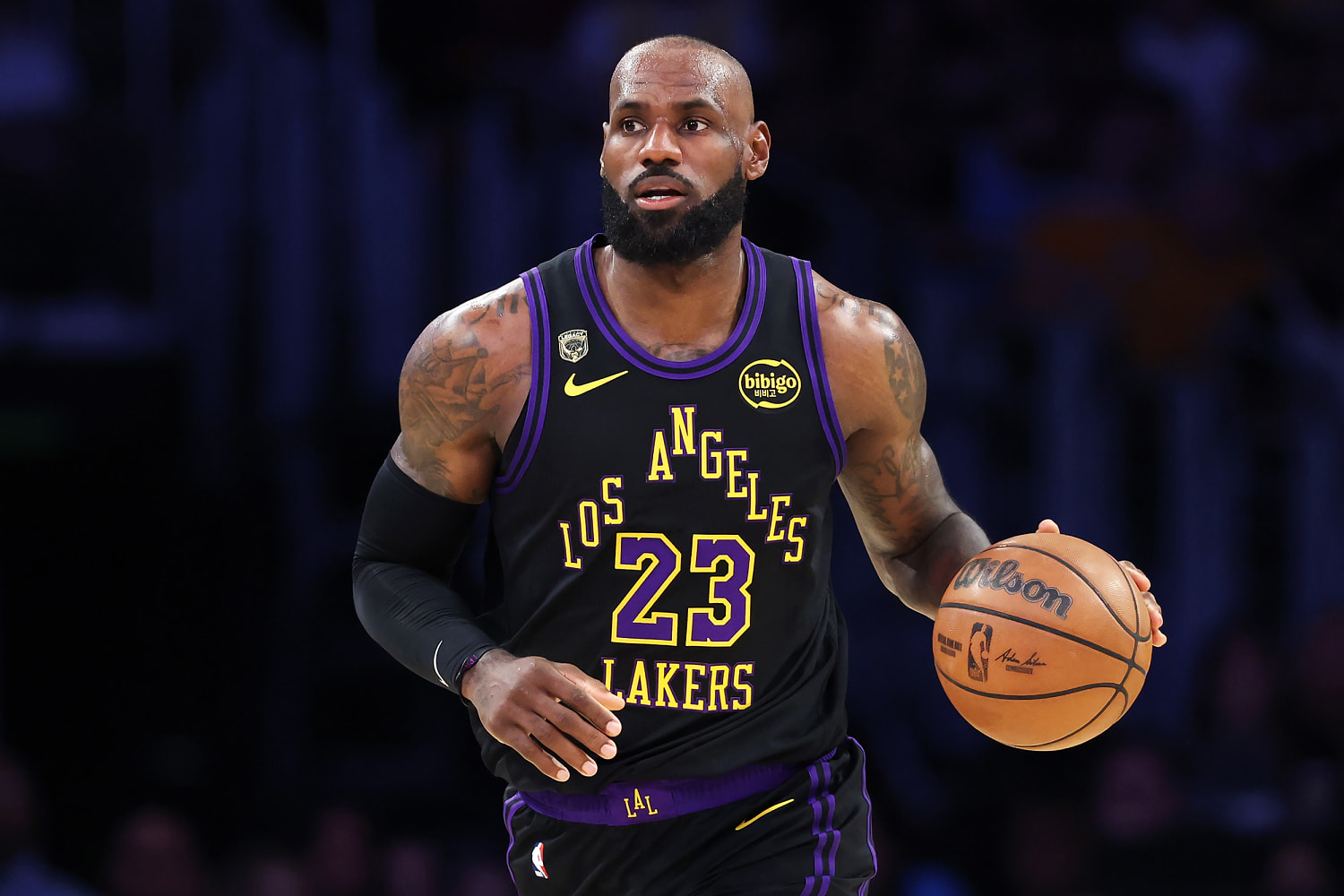
The decision of LeBron James to depart from the Los Angeles Lakers is driven by the intersection of three structural constraints: Collective Bargaining Agreement (CBA) cap mechanics, roster asset depletion, and misaligned competitive timelines. While media narratives focus on personal legacy and market preferences, the underlying driver is mathematical. The current NBA financial ecosystem penalizes top-heavy payrolls so severely that maintaining a championship-caliber roster around two maximum-salaried players under the second apron rules has become functionally impossible for this franchise.
Understanding this exit requires analyzing the specific economic and tactical friction points that rendered the Lakers-James partnership unsustainable. By breaking down the financial penalties, asset scarcity, and tactical limitations, we can map the exact trajectory that forced this separation.
The First Apron Bottleneck and Salary Cap Friction
The 2023 CBA introduced punitive measures designed to dismantle sustained high-spending rosters. The second apron operates not merely as a financial tax, but as a hard basketball restriction. For a franchise with two maximum contracts, the structural limitations manifest in specific operational bottlenecks.
- The Salary Matching Restriction: Under second apron rules, teams cannot take back more salary than they send out in a trade. This eliminates the capability to aggregate multiple mid-tier salaries to acquire a singular high-impact player.
- The Draft Pick Freeze: Teams over the second apron for multiple seasons have their first-round draft pick frozen seven years out, preventing it from being utilized in trade negotiations.
- The Loss of the Mid-Level Exception: The elimination of the Non-Taxpayer Mid-Level Exception (NTMLE) removes the primary mechanism for acquiring high-end rotation players without cap space.
The Lakers entered a cycle where the cost of field validation—simply putting a competitive team on the floor—exceeded the marginal utility of their remaining financial flexibility. With James occupying a maximum slot alongside Anthony Davis, the remaining cap sheet was forced into minimum-contract volatility. This financial architecture guarantees a lack of depth, exposing the roster to extreme variance whenever injuries occur.
Asset Depletion and the Draft Capital Deficit
A team cannot execute a strategic pivot without transactional currency. The Lakers’ previous transactional history created an asset deficit that prevented the front office from upgrading the roster around James.
[Anthony Davis Trade (2019)] ──> Extensive Draft Capital Outflow
                                      │
                                      ▼
[Russell Westbrook Trade (2021)] ─> Loss of Depth & KCP/Kuzma Assets
                                      │
                                      ▼
[Current State] ──────────────────> Zero Neutral Value Mid-Tier Contracts
The sequence of asset deployment since 2019 systematically drained the franchise of draft equity and controllable rookie-scale contracts. The trade for Anthony Davis, while yielding a championship in 2020, required a massive outflow of draft capital. The subsequent acquisition of Russell Westbrook accelerated this depletion by converting functional, cost-controlled depth into a distressed asset that required further capital to displace.
This left the front office with zero neutral-value mid-tier contracts. To match salaries in any meaningful trade, the team would have had to surrender key rotation pieces, creating a net-zero return on on-court production. The lack of draft assets meant the Lakers could not incentivize third-party teams to absorb inefficient salaries, paralyzing their ability to alter the roster configuration.
Tactical Asymmetry and Chronological Mismatch
Beyond the financial spreadsheet, the tactical application of James within the current roster construction revealed a profound style-of-play conflict.
James requires a specific ecosystem to maximize his offensive output: high-gravity perimeter shooters and versatile, switchable defenders who can compensate for his calculated defensive conservation. The Lakers’ inability to acquire these pieces due to the financial constraints outlined above resulted in an optimization paradox.
To compensate for a lack of perimeter shooting, the offensive system had to rely on heavy isolation and paint penetration, crowding the exact spaces James operates in most efficiently. Defensively, the burden placed on Anthony Davis to anchor a compromised perimeter defense accelerated structural fatigue.
The chronological mismatch worsened this friction. James operates on a single-season timeline where every competitive cycle must yield a title opportunity. The front office, facing the long-term penalties of the second apron, had to consider a five-year horizon to avoid total franchise stagnation. This divergence meant that any move satisfying the short-term optimization required by James would permanently damage the long-term structural health of the organization.
The Strategic Path Forward
The departure of James forces an immediate pivot for both parties, dictated by distinct operational objectives.
For the Los Angeles Lakers, the strategic mandate shifts from short-term maximization to asset accumulation and financial resets. The immediate priority is ducking the luxury tax thresholds to unfreeze future draft assets and regain the full suite of trade exceptions. Anthony Davis becomes the central foundational piece, allowing the front office to construct a modern, high-paced defensive identity utilizing younger, high-motor wing players acquired through cap space absorption.
For LeBron James, the objective is the identification of an ecosystem with an existing surplus of draft equity and cost-controlled talent. The ideal landing spot requires an organization that has already weathered the asset-accumulation phase and possesses the financial flexibility to absorb a maximum contract without triggering immediate second-apron restrictions. This allows James to inject high-level decision-making into a pre-optimized roster structure, bypassing the team-building phase entirely.