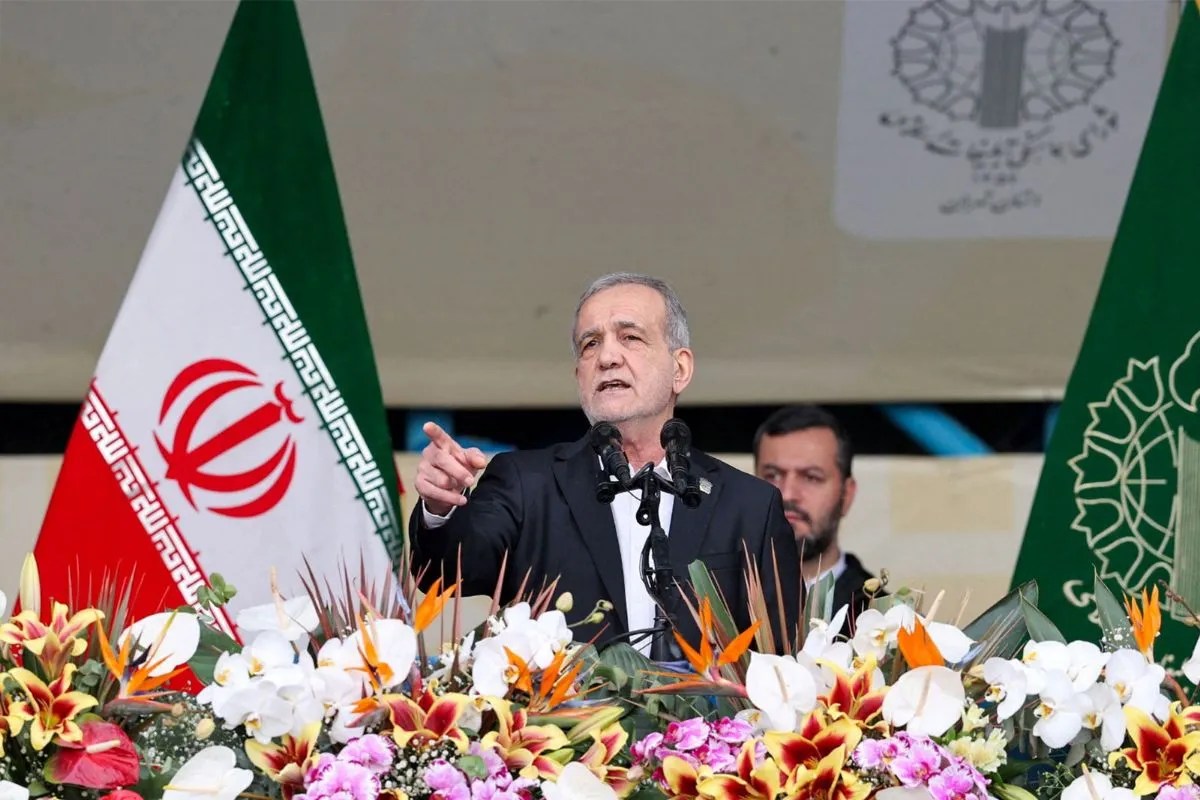
The traditional assessment of Iranian foreign policy frequently treats military rhetoric and state diplomacy as separate, often contradictory, vectors. When Iranian President Masoud Pezeshkian characterizes the nation as a powerful and respected entity while attributing this status to the military's ability to teach enemies a lesson, standard commentary views this merely as nationalistic messaging. A rigorous strategic analysis, however, reveals an integrated framework where military posturing serves as the primary mechanism for diplomatic leverage and economic survival.
Understanding Iran's current geopolitical posture requires moving past superficial political statements to examine the structural feedback loop between defensive capabilities and state sovereignty. Iran operates under severe international sanctions, meaning its "power" is not derived from economic dominance or traditional alliances. Instead, Iranian strategic doctrine relies on a specific cost-imposition model designed to alter the risk calculus of superior state adversaries.
The Tripartite Framework of Iranian Deterrence
The assertion of national strength and respect is anchored on three distinct operational pillars. These components form a defensive matrix that converts asymmetric military capabilities into political stability.
1. Asymmetric Cost-Imposition Systems
Iran’s conventional military hardware faces systemic technological gaps when compared to regional adversaries and global superpowers. To neutralize this deficit, the state has invested heavily in asymmetric systems—specifically ballistic missiles, unmanned aerial vehicles (UAVs), and fast-attack naval craft. The strategic objective here is not total military victory in a conventional conflict, but rather the creation of a credible threat to high-value targets, critical infrastructure, and maritime trade routes. By elevating the projected financial and human cost of an external strike, Iran establishes a baseline level of security that forces competitors to opt for containment over direct confrontation.
2. Strategic Depth via Non-State Proxies
The second pillar relies on forward-deployed deterrence. The network of aligned non-state actors across the Levant, Iraq, and Yemen functions as a multi-theater buffer zone. This structure shifts the potential battlespace away from Iranian borders, ensuring that any kinetic action initiated against Tehran triggers a multi-front escalation. This network acts as a force multiplier, effectively expanding Iran’s operational reach despite severe fiscal constraints.
3. Kinetic Credibility and Signaling
Rhetoric lacks defensive utility without demonstrated capability. When state leadership references teaching enemies a lesson, they are highlighting specific operational milestones where Iran demonstrated its willingness to cross kinetic thresholds. Examples include the direct missile strikes on regional targets or the interception of advanced surveillance assets. These actions serve as empirical proof of intent and capability, validating the deterrence model and ensuring that diplomatic red lines are viewed as credible by external intelligence apparatuses.
The Strategic Synergy of Diplomacy and Defense
A common analytical error is viewing Pezeshkian’s reformist or diplomatic inclinations as fundamentally opposed to the objectives of the Islamic Revolutionary Guard Corps (IRGC). In practice, these two factions operate in tandem within the state's broader survival strategy.
[Military Deterrence/Kinetic Signaling]
                │
                ▼ (Creates Strategic Leverage)
[Diplomatic Re-engagement/Sanctions Relief Efforts]
                │
                ▼ (Secures Capital & Resources)
[State Preservation & Military Capitalization]
This structural relationship demonstrates that diplomacy is not an alternative to military power, but a direct beneficiary of it. Executive diplomatic maneuvers aimed at sanctions relief or economic normalization are only viable because the military apparatus prevents forced regime destabilization. Conversely, the military relies on diplomatic channels to manage escalation and prevent localized kinetic engagements from deteriorating into total war.
The domestic political utility of this framework is equally vital. By publicly validating the military's role in securing national respect, the executive branch maintains internal cohesion, balances competing domestic power centers, and projects a unified front to external observers.
Structural Vulnerabilities and Systemic Risks
While this deterrence model has successfully prevented direct foreign invasion, it possesses inherent friction points that introduce long-term systemic risk to the Iranian state.
- Economic Exhaustion: Diverting scarce capital toward maintaining asymmetric military networks starves the domestic industrial and energy sectors of essential modernization capital.
- The Escalation Dominance Paradox: Relying on kinetic signaling requires a precise calibration of force. A minor miscalculation by proxy forces or a highly effective retaliatory strike by an adversary can inadvertently trigger a full-scale conflict that the state's economic base cannot sustain.
- Diplomatic Isolation: The exact military capabilities that generate security—such as proliferation of UAV technology and missile development—simultaneously act as the primary barriers to western sanctions relief and international normalization.
This creates a persistent bottleneck where the mechanisms used to protect the state directly impede its ability to achieve long-term economic stability.
The Required Shift in Regional Strategy
To navigate this highly volatile equilibrium, Iranian policymakers must transition from a doctrine of passive deterrence to one of calculated strategic integration. The state must leverage its current defensive leverage to secure binding, sector-specific economic agreements rather than pursuing broad, fragile diplomatic grand bargains.
Operational priority must be given to formalizing regional security frameworks that reduce the necessity of active proxy deployment, thereby lowering the risk of accidental escalation while preserving core defensive technologies. Western and regional intelligence frameworks must conversely look past the domestic political rhetoric of the presidency and analyze Iranian state behavior through the cold calculus of resource allocation and kinetic threshold maintenance.