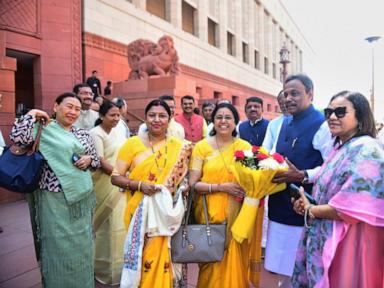
The operational delay in implementing India’s Women’s Reservation Bill (the Nari Shakti Vandan Adhiniyam) is not a product of legislative indecision but a deliberate structural dependency on two massive bureaucratic undertakings: a national census and the subsequent delimitation of electoral boundaries. By tethering gender-based seat allocation to the redrawing of constituencies, the Indian state has effectively subordinated immediate political representation to the complex mathematics of demographic shifts. This creates a bottleneck where the Constitutional right to 33% representation for women is contingent upon solving the "North-South Divide"—a high-stakes geopolitical tension involving the reallocation of federal power based on population growth.
The Tripartite Dependency Framework
To understand why the 33% quota remains theoretical, one must map the three-stage sequence required by the current legislative framework. Each stage introduces a unique set of technical and political friction points.
1. The Census Prerequisite
The 2021 Census, delayed indefinitely due to the pandemic and subsequent administrative shifts, serves as the primary data layer. Under Article 82 of the Indian Constitution, the reallocation of seats in the Lok Sabha (the lower house of Parliament) must be based on the most recent published census figures. Without a completed and verified census, any attempt to redraw boundaries lacks the "Statutory Data Baseline" required to withstand judicial scrutiny.
2. The Delimitation Exercise
Delimitation is the process of fixing limits or boundaries of territorial constituencies in a country to reflect changes in population. The current freeze on the number of seats in the Lok Sabha, established by the 42nd Amendment in 1976 and extended by the 84th Amendment in 2001, is set to expire in 2026. The logic for the freeze was to ensure that states which successfully implemented family planning programs were not "punished" with a reduction in political weight compared to states with higher birth rates.
3. The Quota Integration
The Nari Shakti Vandan Adhiniyam mandates that one-third of all seats in the Lok Sabha and State Legislative Assemblies be reserved for women. However, because these seats are meant to rotate after every delimitation exercise, the government argued that the specific seats to be reserved cannot be identified until the new boundaries are drawn. This creates a "Serial Dependency Error":
- Step A (Census) must validate Step B (Delimitation).
- Step B (Delimitation) must define the geography for Step C (Quota).
The Demographic Divergence and the Federalism Friction
The core conflict preventing the rapid execution of this sequence is the radical divergence in population growth rates between the northern "Hindi Heartland" states and the southern states. If a pure population-based delimitation occurs after 2026, the southern states—which have been more economically productive and demographically stable—risk losing significant relative influence in Parliament.
The Power Shift Calculus
Projections suggest that if the Lok Sabha expands from 543 seats to a proposed 848 to maintain a specific ratio of representatives to citizens, the distribution would shift aggressively:
- Northern Gain: States like Uttar Pradesh and Bihar could see their seat counts increase by over 40%.
- Southern Stagnation: States like Tamil Nadu and Kerala would see much smaller increases, or in a fixed-seat scenario, a net loss of representative power.
The decision to link the Women’s Reservation Bill to this process ensures that the gender quota cannot be implemented without simultaneously addressing this explosive regional power imbalance. It transforms a gender equity issue into a federalist crisis.
Mathematical Constraints of Seat Rotation
A secondary challenge lies in the mechanics of "Rotation of Seats." The legislation specifies that reserved seats shall be allocated by rotation to different constituencies. In a static 543-seat environment, this is a straightforward permutation. However, in a post-delimitation environment where the total number of seats and their geographic boundaries have shifted, the baseline for rotation disappears.
This creates a "Zero-Sum Logic" for male incumbents. By delaying the quota until after delimitation, the government potentially expands the total pool of seats. This allows for the introduction of 33% women representatives without necessarily unseating a proportional number of sitting male members, as the total number of "General" seats could remain stable or even increase as the entire house expands.
The Cost of Sequential Execution
The decision to follow a sequential rather than a parallel track for these reforms introduces significant temporal risks.
- Administrative Lag: A national census takes roughly 18 to 24 months from the start of house-listing to the publication of final data.
- Delimitation Commission Timeline: Historically, Delimitation Commissions (statutory bodies headed by a retired Supreme Court judge) take 2 to 5 years to hold public hearings, manage disputes, and finalize maps.
- Judicial Bottlenecks: Every boundary change is subject to litigation regarding the "Gerrymandering" of specific voting blocs, particularly those representing Scheduled Castes (SC) and Scheduled Tribes (ST), who also have reserved quotas within the broader 33% framework.
This timeline suggests that the 2024 and likely the 2029 general elections will pass without the quota being operational. The "Legislative Intent" is thus decoupled from "Operational Reality."
Structural Flaws in the Implementation Roadmap
The primary criticism from a strategy perspective is the failure to decouple "Reservation" from "Delimitation." There is no technical barrier to implementing a 33% quota within the existing 543-seat structure using current 2011 Census data or projections. The choice to wait for a new delimitation is a political choice, not a mathematical necessity.
The Intersectionality Problem
The current bill does not provide a sub-quota for women from Other Backward Classes (OBCs). Since OBCs constitute a massive and politically volatile demographic, the delay allows the ruling and opposition parties to avoid the internal fracturing that a specific "Quota within a Quota" would trigger. By pushing the implementation years into the future, the immediate pressure to define these sub-categories is neutralized.
Strategic Forecast: The Expansionist Compromise
The most probable path forward is an expansionist model where the total number of seats in the Lok Sabha is increased significantly—perhaps to 888, the capacity of the new Parliament building. This "Dilution Strategy" solves two problems at once:
- Southern Appeasement: It allows the north to gain seats without the south technically losing their current count (though their percentage of the total will still drop).
- Incumbency Protection: It creates enough new seats to accommodate the 33% women’s quota without forcing a large-scale displacement of existing male power structures.
The operational reality remains: the Women’s Reservation Bill is currently a "Post-Dated Check." Its value is entirely dependent on the state’s ability to navigate the most contentious redrawing of Indian political geography since the 1956 States Reorganisation Act.
The strategic play for any stakeholder monitoring this space is to focus on the Delimitation Commission's terms of reference. Once that commission is formed, the actual map of Indian power—and the true timeline for women’s entry into that power—will be decided not by voters, but by the surveyors and statisticians tasked with balancing the scales of a demographically divided nation.