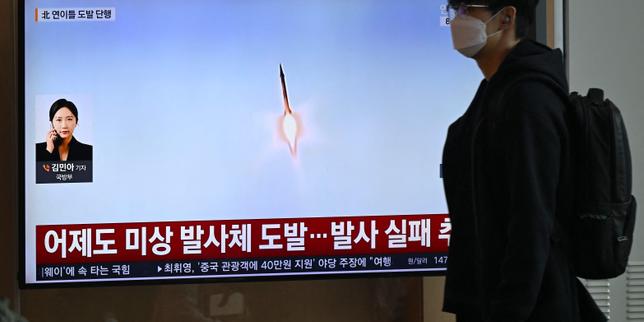
Pyongyang’s consecutive missile tests on Monday, Tuesday, and Wednesday represent a shift from symbolic signaling to operational validation of a diversified nuclear triad. While news cycles often treat these launches as isolated provocations or "cries for attention," a structural analysis reveals a disciplined engineering roadmap designed to saturate regional missile defense systems. The primary objective is the achievement of a credible second-strike capability through mobile, rapid-response delivery platforms that minimize the pre-launch detection window.
The Architecture of Sequential Testing
The decision to conduct tests across three consecutive days serves three distinct technical and strategic functions that single-launch events cannot achieve.
1. Operational Tempo and Readiness Stress-Testing
By launching on consecutive days, the Korean People's Army (KPA) demonstrates the maturity of its command-and-control (C2) infrastructure. Rapid sequencing proves that the logistics chain—fueling, transport-erector-launcher (TEL) deployment, and data telemetry—can function under a sustained high-intensity operational tempo. This reduces the "cooldown" period between strikes, complicating the ability of adversary intelligence assets to reset and re-task surveillance satellites.
2. Diversification of Trajectories
The trilateral testing window allowed for the simultaneous validation of different flight profiles:
- Depressed Trajectories: Lower altitude, high-velocity flights designed to slip under the radar horizons of Aegis-equipped destroyers.
- Lofted Trajectories: High-angle launches that test the thermal limits of reentry vehicles without requiring the physical range of an Intercontinental Ballistic Missile (ICBM).
- Maneuverable Reentry: Testing the late-stage guidance systems of short-range ballistic missiles (SRBMs) to ensure they can bypass Terminal High Altitude Area Defense (THAAD) interceptors.
3. Saturation Logic
The cumulative effect of three days of launches provides a data set for "salvo modeling." In a conflict scenario, North Korea will not fire a single missile; it will fire clusters. Consecutive testing allows engineers to calibrate the timing required to overwhelm the processing limits of the Patriot (PAC-3) and KM-SAM batteries stationed in South Korea.
The Technological Transition from Liquid to Solid Propellant
The underlying driver of this testing frequency is the systemic transition to solid-fuel technology. This is the most significant bottleneck in North Korean missile development, and its resolution fundamentally alters the regional balance of power.
Liquid-fueled missiles require a lengthy fueling process conducted in the open, leaving them vulnerable to "Left of Launch" preemptive strikes. Solid-fuel engines, however, are essentially "ready-to-fire" canisters.
- Storage: Solid-fuel units can be stored in hardened tunnels or mobile bunkers for extended periods.
- Mobility: Because the fuel is integrated into the motor, the missiles are more stable during transport over North Korea’s rugged terrain.
- Launch Latency: The time from "order" to "ignition" is reduced from hours to minutes.
This transition forces South Korea’s "Kill Chain" strategy—a preemptive strike doctrine—into a state of obsolescence. If the detection window is shorter than the decision-making cycle of the defending command, the deterrent value of preemption evaporates.
The Tactical-Strategic Convergence
Pyongyang is no longer distinguishing between tactical (battlefield) and strategic (counter-city) weapons in its testing rhetoric. The recent tests focus on "tactical nukes," a category of weaponry designed for use against concentrated military targets like ports, airfields, or command hubs.
This creates a Ladder of Escalation problem for the US-ROK alliance. If North Korea utilizes a tactical nuclear weapon against a specific military installation, a full-scale strategic nuclear retaliation by the United States would be viewed as disproportionate, potentially fracturing the alliance. By testing these specific delivery systems, Pyongyang is exploiting the "Grey Zone" between conventional skirmishes and total nuclear war.
Logistics of the Transporter-Erector-Launcher (TEL) Fleet
The efficacy of the missiles tested is directly proportional to the survivability of their launch vehicles. Analysis of the recent testing sites indicates a high reliance on off-road capable TELs.
- Geospatial Unpredictability: The KPA is moving away from established launch pads (like Sohae) toward random highway strips, forest clearings, and even submerged barges or rail-based launchers.
- Electronic Warfare (EW) Resilience: The telemetry data from the Monday-Wednesday window suggests an increased use of frequency-hopping and encrypted guidance links, intended to harden the missiles against Western electronic countermeasures.
The Cost Function of Regional Defense
The economic asymmetry of these tests favors the aggressor. The cost of a North Korean SRBM is estimated to be a fraction of the cost of the interceptors required to stop it.
- The Interceptor Ratio: Standard doctrine requires two interceptors per incoming warhead to ensure a high probability of kill (Pk).
- Economic Attrition: By launching three days in a row, North Korea forces Japan and South Korea to activate high-alert protocols, scramble aircraft, and cycle sensor arrays, incurring massive operational costs while Pyongyang collects invaluable flight data.
This creates a "Cost Imposition" strategy where the defender spends significantly more to maintain a status quo that is becoming increasingly fragile.
The Erosion of the Sanctions Paradigm
The ability to conduct a three-day testing marathon suggests that the global sanctions regime has reached a point of diminishing returns. The supply chain for specialized components—high-grade carbon fiber for motor casings, perchlorate for fuel, and CNC machinery for nozzle gimbaling—remains functional.
This points to a robust underground procurement network and, more importantly, a high degree of domestic industrial indigenization. North Korea is no longer merely assembling foreign kits; it is iterating on indigenous designs tailored to the specific constraints of the Korean Peninsula.
Intelligence Gaps and Observational Limits
It is crucial to acknowledge that Western assessments of these tests rely on X-band radar data and satellite imagery. We lack "ground truth" regarding:
- Warhead Integrity: We cannot confirm if the reentry vehicles survived the thermal stress of atmospheric reentry or if the "trigger" mechanisms for a nuclear payload functioned.
- Targeting Precision: While we know where the missiles landed (typically in the East Sea/Sea of Japan), we do not know where they were aimed. A "miss" by North Korean standards might look like a successful flight to an outside observer.
- Internal Failure Rates: The state news agency only confirms successful tests. The number of "cold starts" or mid-flight breakups that may have occurred during this three-day window remains an unknown variable.
Strategic Forecast: The Shift Toward Quantifiable Parity
The trilateral testing cycle signals that North Korea has moved past the "proof of concept" phase and into the "mass production and deployment" phase. The strategic objective is to achieve a level of force density that makes a decapitation strike by the US or South Korea mathematically impossible.
The next logical step in this progression is the demonstration of a MIRV (Multiple Independently Targetable Reentry Vehicle) capability. Once a single missile can carry three to five warheads, the existing missile defense architecture in the Pacific will require a total structural overhaul.
Stakeholders must pivot from a policy of "denuclearization" toward "containment and damage limitation." The technical reality established by this week’s tests confirms that the North Korean missile program is no longer a bargaining chip—it is a permanent feature of the regional security architecture. Future defense planning must prioritize the hardening of digital and physical infrastructure against short-warning, high-velocity strikes, as the luxury of a protracted early-warning window has been effectively neutralized.



