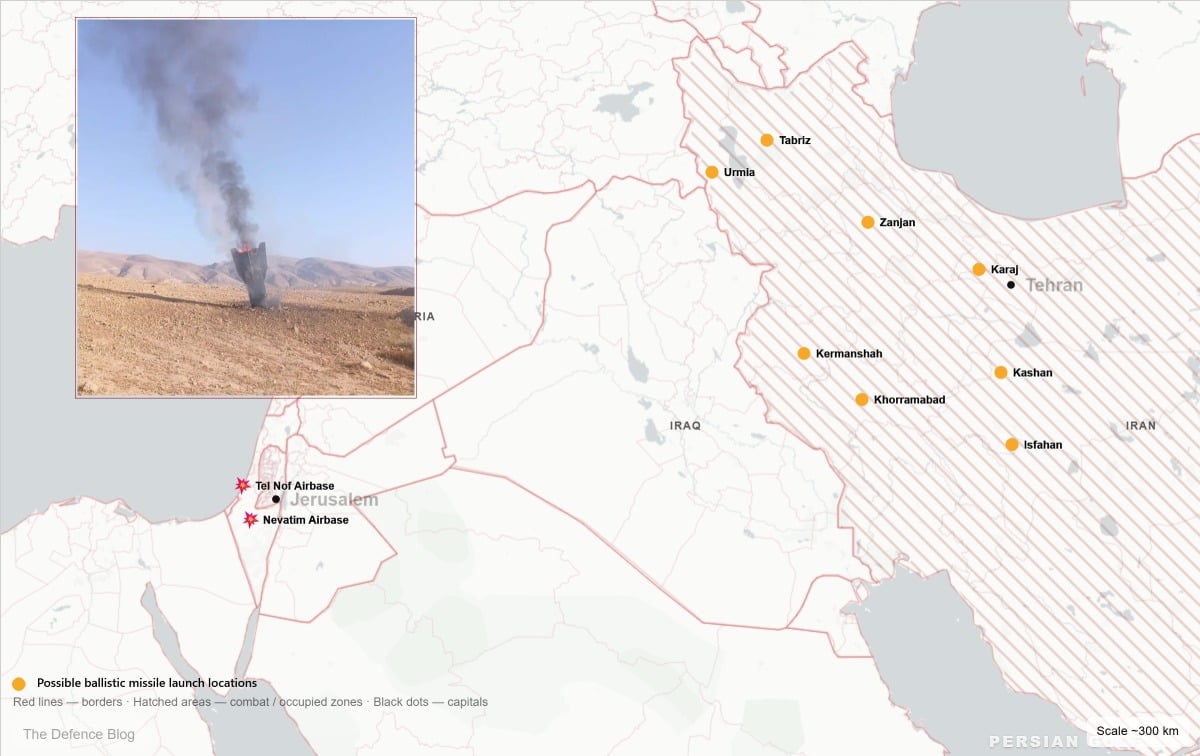
The employment of mass ballistic missile volleys against integrated air defense systems (IADS) represents a shifts from symbolic deterrence to operational counter-force targeting. When assessing a strike of this magnitude—specifically targeting hard airbase infrastructure—traditional media narratives focus heavily on binary outcomes: hit or miss, success or failure. A rigorous military-economic analysis reveals that modern missile strikes operate on a calculus of saturation thresholds, interception cost asymmetries, and structural damage penetration.
To evaluate the strategic reality of these engagements, we must deconstruct the strike into three distinct operational phases: the saturation vector, the interception efficiency function, and the terminal damage mechanism.
The Saturation Vector: Overwhelming the Fire Control Loop
The primary objective of a mass ballistic missile strike is not necessarily the total destruction of every target, but the deliberate exhaustion of the defender’s engagement capacity. Every air defense radar system possesses a finite tracking and engagement limit, dictated by its processing architecture and the number of available fire control channels.
[Ballistic Volley] ---> [Radar Tracking Capacity Limit] ---> [Channel Exhaustion] ---> [Terminal Penetration]
When a battery faces a swarm of incoming targets simultaneously, the attack exploits specific bottlenecks in the defensive loop:
- Radar Horizon and Detection Latency: Ballistic missiles traveling at hypersonic terminal velocities (Mach 5+) grant the defender a highly compressed engagement window, often under two minutes from radar acquisition to impact.
- Target Discrimination Hurdles: Advanced ballistic vectors frequently deploy countermeasures, including separating booster stages, decoys, or intentional fragmentation. This forces the IADS to expend processing power—and interceptors—on non-lethal targets.
- Sensor Saturation: If the number of incoming re-entry vehicles exceeds the simultaneous tracking capacity of the engagement radar, the system experiences a queueing delay. In high-velocity environments, a delay of even seconds allows subsequent missiles to penetrate the defensive umbrella unengaged.
By launching dozens of medium-range ballistic missiles (MRBMs) concurrently, the offensive strategy relies on mathematical probability. If a defensive battery can engage a maximum of 12 targets simultaneously, a 13th or 14th missile sent along the same vector guarantees a penetration of the outer defensive layer.
The Interception Efficiency Function: The Economic and Kinetic Asymmetry
Evaluating the effectiveness of an IADS requires analyzing the exchange ratio across two distinct metrics: kinetic interception probability ($P_k$) and resource depletion economics.
In a typical engagement, defensive doctrines dictate firing at least two interceptors per incoming ballistic target ($2:1$ engagement ratio) to maximize the probability of kill. This creates an immediate inventory bottleneck for the defender.
The Interceptor Inventory Deficit
Modern long-range interceptors, such as the Arrow 3 or Patriot PAC-3, are highly complex, low-yield manufacturing items. A defender's stockpile is finite and cannot be replenished during the timeline of an active conflict. Conversely, while MRBMs are expensive, their manufacturing processes often prioritize mass over sophistication.
A state executing a strike can utilize older, less accurate liquid- or solid-fueled missiles simply to force the expenditure of the defender's premier, multi-million-dollar interceptors. This is an asymmetric cost imposition framework: the offense spends relatively inexpensive capital to deplete an irreplaceable, high-tech defensive inventory.
Terminal Phase Leakage
No air defense system achieves a permanent $100%$ interception rate under saturation conditions. "Leakage" refers to the percentage of missiles that successfully bypass the defensive layers due to interceptor misses, mechanical failures, or fire control exhaustion.
When a missile leaks through the IADS, its accuracy is determined by its guidance package (such as GPS/INS or terminal optical homing). Even if a missile misses its precise aiming point by dozens of meters due to electronic warfare GPS jamming, the sheer kinetic energy and warhead mass of an MRBM ensure significant collateral degradation to the target area.
Terminal Damage Mechanisms: Airbase Vulnerability and Functional Denial
When evaluating impacts on highly fortified military installations like airbases, general assessments often misinterpret the nature of structural damage. Airbases are expansive, redundant networks designed to withstand bombardment. Total destruction is rare; functional denial is the realistic operational goal.
[Warhead Impact]
       |
       +---> Hardened Aircraft Shelters (HAS) -> Highly resistant; requires direct, heavy penetration.
       |
       +---> Runways and Taxiways --------------> Easily disrupted; high operational impact, low repair time.
       |
       +---> Support Infrastructure -----------> Radar, fuel, and munitions hubs create systemic bottlenecks.
The vulnerability matrix of a modern military airbase is divided into three distinct tiers:
1. Runways and Taxiways (The Sortie Generation Matrix)
Runways are large, unhideable targets. Direct hits by conventional high-explosive warheads create deep craters, temporarily halting takeoff and landing operations. However, modern engineering units can repair standard cratering within hours using quick-setting concrete and metal mats. Therefore, runway strikes offer short-term operational denial rather than long-term strategic destruction, unless paired with delayed-fusing submunitions designed to deny repair crews access.
2. Hardened Aircraft Shelters (HAS)
Modern fighter aircraft are rarely left exposed on open tarmacs; they are housed in reinforced concrete shelters designed to mitigate near-miss overpressures. Penetrating a HAS requires specialized unitary warheads with delayed fuses that detonate after piercing several meters of reinforced earth and concrete. If the strike vector utilizes generic high-explosive warheads, impacts on a HAS generally yield superficial structural damage, leaving the aircraft inside fully operational.
3. Logistic and Sensor Nodes
The true single points of failure within an airbase are the unhardened support infrastructures: fuel storage farms, ammunition depots, maintenance hangars, and localized air traffic control or radar installations. Disrupting a base’s centralized fuel delivery system or destroying its main maintenance depot degrades sortie generation capabilities far more effectively than poking holes in a runway. Without fuel and diagnostic maintenance, advanced fighter jets remain grounded regardless of runway status.
The Strategic Matrix of Extended Deterrence
The strategic outcome of a ballistic missile strike cannot be measured solely by counting craters or tallying interceptor costs. The ultimate metric is the shift in geopolitical risk calculation.
An offensive state demonstrates the structural capability to penetrate contested airspace and hold high-value military assets at risk. The defending state, despite demonstrating high technical proficiency via its IADS, is forced to recognize that defense is a diminishing-returns asset under prolonged saturation.
This dynamic alters the calculation of extended deterrence. When the shield is proven to leak under stress, the cost of future conventional escalations rises exponentially for both actors, shifting the conflict from a state of managed deterrence to an unpredictable test of industrial endurance.