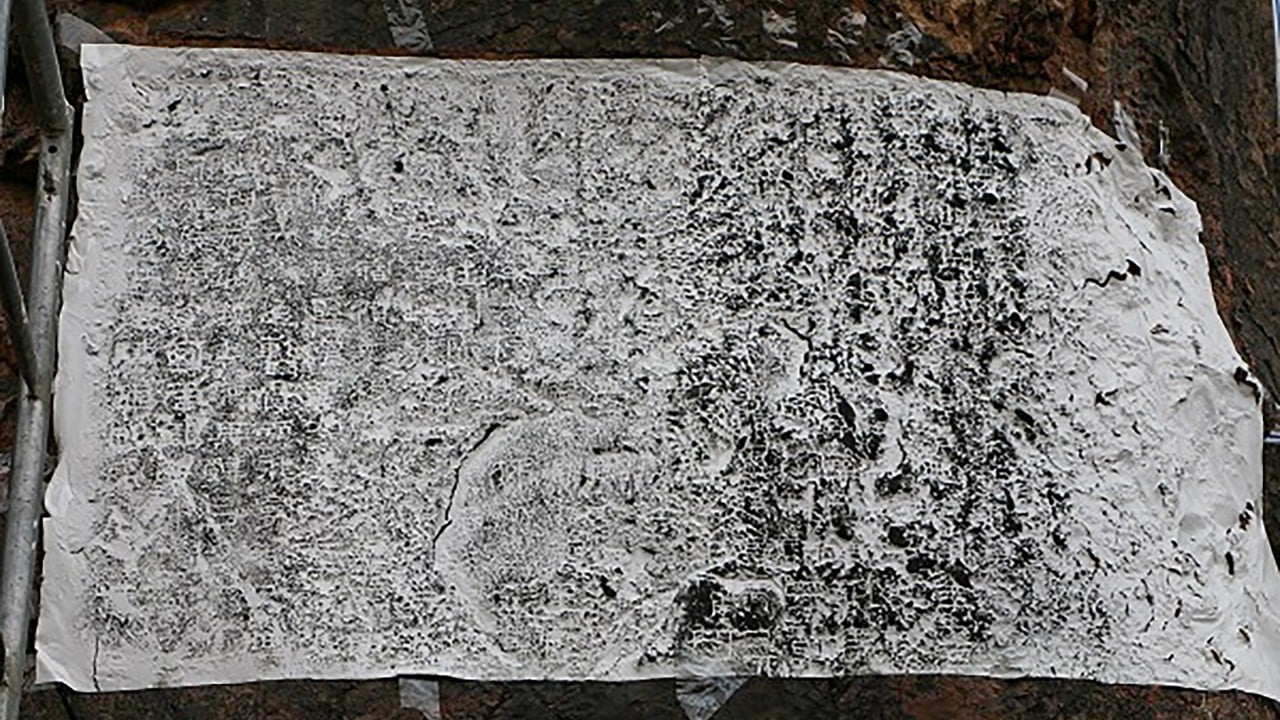
Traditional stone rubbing is a destructive contact-transfer process that directly compromises the structural integrity of ancient cliff inscriptions, transforming a historical documentation technique into an active agent of mechanical and chemical erosion. When practitioners apply wet paper, adhesive binders, and carbon-based inks directly onto a 2,000-year-old Han dynasty cliff face, they introduce severe physical stressors to a weathered stone substrate that has spent two millennia approaching chemical equilibrium with its environment. The degradation observed in celebrated Han cliff carvings—specifically those carved into exposed limestone, sandstone, or granite faces across China—demonstrates a predictable failure mode in cultural heritage management: the prioritization of short-term facsimile reproduction over long-term substrate preservation.
To understand why a single bad impression accelerates the loss of an irreplaceable epigraphic monument, one must analyze the interaction between traditional Chinese rubbing (taben) materials and aged sedimentary or igneous rock matrices. The process does not merely lift an image; it initiates a cascade of surface delamination, pore-clogging, and micro-fracture propagation.
The Physics of Contact-Transfer Degradation
Stone rubbing relies on mechanical force to drive moistened xuan paper into the incised troughs of carved calligraphy, followed by the application of ink via a tamped dauber (tabao). While curators and collectors historically treated this method as a benign copying protocol, materials science reveals four distinct vectors of physical damage inherent to the workflow.
Percussive Micro-Fracturing
To force wet paper fibers into fine chisel marks, operators strike the paper repeatedly with stiff-bristled brushes or wooden mallets. On fresh, unweathered quarry stone, the compressive strength of the rock easily absorbs this kinetic energy. On a Han dynasty cliff face exposed to 2,000 years of thermal cycling and acid rain, the outer millimeter of stone—known as the weathering rind—suffers from severe intergranular decohesion. Each percussive strike transmits shear stress across weakened mineral boundaries, dislodging microscopic quartz or calcite grains. When the dried paper is peeled away, these loosened grains adhere to the cellulose fibers, resulting in irreversible surface stripping.Hydro-Mechanical Swelling and Salt Crystallization
The traditional rubbing workflow requires saturating the stone surface with water, often mixed with traditional organic binders such as baiji (orchid tuber mucilage) or alum to ensure the paper clings tightly to vertical or overhanging rock faces. Liquid water penetrates the porous network of the stone via capillary action. In outdoor cliff environments, this moisture dissolves soluble salts present within the rock matrix or deposited by atmospheric pollution. As the water evaporates during the drying phase required before inking, these dissolved salts migrate toward the surface and recrystallize just beneath the stone face. The volumetric expansion of salt crystals exerts outward pressure exceeding the tensile strength of weathered sandstone and limestone, causing spalling and blistering of the inscribed characters.Chemical Pore Occlusion
Poorly executed rubbings frequently suffer from ink bleed-through, where carbon black suspended in water or oil-based carriers penetrates porous xuan paper and stains the underlying rock. Once carbon particulates lodge inside the capillary pores of weathered stone, they alter the surface albedo and thermal absorption profile of the cliff face. Darkened, ink-stained stone absorbs significantly more solar radiation than adjacent unpainted rock, creating localized thermal gradients. Differential thermal expansion between the stained surface layer and the cooler interior substrate generates shear forces that detach the inscribed crust.Biological Nutrient Loading
Organic adhesives used to tack paper onto vertical rock faces leave behind trace residues of starches, proteins, and polysaccharides. In humid, shaded cliffside microclimates, these residues act as an immediate carbon and nitrogen source for endolithic fungi, cyanobacteria, and lichens. Colonizing microorganisms secrete organic acids—such as oxalic and carbonic acid—that chemically dissolve carbonate minerals in limestone and feldspar in granite, accelerating biodeterioration long after the rubbing crew has departed.
The Institutional Failure Mode in Heritage Access
The vulnerability of Han cliff inscriptions stems not only from the physics of ink and paper, but from a structural misalignment between preservation mandates and cultural demand. Han dynasty lishu (clerical script) cliff carvings—such as the Shimen Song (Ode to the Stone Gate) or the Xixia Song (Ode to the West Gorge)—represent the foundational canon of Chinese calligraphy. Consequently, high-grade rubbings command substantial prestige among scholars, collectors, and state institutions.
This demand creates an operational bottleneck. Heritage site managers frequently face pressure from visiting dignitaries, researchers, or commercial entities seeking authorized impressions. When oversight lapses or uncertified operators gain access to a monument, the resulting "bad impression" is rarely an isolated aesthetic failure; it is a physical trauma event.
An amateur or rushed rubbing operator commits compounding technical errors:
- Excessive wetting to compensate for rough, uneven rock topography, maximizing capillary moisture penetration.
- Over-tamping with hard tools to force thick paper into shallow, eroded strokes, pulverizing the fragile edges of the characters.
- Improper release of partially damp or overly glued paper, tearing away delaminated rock flakes alongside the finished sheet.
- Chemical cleaning post-rubbing, where operators scrub the cliff face with water or solvents to remove accidental ink smudges, driving dissolved carbon deeper into the stone pores and abrading the softened surface.
The core fallacy in traditional epigraphic management is the assumption that a monument that has survived two millennia is inherently durable. In reality, ancient cliff inscriptions exist in a state of metastable equilibrium. Their outer surfaces are often held together by delicate mineral crusts or fragile biofilms. A single aggressive physical intervention breaks that equilibrium, triggering an exponential acceleration in erosion rates that cannot be reversed through conservation treatments.
Non-Contact Digitization Versus Legacy Reproduction
Modern conservation science renders physical contact rubbing entirely obsolete for both scholarly research and high-fidelity reproduction. The operational risk-to-reward ratio of placing wet paper and ink on an ancient cliff face is indefensible when non-invasive optical and laser technologies deliver superior geometric and visual data without exerting a single newton of force on the rock.
Structured-Light and Laser Scanning
Terrestrial laser scanning (TLS) and high-resolution structured-light scanners capture the three-dimensional topography of a cliff inscription at sub-millimeter precision. By projecting calibrated light patterns onto the stone and measuring deformations via dual cameras, these systems generate dense point clouds that map every chisel mark, crack, and spall. Unlike a 2D ink rubbing—which distorts spatial depth and relies on the subjective pressure applied by the operator's hand—a 3D mesh provides an objective, quantifiable baseline of the monument's physical state.
Photogrammetry and Reflectance Transformation Imaging
Close-range photogrammetry combines hundreds of overlapping high-resolution photographs to reconstruct textured 3D models. When paired with Reflectance Transformation Imaging (RTI), conservators can virtually relight the inscription from any angle in post-processing. Virtual raking light reveals shallow, weathered strokes that are completely invisible to the naked eye and impossible to capture via traditional ink rubbing without destroying the remaining stone surface.
Zero-Contact Facsimile Manufacturing
For institutions, museums, or collectors requiring physical artifacts, 3D scan data drives computer numerical control (CNC) milling or stereolithography (SLA) 3D printing to produce exact physical replicas of the cliff face. Operators can then execute traditional ink rubbings on the synthetic resin or cast-stone surrogate indefinitely. This decouples cultural practice and commercial production from the original artifact, eliminating physical wear on the Han dynasty substrate while preserving the intangible craft of taben production.
Operational Limitations of Conservation Protocols
Transitioning from legacy contact methods to non-invasive conservation requires confronting severe operational constraints. No conservation protocol functions as a universal fix, and heritage managers must account for three primary limitations when securing exposed cliff monuments.
First, environmental exposure cannot be engineered away entirely. Eliminating human contact stops mechanical abrasion and ink contamination, yet outdoor cliff inscriptions remain subject to groundwater seepage, freeze-thaw cycles, and atmospheric pollution. Constructing protective shelters or roofs over cliff faces mitigates direct rainfall, but poorly designed enclosures alter local airflow, trapping humidity and accelerating salt efflorescence and biological growth.
Second, consolidation treatments carry long-term chemical risks. When a bad rubbing leaves a cliff face flaking and friable, conservators often turn to chemical consolidants—such as ethyl silicates or acrylic resins—to bind loose mineral grains back together. However, if a consolidant forms an impermeable surface crust over porous stone, migrating groundwater becomes trapped behind the treated layer. Subsequent freezing or salt crystallization then blows off the entire consolidated face in thick slabs, causing far worse damage than untreated granular disintegration.
Third, digital preservation introduces archival fragility. While a Han cliff inscription carved in granite can endure for two millennia, raw point-cloud files and proprietary 3D mesh formats face rapid technological obsolescence. Without continuous migration to open archival standards and redundant cold storage, digital surrogates risk becoming unreadable within decades, leaving future scholars with neither a durable physical monument nor accessible data.
Strategic Framework for Monument Protection
To prevent catastrophic surface loss across vulnerable cliff inscriptions, heritage authorities and site directors must enforce a strict zero-contact operational doctrine.
Enact an Absolute Moratorium on Direct Rubbings
Reclassify all direct ink-and-paper rubbing of pre-modern stone inscriptions as a destructive intervention equivalent to sampling or excavation. Prohibit the practice entirely on original stone substrates, permitting exceptions only under emergency salvage protocols where a cliff face faces imminent, unavoidable destruction from infrastructure or geological collapse.Establish High-Resolution Baseline Twins
Deploy sub-millimeter structured-light scanning and RTI photography across all Grade-A epigraphic sites immediately. Store the resulting geometric meshes as the definitive legal and scholarly record of the monument, utilizing periodic re-scans every five years to quantify natural erosion rates via automated cloud-to-cloud distance comparison.Shift Production to Surrogate Matrices
License official museum workshops and master rubbing artisans to produce editions exclusively from high-density polymer or cast-mineral replicas generated from the baseline 3D scans. Mandate clear provenance stamping on all surrogate rubbings to maintain market transparency while satisfying collector and educational demand without touching the historical rock.Implement Microclimate and Hydrological Controls
Redirect surface runoff away from inscribed cliff faces using upslope drainage channels and drip lines to starve the stone of the capillary water required for salt crystallization and biological colonization. Monitor rock surface temperature and relative humidity continuously to detect moisture intrusion before visible spalling occurs.🔗 Read more: The Illusion of Victory in the 2026 Iran Ceasefire