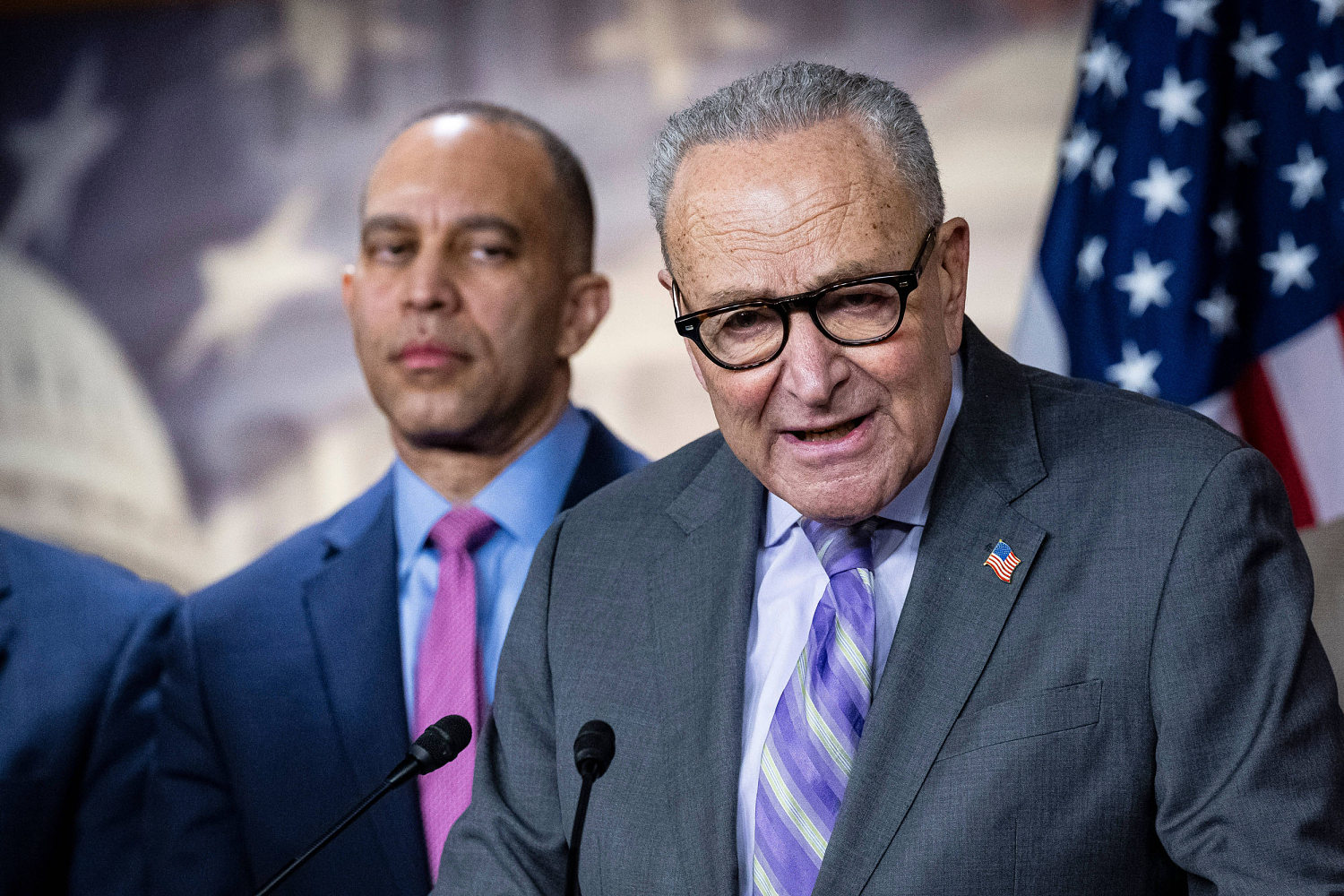
Political commentary frequently mistakes vocal dissent for structural vulnerability. The observation that House Minority Leader Hakeem Jeffries and Senate Majority Leader Chuck Schumer face widespread criticism from their own ranks yet encounter zero formal leadership challengers is not a paradox; it is the predictable output of modern institutional design. A rigorous examination of congressional power structures demonstrates that leadership stability in the contemporary Democratic caucus relies on three interlocking mechanisms: centralized fundraising monopolies, punitive committee assignment architectures, and the collective action problem inherent in legislative insurgency. Understanding how these variables interact explains why internal ideological friction rarely translates into an actual leadership vote.
The Structural Architecture of Leadership Insulation
To understand why criticism does not produce challengers, one must separate rhetorical dissatisfaction from institutional leverage. Members of Congress operate within an asymmetric incentive system where the cost of mounting a failed leadership challenge approaches total career annihilation, while the probability of success remains near zero without pre-existing institutional backing.
Centralized Campaign Finance Monopolies
Modern congressional leadership is fundamentally a capital-allocation enterprise. The primary function of a party leader is no longer strictly legislative floor management; it is the aggregation and distribution of campaign funds across vulnerable districts and states.
Through leadership PACs, joint fundraising committees, and direct influence over the Democratic Congressional Campaign Committee (DCCC) and the Democratic Senatorial Campaign Committee (DSCC), Jeffries and Schumer control the financial lifeblood of their caucuses. When a rank-and-file member criticizes leadership on cable news or social media, that member is engaging in low-cost district maintenance—signaling ideological alignment to local primary voters. Mounting a formal challenge, by contrast, requires severing ties with the central fundraising apparatus.
A challenger cannot rely on small-dollar grassroots donations alone to fund a caucus-wide leadership race, because leadership elections are decided by peers who prioritize their own re-election security. Any member seeking to unseat Jeffries or Schumer would immediately need to demonstrate an equal or superior capacity to raise hundreds of millions of dollars for frontline incumbents. Because no alternative fundraising infrastructure exists at that scale within the party, potential challengers lack the baseline capital required to make a credible bid.
The Committee Assignment and Legislative Bottleneck
Beyond campaign finance, leadership controls the internal distribution of institutional power through committee assignments and floor access. In the House, the Steering and Policy Committee—heavily weighted toward leadership allies—determines who sits on high-value panels such as Ways and Means, Appropriations, and Energy and Commerce. In the Senate, Schumer exercises decisive influence over committee rosters and the legislative calendar.
This creates a clear cause-and-effect deterrent:
- Committee Exile: A member who launches an unsuccessful challenge faces immediate removal from premier committees, stripping them of fundraising appeal and legislative relevance.
- Bill Stagnation: Leadership controls which bills reach the floor for a vote. Insurgents find their sponsored legislation permanently stalled in committee, depriving them of tangible policy achievements to bring back to their constituents.
- Staff and Resource Starvation: Leadership dictates the allocation of office budgets, travel authorizations, and institutional perks that facilitate a member's daily operations.
The expected utility of a challenge is therefore overwhelmingly negative. Rational actors within the caucus recognize that public criticism carries a near-zero penalty, whereas formal opposition carries a near-certain penalty.
The Collective Action Problem in Legislative Insurgencies
Political analysts often treat ideological factions—such as the Congressional Progressive Caucus or moderate coalitions like the Blue Dog Coalition and Problem Solvers Caucus—as monolithic voting blocs capable of toppling leadership. This assumption ignores the fundamental game theory governing legislative coalitions.
Coordination Failure and the First-Mover Disadvantage
Removing an entrenched leader requires solving a classic coordination problem. If fifty members privately agree that leadership is failing, none of those fifty has an incentive to be the first to declare candidacy. The first mover absorbs the full retaliatory force of the leadership apparatus before a protective coalition can solidify.
Furthermore, the ideological factions criticizing Jeffries and Schumer have mutually exclusive policy objectives. Progressive critics fault leadership for insufficient aggression on social spending, judicial reform, or foreign policy constraints. Moderate critics simultaneously fault leadership for failing to rein in progressive rhetoric that damages the party brand in swing districts.
Because these two groups criticize the same leaders for opposite reasons, they cannot unite behind a single alternative candidate. A progressive challenger would alienate the moderate frontline members whose votes are necessary to win a majority in the caucus; a moderate challenger would trigger an immediate revolt from the progressive wing. Jeffries and Schumer occupy the median institutional position, serving as the equilibrium point that prevents open civil war between the party's ideological poles.
The Illusion of Asymmetric Ideological Pressure
Comparing the Democratic caucus to the House Republican Conference highlights why Democratic leadership remains insulated while Republican leadership has experienced repeated structural collapses. The divergence is not a matter of personality, but of rule structures and external media ecosystems.
In the House Republican Conference, a single member—or a tiny faction—previously utilized the motion to vacate the chair as a procedural weapon, lowering the threshold for a leadership crisis to near zero. Democrats maintain strict caucus rules that require a majority vote within the closed-door party caucus before any leadership question reaches the floor, neutralizing minority-faction hostage-taking.
Simultaneously, the media incentives differ sharply. Right-wing media ecosystems reward insurgent Republicans with national fame and direct-to-donor fundraising pipelines when they attack their own leadership. While progressive media outlets frequently critique Schumer and Jeffries, they do not possess the unified commercial scale required to sustain a rebellious member who has been completely cut off from institutional Democratic fundraising and committee power.
Risk Offloading and the Scapegoat Function
A critical operational reality missed by surface-level political reporting is that rank-and-file members actively benefit from having entrenched leaders absorb public blame. In organizational theory, this is known as upward risk delegation.
Managing Voter Dissatisfaction Without Structural Change
When voters express frustration with legislative gridlock, economic conditions, or unpopular compromises, individual members of Congress need a mechanism to deflect responsibility away from their own voting records. Schumer and Jeffries function as centralized shock absorbers for the entire party.
- Frontline Moderates: Can campaign in swing districts by pointing to their public disagreements with Schumer or Jeffries, establishing independent credibility with swing voters while still benefiting from leadership-directed campaign funds.
- Safe-Seat Progressives: Can satisfy activist bases by attacking leadership for watering down legislation, without ever risking the actual collapse of the party's legislative majority.
If a challenger were to successfully unseat Jeffries or Schumer, the rank-and-file members would lose this protective buffer. A new leader would immediately face the exact same structural constraints—narrow margins, divided government, and ideological polarization—while lacking the institutional relationships and fundraising infrastructure required to protect vulnerable incumbents. Consequently, maintaining the status quo while publicly critiquing it is the optimal survival strategy for the vast majority of Democratic lawmakers.
The Succession Pipeline and Generational Containment
The absence of challengers is also a function of deliberate succession management. Leadership stability depends on controlling the talent pipeline so that ambitious, rising members see their path to advancement through the existing hierarchy rather than against it.
Institutional Co-optation
Hakeem Jeffries' ascent to Minority Leader exemplifies controlled succession. Rather than emerging from an insurgency against Nancy Pelosi, Jeffries rose through established institutional channels—serving as Democratic Caucus Chair and aligning closely with outgoing leadership—ensuring a seamless transfer of fundraising networks and committee loyalties.
By elevating ambitious younger members into deputy leadership positions, vice-chair roles, and key committee slots, Jeffries and Schumer effectively co-opt the exact individuals who possess the political talent to mount a future challenge. Once a member enters the leadership orbit, their personal career trajectory becomes tied to the preservation of the hierarchy. Challenging the top leader would destroy the very ladder they are climbing.
The Senate Seniority Shield
In the Senate, Chuck Schumer benefits from an even stronger structural barrier: the seniority system. Senate power accumulates slowly over decades. Senators who have spent fifteen or twenty years climbing the seniority ladder on committees like Finance, Judiciary, or Appropriations have massive sunk costs in the existing order.
Mounting a challenge against Schumer would jeopardize the institutional predictability that protects their own committee chairmanships or ranking member statuses. Even Senators with presidential ambitions avoid direct leadership challenges, recognizing that the role of Senate Majority or Minority Leader is a grueling administrative post that requires constant legislative compromise—a liability in national primaries. Ambition in the Senate is channeled outward toward the White House rather than upward toward the leader's desk.
Limitations of the Incumbency Shield
While the structural defenses surrounding Jeffries and Schumer are formidable, they are not absolute. Analytical rigor requires identifying the exact boundary conditions under which this equilibrium breaks down. The incumbency shield fails only when external shocks overwhelm internal deterrent mechanisms.
Catastrophic Electoral Realignment
The primary vulnerability of any congressional leader is a generational electoral wipeout that invalidates their core value proposition: winning majorities. If the Democratic Party suffers a catastrophic loss across both chambers—losing seats previously considered safe—the fundraising and strategic competence of the leadership team is discredited. In that scenario, the fear of losing the next election outweighs the fear of leadership retaliation, lowering the barrier to coordination among insurgents.
Exogenous Financial Disruption
The leadership monopoly over campaign finance relies on the current regulatory and technological framework of political fundraising. If campaign finance laws shift dramatically, or if decentralized digital fundraising platforms evolve to allow independent ideological factions to consistently out-raise central party committees, the financial leverage held by Schumer and Jeffries would erode. Without the ability to punish rebels financially, committee exile alone loses much of its deterrent power.
Generational Actuarial Reality
In the Senate specifically, biological and actuarial timelines represent a hard constraint. While Jeffries represents a newer generation of House leadership, Schumer and his top deputies belong to an older cohort. Institutional insulation cannot prevent eventual generational turnover; it only ensures that when transitions occur, they happen via negotiated succession rather than hostile takeovers.
Strategic Forecast and Operational Reality
Political observers waiting for internal Democratic dissatisfaction to coalesce into an open leadership rebellion are misreading the mechanics of the institution. The gap between vocal criticism and formal challenge is not a sign of indecisiveness among Democratic lawmakers; it is evidence of a highly rational, self-reinforcing equilibrium.
As long as the central party apparatus controls the primary mechanisms of campaign finance distribution and committee power, rational lawmakers will continue to utilize public criticism as a low-cost signaling tool while preserving the underlying leadership structure. True structural change within the Democratic caucus will not originate from a grassroots revolt on the floor or a sudden surge of ideological courage among backbenchers. It will occur only through pre-negotiated, leadership-sanctioned succession—or in the immediate aftermath of a historic electoral collapse that strips the current hierarchy of its institutional legitimacy. Until one of those two thresholds is crossed, Jeffries and Schumer will remain simultaneously criticized and unchallenged.