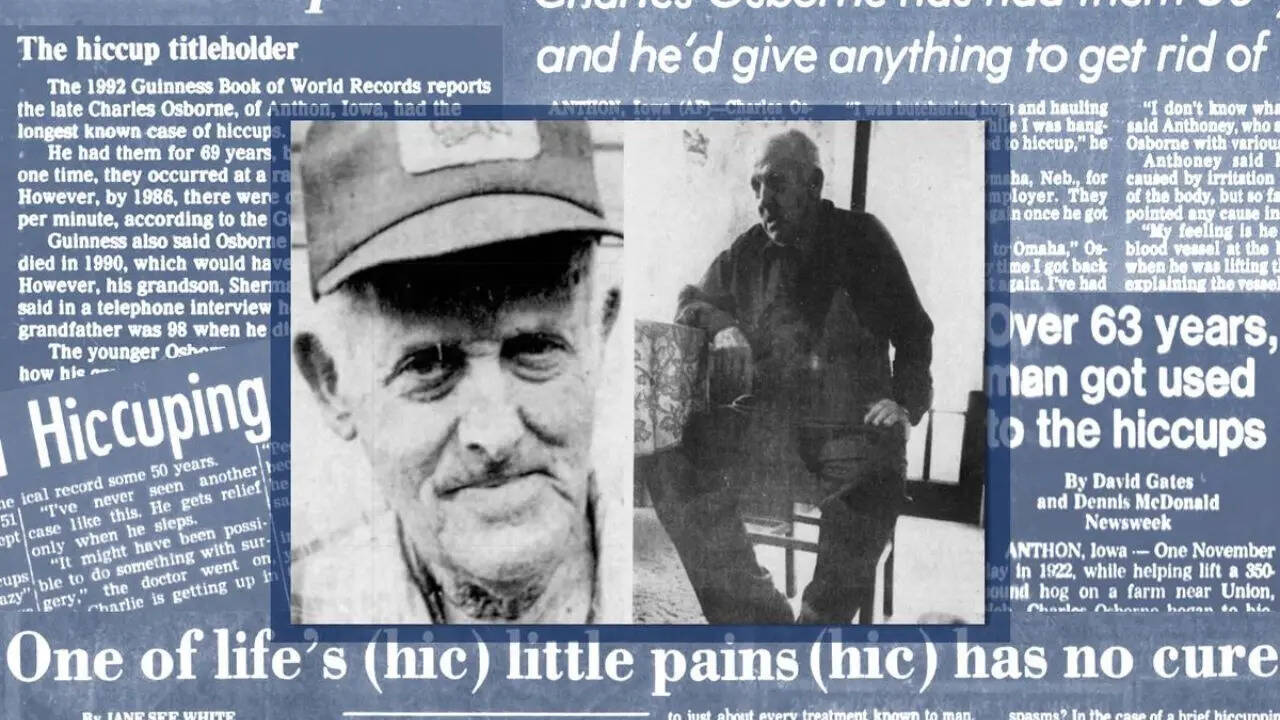
Charles Osborne hiccupped continuously from 1922 to 1990. While popular media treats this as a curiosity of Guinness-world-record proportions, a clinical deconstruction reveals a catastrophic failure of the reflex arc and a lifelong adaptation to neurological dysfunction. To understand the Osborne case is to understand the fragile intersection of the phrenic nerve, the vagus nerve, and the brainstem’s respiratory control centers.
The Singultus Reflex Arc A Structural Breakdown
The hiccup, or singultus, is not a simple muscle twitch. It is a coordinated, involuntary respiratory event characterized by a sudden contraction of the diaphragm and external intercostal muscles, followed immediately by the abrupt closure of the glottis. This closure creates the "hic" sound and represents a high-velocity interruption of airflow.
The Osborne event followed a classic three-part neurological circuit:
- The Afferent Limb: This consists of the vagus and phrenic nerves, along with sympathetic chains (T6-T12). In Osborne’s specific case—reported to have begun after a fall while weighing a hog—the catalyst was likely a traumatic vascular event or a specific lesion in the brainstem, rather than a simple peripheral nerve irritation.
- The Central Mediator: The "hiccup center" is not a single localized point but a diffuse network in the midbrain, specifically the medulla oblongata and the reticular formation.
- The Efferent Limb: The motor output travels via the phrenic nerve to the diaphragm and the recurrent laryngeal nerve to the glottis.
Osborne’s condition represents a permanent "short circuit" in this mediator. Once the reflex was triggered by his 1922 accident, the inhibitory mechanisms—the neurological "brakes" that normally terminate a hiccup bout—were either destroyed or permanently suppressed.
Quantifying the Physiological Tax
Osborne’s estimated 430 million hiccups over 68 years equate to a staggering metabolic and mechanical load. In the early stages of his condition, his frequency was recorded at approximately 40 iterations per minute. This rate eventually decelerated to roughly 20 per minute in his later years.
The Kinetic Energy of Chronic Contraction
The diaphragm is a skeletal muscle, yet it lacks the rest periods afforded to other muscle groups during chronic singultus.
- Mechanical Stress: Each hiccup involves a rapid pressure drop in the thoracic cavity.
- The Glottal Brake: The vocal cords slam shut within 35 milliseconds of the diaphragmatic contraction.
- The Cumulative Effect: At 20 hiccups per minute, Osborne experienced 1,200 glottal impacts per hour, or 28,800 per day.
This creates a high-risk environment for gastroesophageal reflux disease (GERD). The constant negative pressure in the esophagus pulls gastric acid upward, which, over 68 years, would typically lead to severe esophagitis or Barrett’s esophagus. The fact that Osborne maintained a baseline of health suggests a highly efficient, though involuntary, gastric venting system or a physiological tolerance for chronic acidity.
The Cognitive Adaptation Strategy
Osborne did not stop hiccupping to eat, speak, or sleep. His survival depended on a technique known as "breath-masking." This is a learned suppression of the acoustic component of the hiccup. By timing his inhalations and speech patterns to coincide with the inevitable diaphragmatic contractions, he neutralized the glottal "snap."
This required a permanent state of hyper-vigilance. He essentially bifurcated his consciousness: one part managing the social and functional requirements of daily life, the other monitoring the 3-to-5-second rhythm of his internal tremors. This adaptation highlights the brain's plasticity in the face of intractable autonomic dysfunction.
Differential Diagnosis of Intractable Singultus
To categorize the Osborne case within modern medicine, we must distinguish between "persistent" hiccups (lasting more than 48 hours) and "intractable" hiccups (lasting more than two months). Osborne’s 816-month duration stands as the extreme outlier in medical literature.
The failure to resolve the condition during his lifetime points to a structural rather than systemic etiology. Modern diagnostic frameworks would categorize his condition under three potential failure points:
1. Central Nervous System (CNS) Lesions
A traumatic brain injury (TBI) from his fall likely resulted in a small, localized hemorrhage in the medulla. Even a microscopic lesion in the reticular activating system can disrupt the inhibitory neurotransmitters—specifically Gamma-Aminobutyric Acid (GABA) and glycine—that regulate the respiratory rhythm.
2. Vagal and Phrenic Irritation
Chronic irritation of the vagus nerve (Cranial Nerve X) can create a feedback loop. If the hog-weighing accident caused a hiatal hernia or a permanent displacement of the diaphragm, the afferent signals to the brainstem would never cease, keeping the reflex arc in a state of "on."
3. Metabolic and Pharmacological Factors
While unlikely to be the primary cause for Osborne, electrolytes like calcium and potassium play a role in nerve excitability. Hyponatremia (low sodium) can exacerbate the frequency. However, given the 68-year duration, metabolic causes are ruled out as the primary driver, as they would have resulted in other systemic failures far sooner.
The Limits of Intervention
During Osborne's life, medical intervention was rudimentary. Today, the treatment protocol for intractable singultus follows a strict hierarchy of escalation:
- Pharmacological Blockade: The first line of defense involves Chlorpromazine (the only FDA-approved medication for hiccups), Baclofen (a GABA agonist), or Gabapentin. These aim to dampen the neurological excitability of the reflex arc.
- Anesthetic Intervention: If drugs fail, a phrenic nerve block is attempted. This involves injecting an anesthetic to temporarily "paralyze" the nerve signal to the diaphragm.
- Surgical Implantation: The most aggressive modern solution is the implantation of a vagus nerve stimulator (VNS) or a diaphragmatic pacer. These devices use electrical impulses to override the erratic signals of the hiccup reflex.
Osborne's condition ceased spontaneously in 1990, one year before his death. This suggests a secondary neurological shift—perhaps an age-related atrophy of the very neural pathways that sustained the reflex, or a secondary vascular event that finally silenced the "hiccup center."
Strategic Implications for Chronic Condition Management
The Osborne case serves as a masterclass in the body's ability to maintain homeostasis despite a permanent break in the autonomic system. The strategic takeaway for modern medicine is the necessity of early aggressive intervention in "persistent" cases to prevent the neural pathways from becoming "hard-wired" through long-term potentiation.
When the hiccup reflex passes the 48-hour mark, it is no longer a symptom; it is a developing neurological pathology. The objective must be to break the cycle before the brain adapts to the dysfunction as its new baseline. Practitioners should prioritize MRI imaging of the brainstem and upper cervical spine immediately upon the failure of first-line pharmacological treatments to identify the structural "glitch" before it becomes permanent.