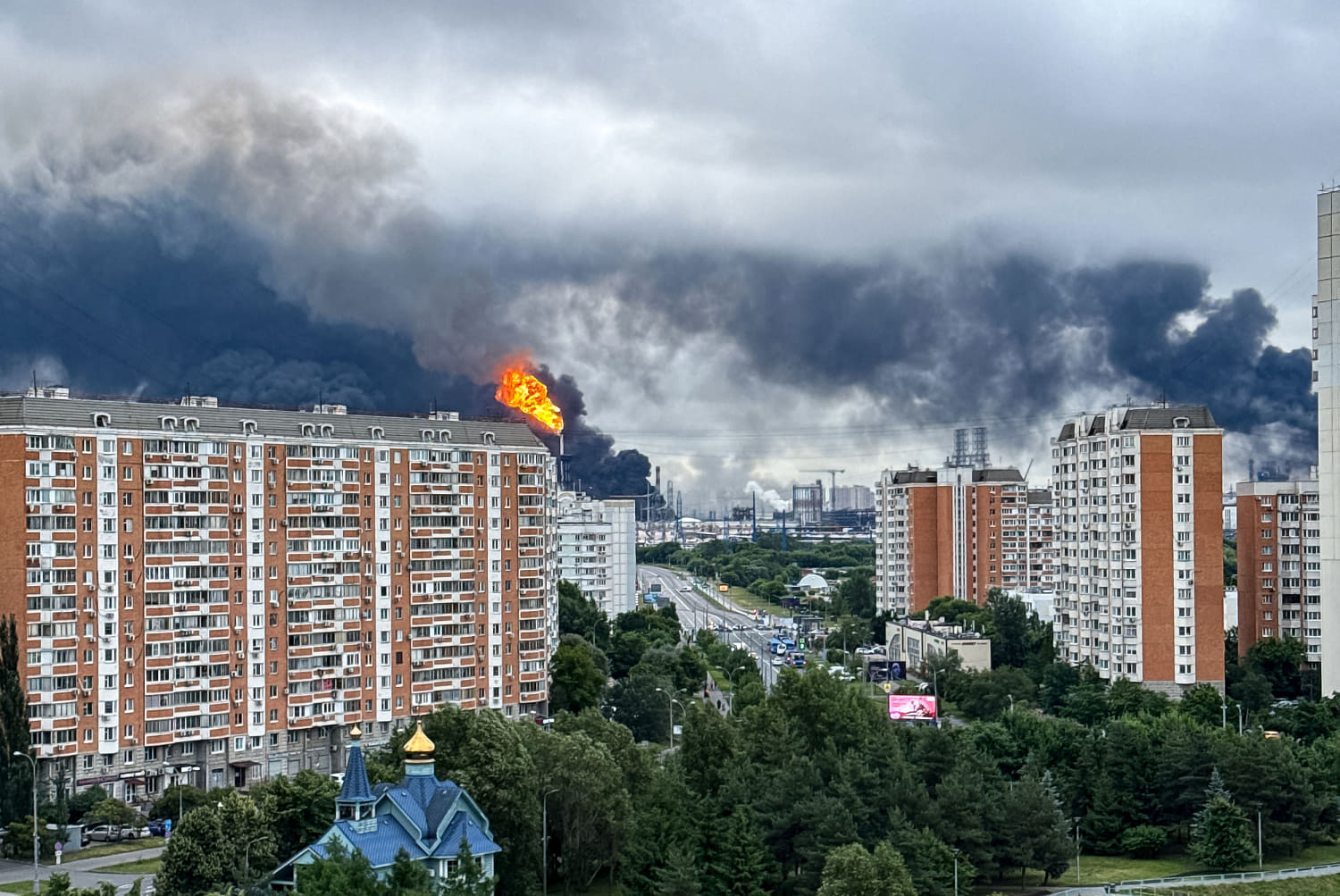
Long-range uncrewed aerial vehicle strikes targeting primary refining assets represent a structural shift in asymmetric warfare, moving from tactical battlefield disruption to the systematic degradation of industrial processing capacity. When a nation deploys low-cost loitering munitions against highly centralized petrochemical nodes, the strategic objective scales past immediate physical destruction. The true target is the operational equilibrium of the adversary’s domestic energy market and its capacity to sustain refined product exports. Optimizing an offensive campaign of this nature requires an understanding of downstream vulnerabilities, specifically the thermal cracking and distillation units that form the single point of failure in modern refining architectures.
The Microeconomics of Asymmetric Attrition
To evaluate the efficacy of long-range aerial campaigns against industrial targets, one must analyze the cost-exchange ratio. This economic framework dictates that an offensive vector remains viable as long as the cost of the strike mechanism is orders of magnitude lower than the cost of the target's repair, combined with the economic friction generated by operational downtime.
Cost-Exchange Ratio = (Cost of Munitions) / (Direct Asset Damage + Indirect Economic Friction)
In the context of modern industrial attrition, the variables scale as follows:
- Offensive Capital Expenditure: Long-range attack drones utilized in these operations rely heavily on commercial-off-the-shelf components, fiberglass hulls, and low-yield internal combustion engines. A single unit capable of navigating a one-thousand-kilometer trajectory via pre-programmed Global Navigation Satellite System coordinates and optical terrain mapping possesses an estimated production cost of thirty thousand to one hundred thousand dollars.
- Defensive Air Defense Capital Expenditure: Traditional kinetic interception relies on surface-to-air missile systems. The unit cost of a single interceptor missile frequently exceeds one million dollars. This creates a structural deficit for the defender, where successful interceptions still result in economic depletion.
- Asset Replacement Costs: The primary target within a refining complex is almost exclusively the atmospheric distillation column or the vacuum distillation unit. These components are custom-engineered, vertically oriented steel structures lined with specialized alloys designed to withstand high thermal loads and corrosive sulfur compounds. Replacing a heavily damaged fractionation tower requires custom fabrication, metallurgy testing, and specialized maritime transport logistics, incurring capital expenditures ranging from tens of millions to hundreds of millions of dollars.
- Downstream Economic Friction: The immobilization of a major refinery removes significant daily refining capacity from the domestic market. If a facility processing one hundred and twenty thousand barrels per day is offline for six months, the lost refining margin and the necessity of importing finished products or rerouting crude to distant facilities introduces systemic inefficiencies into the broader macroeconomic framework.
The second limitation facing the defender is geographic distribution. Petrochemical infrastructure is inherently fixed and expansive. A typical refinery occupies several square kilometers, presenting a massive radar cross-section and numerous highly flammable storage structures. Protecting these assets comprehensively requires the static deployment of point-defense systems, removing those assets from mobile frontline maneuvers.
The Structural Vulnerability of Fractionation Architecture
A refinery is not a uniform target; it is a complex network of interconnected subsystems. Randomly striking a storage tank farm or an administrative building yields minimal long-term strategic value, as crude oil storage can be bypassed or managed via alternative logistics pipelines. True operational paralysis requires targeting the core thermodynamic processing nodes.
The processing flow relies on a specific sequence of thermal separation:
Primary Distillation Infrastructure
Crude oil enters the facility and passes through desalting units before being heated to approximately three hundred and fifty degrees Celsius in a direct-fired furnace. The vapor-liquid mixture is then introduced into the atmospheric distillation column. This tower utilizes internal trays to separate crude fractions based on their boiling points, producing liquefied petroleum gas, naphtha, kerosene, diesel, and heavy atmospheric residue.
Because all downstream conversion units—such as fluid catalytic crackers, hydrocrackers, and reformers—depend entirely on the feedstocks generated by this primary column, a critical strike on the distillation tower effectively deactivates the entire refinery. The facility is reduced to a passive storage terminal, incapable of transforming raw crude into high-value transport fuels or military-grade propellants.
The Thermal Runaway Variable
Petrochemical facilities operate under extreme pressure and temperature thresholds. When a kinetic impactor breaches a pressurized hydrocarbon line or a distillation column shell, the immediate result is catastrophic pressure loss accompanied by the ignition of superheated volatile fractions.
The resulting fire operates as a secondary, highly destructive system that deforms surrounding structural steel supports. Once structural steel exceeds five hundred degrees Celsius, its yield strength drops by roughly half, causing the physical collapse of adjacent pipe racks, heat exchangers, and control infrastructure. This cascading failure mechanism multiplies the initial kinetic damage of the drone payload without requiring additional offensive energy investment.
Logistical Bottlenecks in Post-Strike Remediation
Quantifying the duration of operational downtime following an industrial air attack requires analyzing the global supply chain for heavy industrial machinery. The timeline for restoring a crippled refining node is governed by rigid engineering and logistical constraints rather than political will or financial liquidity.
Custom Metallurgy and Fabrication Lead Times
Fractionation towers are not off-the-shelf commodities. Each unit is uniquely engineered to match the specific chemical composition of the crude assay it is designated to process. The engineering phase alone requires weeks of computational fluid dynamics modeling and stress analysis. Following design finalization, the procurement of thick-gauge carbon steel or specialized stainless-steel plates is subject to global steel mill scheduling.
The fabrication process requires specialized automated welding systems capable of executing precise multi-pass welds that undergo rigorous radiographic testing to ensure structural integrity under pressure. In standard market conditions, the lead time for a large-scale distillation column spans twelve to twenty-four months from contract signing to dock delivery.
Global Trade Restrictions and Sanctions Engineering
When a state operating under international trade restrictions or technology blockades experiences damage to its industrial infrastructure, the remediation timeline expands non-linearly. Modern refining control systems rely on complex distributed control systems and safety instrumented systems manufactured almost exclusively by a small cohort of Western engineering firms.
The denial of legal access to these proprietary components introduces several operational friction points:
- Software Configuration Barriers: Replacing a damaged control node requires proprietary firmware updates and configuration tools that cannot be legally acquired or updated without original manufacturer authentication.
- Reverse-Engineering Latency: Attempting to substitute domestic or un-sanctioned third-party control hardware requires complete reverse-engineering of the facility’s operational logic, adding months of testing and validation to prevent subsequent industrial accidents.
- Surrogate Procurement Networks: Sourcing critical valves, compressors, and high-pressure pumps via roundabout supply lines involving intermediary nations increases acquisition costs and introduces unpredictable delays, leaving the asset offline for extended periods.
This structural delay creates a compounding bottleneck. As multiple facilities are sequentially targeted, the aggregate refining deficit accumulates faster than the domestic industrial apparatus can execute repairs.
Macroeconomic Contortion and Market Adaptation
When a substantial percentage of domestic refining capacity is removed from operation via systematic kinetic interdiction, the state must re-engineer its macroeconomic flows to prevent internal destabilization.
Refining Deficit = (Total Domestic Demand + Export Commitments) - Active Operational Capacity
This deficit forces a strategic pivot toward crude export maximization coupled with finished product import reliance.
The Crude Oil Displacement Paradox
A nation that loses its internal refining capacity does not stop extracting crude oil unless its storage and pipeline networks reach absolute capacity. Instead, the unrefined crude that can no longer be processed domestically must be redirected to global export markets. This creates an immediate shift in supply dynamics:
- Global Supply Influx: An increased volume of raw crude hits the international market, putting downward pressure on global benchmark crude prices.
- Discount Compounding: To clear these unexpected volumes quickly, particularly when facing regulatory or geopolitical friction, the exporting state must offer deeper discounts relative to standard benchmarks, reducing the net revenue generated per barrel extracted.
- Logistical Redirection: Pipelines originally optimized to transport crude toward domestic inland refineries must operate in reverse or divert volumes toward maritime export terminals, straining the physical infrastructure of the pipeline network.
Domestic Fuel Rationing and Inflationary Pressures
While crude exports rise, the domestic availability of gasoline, diesel, and aviation fuel plummets. To prevent total exhaustion of military and critical agricultural fuel reserves, the state is forced to implement structural interventions:
The first intervention is the immediate prohibition of finished fuel exports to conserve remaining domestic inventories. While this stabilizes internal supply temporarily, it eliminates a critical source of hard currency revenue.
The second intervention is the introduction of state-managed fuel subsidization or direct rationing for commercial entities. If wholesale prices are allowed to float freely, the scarcity of diesel rapidly drives up logistics and transportation costs across all sectors of the economy, embedding inflationary pressures into basic consumer goods and agricultural products.
Defensive Re-Alignment and Kinetic Point Security
To counter the persistent threat of low-altitude, low-radar-cross-section loitering munitions, industrial security strategy must evolve past reliance on strategic missile defense. The low altitude at which these autonomous vectors fly exploits the radar horizon limitations of long-range air defense systems, allowing drones to utilize local terrain features for masking until they approach the target zone.
Autonomous Kinetic Interception Networks
Modern doctrine dictates the deployment of localized, dense point-defense networks arrayed directly around the perimeter of high-value industrial zones. These networks rely on a combination of active electronically scanned array radars optimized for micro-targets and electro-optical tracking systems capable of detecting the thermal signatures of small internal combustion engines.
Interception mechanisms must be optimized for cost-efficiency to counteract the asymmetric cost-exchange ratio. This is achieved by utilizing automated mobile anti-aircraft gun platforms firing programmable air-burst ammunition. By detonating a cloud of tungsten pellets directly in the flight path of an incoming drone, these systems achieve high probability-of-kill metrics at a fraction of the cost of a guided missile.
Passive Structural Hardening and Electronic Shields
Physical mitigation strategies offer a non-kinetic layer of defense that cannot be deceived by electronic jamming or depleted by saturation attacks. The installation of high-tensile steel netting around distillation columns and gas fractionation units serves to detonate shaped-charge drone payloads prematurely, before they contact the primary pressure vessel skin. This absorbs the kinetic energy and directs the blast fragmentation outward, preserving the structural integrity of the core processing asset.
Simultaneously, continuous localized electronic warfare umbrellas are deployed to disrupt the navigational apparatus of incoming vectors:
Navigation Vector = GNSS Coordinates + Inertial Measurement Input + Optical Terrain Correspondence
By saturating the local airspace with high-power spoofing signals that mimic alternative satellite configurations, defensive systems force the drone's flight computer to execute erratic course corrections or default to inertial measurement units. Because low-cost inertial systems drift significantly over long distances, this disruption degrades target precision sufficiently to miss the narrow footprint of critical processing towers, causing the munition to detonate harmlessly in open spaces within or adjacent to the industrial perimeter.
The Definitive Shift in Attrition Methodology
The systemic targeting of primary refining capacity demonstrates that industrial infrastructure remains highly vulnerable to coordinated, low-cost autonomous air campaigns. The ultimate resolution of this conflict dynamic will not be determined by pure battlefield territorial control, but by the mathematical intersection of structural repair timelines, domestic economic resilience under intense inflationary stress, and the speed at which defensive automation can be scaled to protect geographically dispersed production assets.


