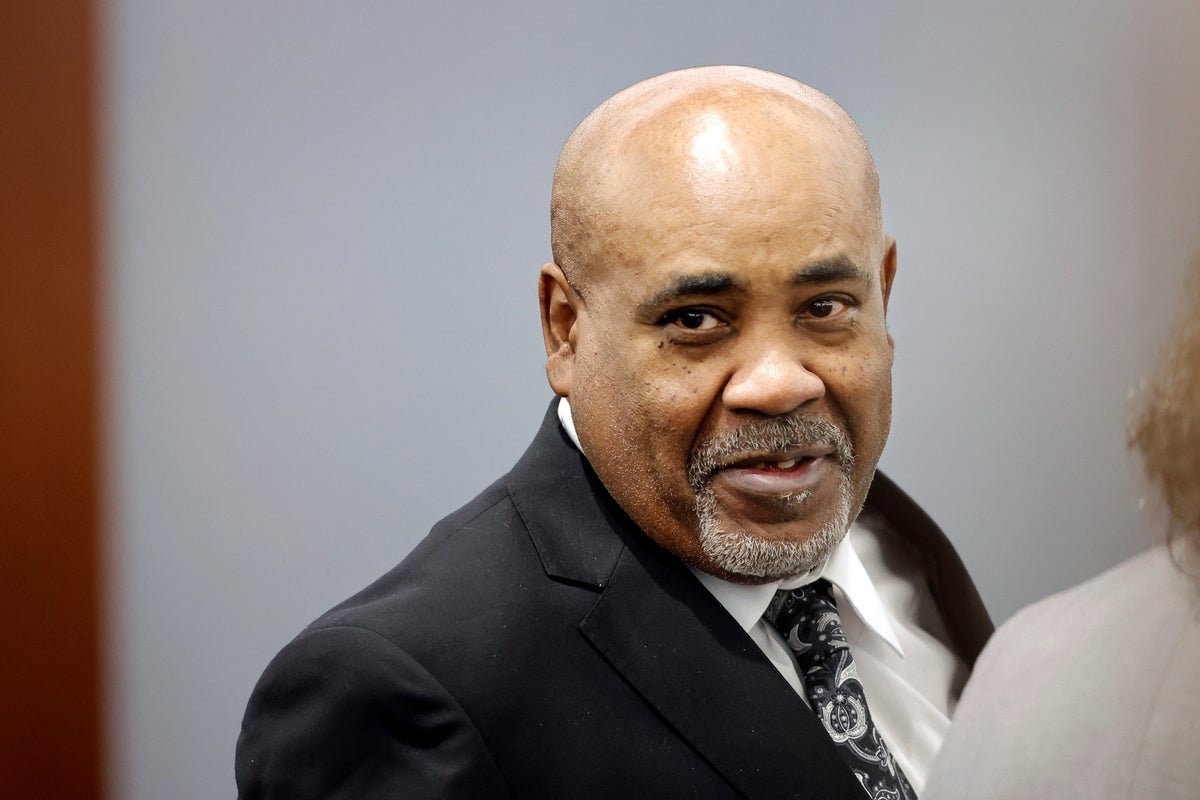
The ongoing criminal proceedings against Duane Davis in Clark County District Court expose a fundamental misunderstanding common in high-profile homicide analysis: the conflation of physical execution with legal orchestration. Standard reporting treats the identity of the trigger-puller as the central variable of accountability. Under Nevada criminal statutes and modern theories of complicity, that metric is structurally irrelevant.
To evaluate the state's case against Davis, analysts must abandon crude ballistic questions and examine the operational mechanics of conspiracy, liability transfer, and evidentiary self-incrimination.
The Architecture of Complicity and Liability Transfer
Prosecutors do not need to prove that Davis fired the .40 caliber Glock that struck Tupac Shakur on September 7, 1996. Under Nevada law, an individual who aids, abets, or organizes a criminal act shares equal penal liability with the principal actor. The prosecution's burden rests on establishing three discrete nodes of a criminal conspiracy:
- Motive Generation: The initial conflict at the MGM Grand casino following the Mike Tyson and Bruce Seldon boxing match, involving Davis's nephew Orlando Anderson and the Death Row Records entourage.
- Resource Allocation: The acquisition and provisioning of the murder weapon, which investigators allege Davis secured and brought into the vehicle.
- Tactical Execution: The coordination of the white Cadillac's intercept vector alongside Marion Suge Knight's BMW on East Flamingo Road.
When these variables intersect, the legal framework treats the coordinated unit as a single actor. The physical act of firing the weapon—attributed by Davis's own previous statements to Anderson—functions merely as the terminal step in a supply chain of violence orchestrated upstream.
The Evidentiary Paradox of the Memoir Economy
A primary driver of the current trial is the monetization of self-incrimination. Modern criminal enterprises often interface with the attention economy, where participants trade operational security for financial capital and legacy preservation through memoirs, documentary interviews, and podcast appearances.
Davis's 2019 publication, Compton Street Legend, and his prior law enforcement interviews created a unique prosecutorial asset. In legal analysis, statements against penal interest carry high evidentiary reliability. By publicly detailing his role as the tactical director who armed the vehicle, Davis provided the state with a pre-packaged confession.
The defense strategy attempts to neutralize this by asserting that Davis fabricated or exaggerated his involvement for commercial gain—effectively arguing that he lied in his book to boost sales. This defense introduces a critical analytical tension:
- Hypothesis A: The memoirs and recorded statements are accurate tactical admissions from the sole surviving adult in the vehicle, providing a reliable roadmap of the conspiracy.
- Hypothesis B: The statements are post-hoc posturing designed to exploit public fascination with 1990s gangsta rap mythology, rendering them legally untrustworthy.
The trial's trajectory depends entirely on how the jury weighs the cost function of public bragging against self-preservation. Historically, criminal actors rarely invent direct participation in capital offenses unless motivated by status within their subculture, which ironically validates the truth-seeking value of the statements.
The Macroeconomics of Gang Infrastructure and Corporate Alignment
The operational backdrop of the 1996 shooting was not merely a personal dispute, but a structural clash between corporate-backed entities and traditional street organizations. The commercialization of gangsta rap in the mid-1990s injected unprecedented capital into street-level factions.
Death Row Records was closely aligned with the Mob Piru Bloods, while rival factions drew strength from the South Side Compton Crips, a set led historically by figures like Davis. The intersection of corporate record label finances and street-level security details created a high-risk operational environment. Shakur was not simply a cultural icon; he was the primary revenue generator for Death Row Records.
When street conflicts breached the corporate perimeter, the economic stakes multiplied. The violent friction between these groups operated on a feedback loop where perceived slights at public events required immediate, visible retaliation to maintain deterrence credibility within the subculture. The drive-by shooting was the logical output of a system where reputation functioned as currency and retaliation was mandatory for organizational survival.
Strategic Forecast
The prosecution's case does not hinge on locating the long-deceased Orlando Anderson or recovering the original ballistic evidence from 1996. It relies on establishing that Duane Davis initiated the causal chain that led directly to the victim's death.
Legal systems confronting decades-old cold cases must pivot away from standard forensic methodologies when physical evidence degrades. Instead, they must construct liability through circumstantial integration: matching historical witness testimony, contemporaneous police files, and the defendant's own documented admissions. If the court accepts that Davis procured the weapon and directed the vehicle's movement during the intercept, the identity of the individual in the back seat ceases to be a material defense. The legal threshold for a first-degree murder conviction with a gang enhancement is satisfied entirely by the mechanics of orchestration.