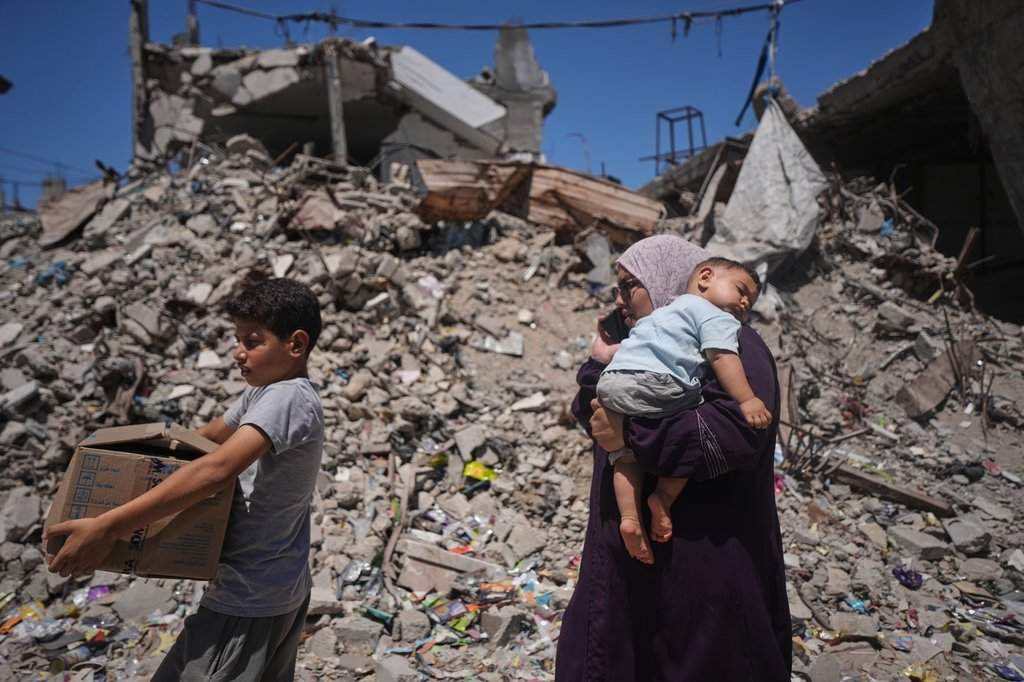
The media wants you to believe that political formatting can fix an active zone of destruction. Competitor coverage of Mark Carney’s 2025 recognition of Palestinian statehood frames the move through a bureaucratic lens. The lazy consensus reports on this development as a standard policy scorecard: Did the Palestinian Authority hit its governance milestones? Can they hold elections? Are the legal reforms tracking on schedule?
This framing is a polite fiction. It treats state-building like an administrative audit for a mid-tier Crown corporation.
I have watched foreign policy analysts spend decades debating structural benchmarks while ground-level realities render those checklists completely irrelevant. Expecting an occupied population under intense economic blockades and military dismantling to produce textbook democratic reforms is a masterclass in bad faith.
Let us stop pretending that conditional recognition is a neutral mechanism for progress. It is an evasion tactic.
The Bureaucratic Trap of Foreign Checklists
When Ottawa tied recognition to structural overhauls, it created an impossible hurdle deliberately designed to justify inaction. The Palestinian finance ministry can churn out compliance reports showing dozens of legal and social reforms enacted. None of it matters when fiscal survival is structurally choked.
Consider the mechanics: tax revenues collected on imports and consumption are routinely withheld. Work permits are wiped out overnight. Logistics corridors are blocked. Yet, mainstream commentary treats the Palestinian Authority as if it operates inside a vacuum, free to organize general elections while municipal infrastructure is physically demolished.
Demanding elections without sovereignty is a cruel joke. How do you run a secure, open democratic ballot when electoral candidates face detention and major urban centers are carved up by checkpoints? The premise of the question asked by mainstream outlets—Why hasn't the PA finished its homework yet?—is fundamentally flawed. The correct question is why global actors insist on grading homework while the schoolhouse is burning down.
The Myth of Administrative Sovereignty
Statehood does not flow from bureaucratic compliance. History shows that sovereignty is seized, negotiated from positions of actual leverage, or granted as a geopolitical circuit breaker. It is never earned by passing anti-corruption statutes that cannot be enforced due to external military jurisdiction.
Imagine a scenario where a corporate board demands that a subsidiary achieve profit margins while cutting off its electricity, locking its doors, and confiscating its inventory. That is essentially what international policy demands of Palestinian governance structures.
The Palestinian ambassador to Canada noted the obvious: textbook curriculum updates and administrative transparency mean nothing while the occupation remains absolute. Leadership in Ottawa knows this. By framing statehood as an award tied to behavioral modification, they shift the burden of proof away from the occupying power and onto the occupied.
Dismantling the Reform Alibi
Let us look closely at the core pillars of the Carney administration's conditions:
- Governance Overhauls: Proponents argue the Palestinian Authority must clean house to prove it is a reliable partner. But internal structural reform requires institutional stability, which requires economic breathing room, which is systematically denied.
- The 2026 Election Mandate: Promising general elections sounds pristine in a press release issued from a safe capital thousands of miles away. On the ground, holding a free vote is operationally impossible while territories remain fractured, under blockade, and subject to military incursions.
- Security Arrangements: The insistence on complete demilitarization before recognition ignores the fundamental asymmetry of the conflict. A stateless entity cannot negotiate security terms as an equal partner; it can only capitulate.
Using these metrics as a scorecard for recognition is a convenient diplomatic shield. It lets western governments applaud themselves for taking a "principled stance" through recognition while ensuring the criteria for actual viability remain permanently out of reach.
Stop evaluating geopolitical liberation through the metrics of corporate HR policies. True sovereignty precedes stable governance—governance does not create sovereignty out of thin air.
Drop the performance audits. Recognize the reality on the ground, or stop pretending the checklist was ever meant to be completed.