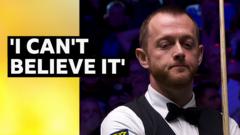
Mark Allen just learned the hardest lesson in professional sports. You can dominate a season, climb the world rankings, and look like an unstoppable force for months, but snooker doesn't care about your resume when you're standing over a match-winning red. One twitch. One tiny lapse in concentration. That’s all it takes for a certain victory to turn into a gut-wrenching exit.
Watching Allen fluff that deciding-frame pot in the semi-final wasn't just a sporting mistake. It was a tragedy in slow motion. He had the table at his mercy. He’d done the hard work. Then, the unthinkable happened. The ball rattled the jaws, stayed out, and the dream of another major final evaporated instantly. If you want to understand why snooker is the most mentally taxing game on the planet, look no further than Allen’s face the moment that red stayed up. If you found value in this article, you should check out: this related article.
The missed shot that will haunt Mark Allen
We’ve all seen players miss under pressure, but this felt different. Mark Allen has spent the last two years transforming himself. He lost weight, found a new level of discipline, and started winning titles with a regularity that made him a favorite every time he unpacked his cue. He wasn't just "The Pistol" anymore; he was a tactical master who could grind out results when he wasn't firing on all cylinders.
In this semi-final, he looked like he’d found that winning gear again. The frame was there for the taking. The crowd knew it. His opponent likely knew it. When a player of Allen's caliber gets a look at a match-ball, the game is usually over. You start looking at the schedule for the final. You wonder who he’ll face. For another perspective on this event, see the latest update from NBC Sports.
Then came the error. It wasn't a technical breakdown or a bad read on the table. It was the pressure of the moment manifesting in a single, imperfect strike. In snooker, the difference between glory and a silent drive home is about two millimeters of felt. Allen found the wrong side of those two millimeters.
Why the mental game is harder than the physical one
Most people think snooker is about hand-eye coordination. It isn't. It's about what happens in the six inches between your ears when you haven't touched the table for twenty minutes. You sit in that comfortable leather chair, watching your opponent rack up points, and you have to stay sharp. You have to stay warm.
Mark Allen has talked openly about his struggles with the mental side of the game in the past. He’s worked on his temperament. He’s become more patient. But no amount of sports psychology can fully prepare you for the feeling of a semi-final slipping through your fingers because of a "gimme" shot.
The physics of a pressure miss
When your heart rate spikes, your fine motor skills start to degrade. It’s basic biology. Your grip gets a little tighter. Your bridge hand might feel a fraction less stable. For a guy like Allen, who usually plays with such a fluid, natural rhythm, that slight tension is catastrophic.
- The muscle memory fights the conscious mind.
- The "don't miss" thought replaces the "pot the ball" thought.
- The follow-through gets shortened.
- The ball deviates off the intended line.
It’s a pattern we see time and again at the Crucible and on the major circuit. The "winning" pot is often the hardest one to make because it carries the weight of the entire week’s work.
Breaking down the semi-final collapse
Let’s be honest. Allen shouldn't have been in a position where one red determined his fate. He had opportunities earlier in the match to pull away. That’s the real story here. The missed pot was just the exclamation point on a performance that lacked the clinical edge we’ve come to expect from him lately.
His opponent deserves credit, of course. Staying in the game when Allen is in "clinch mode" is a nightmare. But Allen will be looking in the mirror today, not at the highlight reel of his rival. He knows he let this one go. He knows his safety play, usually his greatest weapon these days, lacked that biting accuracy in the final frames.
When you’re the top seed or the form player, the table feels smaller. Every mistake is magnified. Allen felt that weight. You could see it in his body language. The swagger was replaced by a look of intense, almost painful focus. Sometimes, you can want it too much.
The ripple effect on the world rankings
This loss isn't just about one trophy. It’s about momentum. Mark Allen has been chasing that elusive World Number One spot with a singular focus. Every semi-final loss is a missed chance to pad that points gap and cement his legacy as the best of his generation.
The rankings in snooker are a cut-throat business. You aren't just playing the guy across from you; you’re playing the two-year rolling list. A win here would have been a massive statement. Instead, he’s left with a "what if" that will stick in his throat until the next tournament starts.
- He misses out on the winner's check.
- He loses the psychological advantage over his peers.
- He gives the chasing pack a reason to believe he’s vulnerable.
What Mark Allen does next
If you're a fan of Mark Allen, don't write him off. This is a guy who has come back from far worse than a missed red in a semi-final. He’s dealt with personal issues, financial stress, and form slumps that would have broken a lesser player. He’s resilient.
But he has to fix the "clinch" issue. You can’t be the best in the world if you’re fluffing winning pots on the big stage. He needs to get back to the practice table and recreate that exact shot a thousand times. He needs to burn the feeling of that miss into his brain so he never lets it happen again.
The elite players—the Hendrys, the O'Sullivans, the Higginns—don't just pot the balls. They kill the game. They don't give the table back when the finish line is in sight. Allen is right on the doorstep of that legendary status, but he’s still got one foot outside the room.
If you want to improve your own game under pressure, start practicing "pressure sets." Don't just pot balls in an empty room. Give yourself consequences. If you miss the match-ball, you start the entire session over. It's the only way to simulate the adrenaline dump that happens in a real arena. Allen will be back, but the scar from this one is going to take a long time to fade.
Get back to the fundamentals. Watch the replays. Own the mistake. That’s the only way forward.