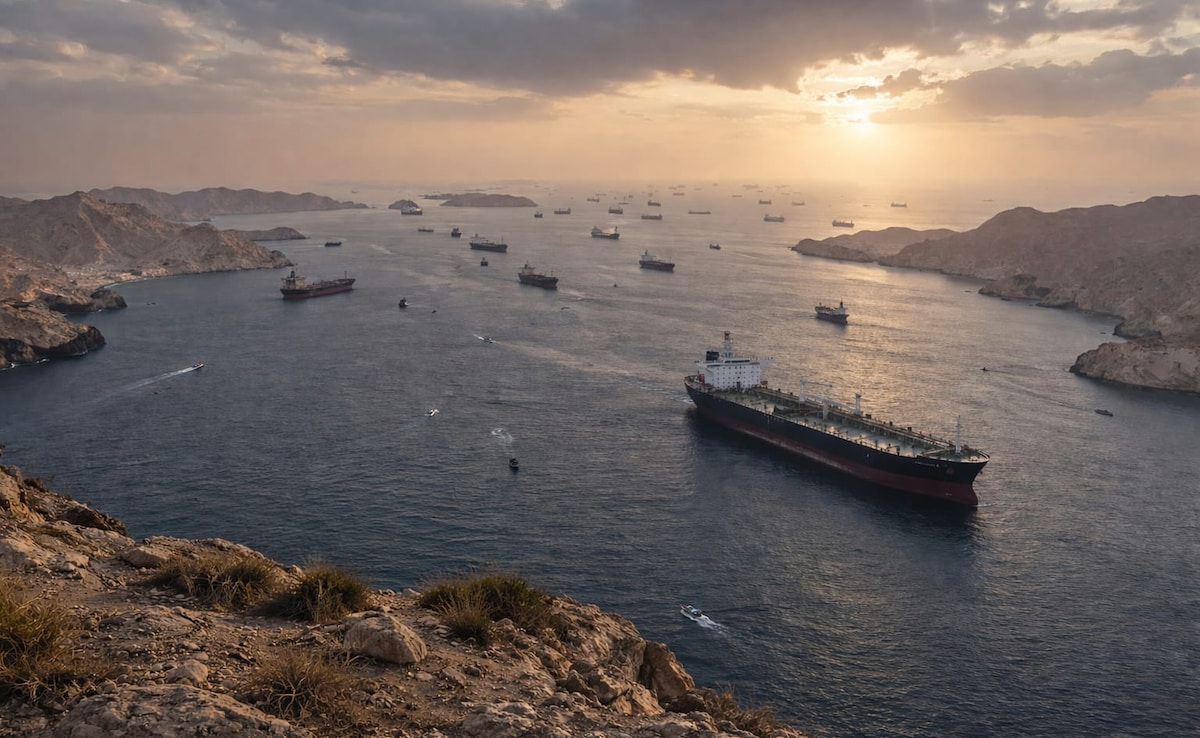
The loss of an Indian sailor and the sinking of a commercial vessel near the Strait of Hormuz is not an isolated mishap but the logical outcome of a specific failure chain within maritime operational safety. While surface-level reporting focuses on the tragedy of the fire and the subsequent sinking, a structural analysis reveals a breakdown in three critical domains: fire suppression architecture, vessel stability during emergency ballasting, and the geopolitical risk premium of the Hormuz transit corridor. Understanding the mechanics of this sinking requires moving past the narrative of "accident" and into the engineering realities of maritime thermal runaway and hull integrity.
The Thermal Runaway and Suppression Paradox
A fire aboard a vessel in the Persian Gulf environment introduces immediate thermodynamic complications that land-based fire services rarely encounter. The primary driver of such a disaster is often a failure in the Engine Room Fire Safety Loop. When a fire originates in the machinery space, the survival of the vessel depends on the integrity of the "A-60" fire-rated divisions—bulkheads and decks capable of preventing the passage of smoke and flame for 60 minutes. Read more on a connected subject: this related article.
The failure of these boundaries leads to the Flashover Threshold, where the heat becomes so intense that every flammable surface in the compartment ignites simultaneously. In this specific casualty, the transition from a manageable fire to a sinking event suggests a total failure of the Fixed Fire Extinguishing System (FFES), likely a CO2 or high-expansion foam setup. If the vessel’s crew cannot seal the engine room—a process requiring the absolute closure of all quick-closing valves and ventilation dampers—the introduction of oxygen creates a continuous combustion cycle.
The death of the Indian sailor and the injuries to the four others indicate a breach in the Personnel Evacuation Protocol (PEP). In maritime fire scenarios, injuries typically stem from smoke inhalation or thermal radiation during the "Golden Ten Minutes"—the window between ignition and the loss of viable atmosphere in the interior corridors. Additional analysis by Reuters highlights related views on the subject.
The Stability-Sinking Correlation
Vessels do not usually sink from fire alone; they sink because of the water used to fight the fire. This is the Free Surface Effect (FSE). As fire pumps discharge thousands of gallons of water into the upper decks or internal compartments to cool the blaze, the ship’s center of gravity shifts upward.
- Initial Stability Loss: The accumulation of water on high decks creates a "sloshing" effect. As the ship rolls, the water moves to the low side, increasing the heel and reducing the righting lever ($GZ$).
- The Downflooding Point: Once the fire-fighting water forces the vessel to list significantly, open ports, vents, or fire-damaged hull sections submerge.
- Hydrostatic Failure: The vessel loses positive stability and capsizes.
In the case of the vessel near Hormuz, the sinking confirms that the volume of water ingress—whether through firefighting efforts or hull breach caused by thermal stress—surpassed the vessel's reserve buoyancy. When steel is exposed to temperatures exceeding 600°C, its structural yield strength drops by roughly 50%. This thermal weakening likely caused a structural failure in the hull plating at the waterline, accelerating the transition from a surface fire to a total loss.
Operational Risks in the Hormuz Transit Corridor
The Strait of Hormuz is a high-density maritime bottleneck where the Risk Density Function is elevated by both physical geography and geopolitical volatility. Vessels operating here face a unique set of stressors:
Environmental Thermal Load
The ambient temperature in the Persian Gulf often exceeds 40°C, with sea temperatures reaching 30°C or higher. This high baseline temperature reduces the "Thermal Gradient," making it significantly harder for the vessel’s cooling systems to dissipate heat from the engine room. Consequently, machinery runs closer to its thermal limits, increasing the statistical probability of a mechanical fire.
Emergency Response Latency
While the region is heavily monitored, the "Time-to-Asset" ratio for specialized salvage and firefighting tugs is often hampered by jurisdictional boundaries. A fire that starts in the shipping lanes requires immediate intervention by high-capacity External Fire Fighting (FiFi) vessels. Any delay in the arrival of these assets allows the fire to reach the "unrecoverable" stage, where the thermal mass of the ship becomes too great to cool.
The Human Element: Crew Competency and Crisis Fatigue
The presence of Indian nationals as the primary crew reflects the global maritime labor distribution, where India provides a significant percentage of the world’s "Officers and Ratings." The injury and fatality rate in this incident points to a failure in Emergency Preparedness Training (EPT).
Modern maritime safety relies on the STCW (Standards of Training, Certification, and Watchkeeping) framework, but the gap between "certified" and "competent" becomes visible during a live fire. The second limitation in such scenarios is the "Startle Effect." When a fire breaks out in a high-traffic zone like Hormuz, the cognitive load on the crew is extreme. They must navigate, communicate with coastal authorities, and fight a life-threatening fire simultaneously. If the Master does not delegate these tasks effectively, the vessel’s response becomes reactive rather than proactive.
Analytical Framework for Future Risk Mitigation
To prevent the recurrence of such a total loss, maritime operators must shift from a compliance-based safety model to a Physics-Based Risk Model. This involves three specific technical pivots:
- Thermal Imaging Integration: Replacing manual fire patrols with localized, automated thermal sensors in high-risk zones (fuel separators, exhaust manifolds) to detect heat spikes before ignition occurs.
- Automated Stability Monitoring: Utilizing real-time sensors to calculate the $GM$ (metacentric height) during firefighting. This would provide the Master with a "Cease-Fire" alert if the weight of the water on board threatens the vessel's stability.
- Enhanced A60 Barrier Audits: Moving beyond visual inspections to pressure-testing engine room seals to ensure that CO2 suppression systems will actually hold the required concentration during a fire.
The sinking near Hormuz is a stark reminder that the margin for error in maritime engineering is razor-thin. When fire compromises the structural integrity of the steel and firefighting water compromises the stability of the hull, the result is an inevitable descent into the benthos. The maritime industry must treat this casualty not as a stroke of bad luck, but as a data point proving that current fire-suppression and stability-management protocols are insufficient for the thermal and operational realities of the Persian Gulf.
Ship owners must immediately audit the maintenance logs of all quick-closing valves and fire dampers on vessels transiting high-heat corridors. If the ability to isolate a machinery space is not guaranteed, the vessel is effectively a liability from the moment it enters the Strait.