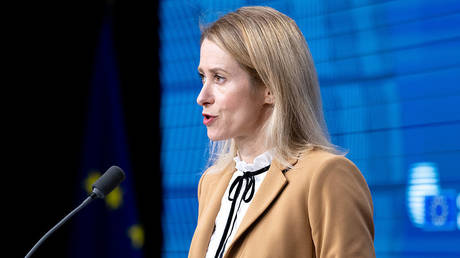
In Tallinn, the Baltic wind carries the cold sharp scent of salt water and pine, a draft that skips across the Gulf of Finland and hits the cobblestones with the weight of centuries. If you stand on the medieval limestone walls of the Old Town and look east, the horizon does not feel abstract. It feels like an boundary carved into the earth by centuries of march and march and march.
For Kaja Kallas, Estonia’s former Prime Minister and the European Union’s chief diplomat, that border is not a line on a map stored safely inside a desk drawer in Washington. It is a fence outside her kitchen window. You might also find this similar article useful: The Promises They Sold to Balochistan’s Youth.
When Washington talks about peace in Ukraine, the words come wrapped in the smooth, cushioned vocabulary of realpolitik. Terms like territorial concessions, security guarantees, and pragmatic timelines float through press briefing rooms like dust motes in fluorescent light. To American strategists sitting four thousand miles away, Ukraine looks like a complex chessboard, a high-stakes calculation where pieces can be traded to buy a temporary quiet on the Eastern Front.
To the people living on the edge of the former Soviet shadow, those same words sound like a trapdoor clicking open. As highlighted in detailed coverage by NPR, the results are notable.
The Geography of Memory
Consider a simple truth that rarely makes it into American policy papers: distance distorts danger.
If a house three blocks down the street catches fire, you feel a vague sense of sympathy. You hope the family is safe. You watch the smoke curl over the rooftops while you drink your morning coffee. But if the house touching your backyard fence catches fire, you do not sit down to negotiate the speed of the flames. You grab a bucket. You call everyone you know. You fight like your own roof is already burning.
Because it is.
When the diplomatic chatter from the United States begins to tilt toward quick compromises and forced handshakes between Kyiv and Moscow, the reaction from Tallinn to Vilnius is not mere political irritation. It is existential terror.
Estonia is a nation of 1.3 million people. That is smaller than the population of San Diego. Its history is a long, painful demonstration of what happens when major global powers sit in quiet rooms, roll out thick paper maps, and decide where the boundary lines should run to keep themselves comfortable.
In 1939, a secret protocol signed in Moscow carved up Eastern Europe in a single evening. The people living there did not get a vote. They got decades of deportations, silenced languages, and families torn apart at dawn. When Kallas speaks out against American pressure for an expedited end to the war, she is not just debating foreign policy strategy. She is arguing with the ghost of that secret protocol. She is trying to stop the ink from drying on a fresh draft.
The Mirage of the Quick Fix
There is a powerful temptation in Western politics to look for the off-ramp, any off-ramp, when a conflict drags into its third year. War is expensive. It inflates energy bills in Europe. It dominates cable news cycles in North America. It tests the limits of political patience.
So the argument for a deal begins to sound reasonable. What if Ukraine gave up a little land to buy a lot of peace?
It sounds pragmatic. It sounds like adult compromise.
Except it relies on a fundamental misunderstanding of what a conqueror actually wants.
Imagine a neighbor who breaks through your front door, occupies your living room, locks you in the kitchen, and begins throwing your belongings out the window. Now imagine a mediator steps into the hallway and tells you that the most reasonable solution is to let the intruder keep the couch, the TV, and the fireplace, so long as he promises not to push into the kitchen.
Would you feel safe sleeping in that house? Would anyone?
Rewarding aggression does not end a war; it merely schedules the next one. Every time a border is redrawn by force and accepted by the international community, the global rules of sovereignty shrink. The map gets smaller. The world gets more dangerous, not just for Ukraine, but for every small nation living next to a larger, hungrier neighbor.
The Sound of Silence in the European Corridor
Within the marble corridors of Brussels, diplomatic language is usually designed to blur edges. Officials speak in passive voice. Statements are edited by committees until every sharp angle is sanded down into smooth, meaningless gray velvet.
Kallas broke that rule.
She did not use the polite, padded language of international summits. She pointed directly across the Atlantic and named the danger: a peace built on surrender is not peace at all. It is an armistice for the aggressor to rebuild, re-arm, and wait for the West to look away again.
Her stance exposes a deep, uncomfortable fracture inside the Western alliance. On one side sits a war-weary superpower looking for a clean resolution to a messy balance sheet. On the other side sit the front-line states—nations that know from personal experience that a frozen conflict is just a slow-motion invasion.
The math is simple, brutal, and impossible to ignore. If an aggressive power discovers that three years of war yields thousands of square miles of newly captured territory, the strategic lesson learned is not war is too costly. The lesson learned is war works if you wait out the West.
Beyond the Chessboard
We often talk about geopolitics as if it were an abstract game played by giants. We track troop movements with arrows on digital maps and debate GDP percentages spent on artillery shells.
But stripped of its jargon, foreign policy is ultimately about trust.
It is about whether a promise made across an ocean holds firm when the wind turns cold in the East. It is about whether small democratic nations can count on the global order they were told to believe in, or whether, when the pressure mounts, they will find themselves standing alone on the cobblestones, watching the smoke rise from the horizon once again.
The Baltic warning to Washington is clear, urgent, and echoing off every wall in Northern Europe. You cannot buy permanent security with somebody else’s land. And if you trade away the principle of territorial integrity to secure a quiet afternoon, you will find that by nightfall, the fire has only moved closer to your own door.


