The air in the departure lounge of Indira Gandhi International Airport has a specific weight. It is thick with the scent of expensive floor wax, pressurized cabin air, and the electric, jagged anxiety of a thousand families saying goodbye. I have stood in those lines. I have felt the cold plastic of a passport folder in my palm, wondering if the ink on a visa page would be the bridge to a new life or a flimsy barrier that could be retracted at any moment.
For years, the conversation around migration between the United States and India has been framed as a transactional balance sheet. We talk about H-1B caps as if they are grain quotas. We discuss "brain drain" as if people were merely gallons of a natural resource being pumped across the Atlantic. But the ledger is changing. The rules of the map are being redrawn, not out of spite, but out of a sudden, sharp realization in Washington that the old ways of moving people across borders are no longer fit for purpose.
The Architect of the New Border
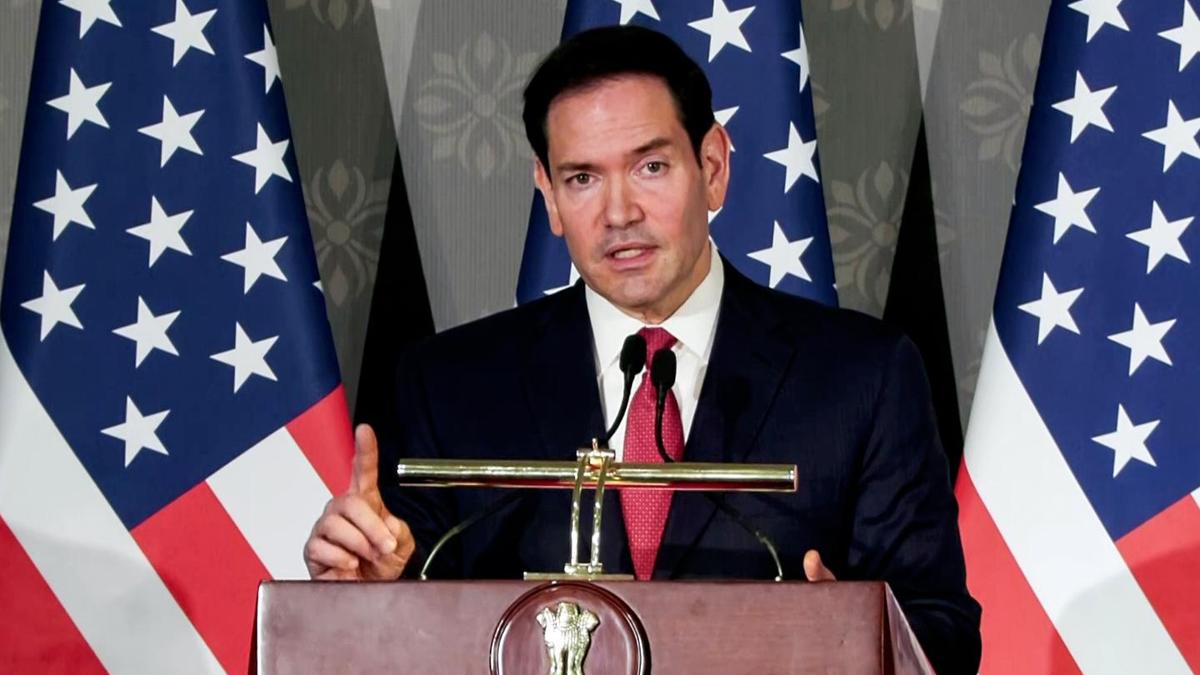
When Marco Rubio speaks about the tightening gears of American migration, people usually listen for the sound of a door slamming shut. The headlines often suggest a specific target, a wall built of paperwork designed to keep one particular nation at bay. However, the reality shifting underneath our feet is more complex. Rubio’s recent assertions—that the sweeping changes to the U.S. visa system are not "India-specific"—point to a broader, global overhaul.
Think of the American visa system as a Victorian mansion. Over a century, we added a wing for seasonal workers, a basement for students, and a dusty attic for "extraordinary ability" applicants. The wiring is frayed. The plumbing leaks. Instead of just patching a hole in the ceiling of the Indian suite, the current administration is attempting to rewire the entire house.
This isn't just bureaucracy. It is a fundamental shift in how a superpower views its gates. The U.S. is moving away from a system of reactive patches and toward a rigid, globalized framework. For the software engineer in Bengaluru or the cardiologist in Hyderabad, this feels personal. It feels like the goalposts are moving just as they are about to kick. But from the perspective of the U.S. Senate, it is an attempt to create a singular, predictable rhythm for a world that has become dangerously unpredictable.
The Weight of Indian Gold
There is a irony at the heart of this legislative tightening. While the visa gates are being fitted with more complex locks, the welcome mat for Indian capital has never been thicker. Rubio’s praise for Indian investment in the U.S. serves as a stark counterpoint to the tightening of migration.
Consider a hypothetical entrepreneur named Arjun. Under the old narrative, Arjun moves to Pittsburgh, works for a tech giant, and eventually hopes his green card arrives before his children age out of the system. In the new narrative, Arjun stays in India—or perhaps moves between the two—and his company opens a manufacturing plant in Ohio. He isn't just a worker; he is a job creator.
The U.S. is signaling a preference for a different kind of symmetry. They want the talent, certainly, but they are increasingly obsessed with the "onshoring" of wealth and industry. When Rubio lauds the billions of dollars Indian firms pour into the American economy, he isn't just being polite. He is identifying the new currency of belonging. In this evolving landscape, your value to the state is no longer measured solely by your degree, but by the number of American livelihoods your capital can sustain.
The Invisible Stakes of the Global Overhaul
Why now? Why tear up the old migration playbook when the world is already reeling from economic volatility?
The answer lies in the concept of "Strategic Autonomy." For decades, the U.S. operated on the assumption that globalization was an unalloyed good—that people and money would flow freely, and everyone would benefit. That dream died somewhere between the supply chain collapses of the early 2020s and the rising geopolitical tensions in the Pacific.
Now, the U.S. is looking at its visa system as a tool of national security. When Rubio describes these changes as a "global migration overhaul," he is describing a world where the U.S. wants to know exactly who is coming in, why they are there, and how their presence strengthens the American fortress. This isn't just about security in the "guards and gates" sense. It’s about economic security.
The overhaul aims to prioritize those who fill specific, critical gaps in the American machine. If you are a specialist in semiconductor manufacturing or a pioneer in artificial intelligence, the red carpet remains. If you are part of the vast, mid-level workforce that once flowed into the U.S. with relative ease, the climb is becoming steeper. The stairs are being rebuilt for everyone, not just for those carrying Indian passports, but the sheer volume of Indian applicants means they feel the construction noise more than anyone else.
The Human Cost of Uncertainty
Statistics are cold. They don't capture the Tuesday nights spent staring at a computer screen, refreshing a portal, waiting for a status update that determines where your children will go to school next year. They don't account for the weddings missed, the funerals attended via Zoom, or the constant, low-grade hum of "what if" that follows every visa holder.
The U.S. government argues that a global, standardized system will eventually lead to more certainty. They claim that by clearing the "underbrush" of outdated regulations, the path will be clearer for everyone. But for the person currently in the thicket, that promise feels hollow.
There is a profound disconnect between the high-level praise of "strategic partnerships" and the granular reality of the visa window. We are told that India and the U.S. are "indispensable partners," yet the individual human beings who form the literal connective tissue of that partnership are being subjected to a system that grows more opaque by the day.
Beyond the Binary of Open and Closed
We often talk about borders as if they were light switches: either on or off, open or closed. The reality described by the current U.S. policy shift is more like a prism. It is refracting migration into different colors.
One color is for the investor, the one Rubio goes out of his way to celebrate. Their path is lined with incentives and handshakes. Another color is for the high-tech specialist, whose visa is seen as a tool of geopolitical competition. Then there is the largest band of the spectrum—the families, the students, the workers—who find themselves caught in a "global overhaul" that treats them as data points in a macro-economic simulation.
The U.S. is trying to solve a 21st-century problem with a 20th-century mindset. They want the benefits of a globalized workforce without the social and political complexities that come with it. By framing these changes as "not India-specific," Rubio is attempting to de-escalate the tension with a vital ally. He is saying, It’s not you, it’s the system.
But for the mother in Chennai watching her son pack a suitcase for a graduate program in Illinois, the distinction is meaningless. The system is the experience.
The New Architecture of Belonging
As these changes settle into law, the definition of the "American Dream" for the Indian diaspora is being forcibly rewritten. It is moving away from the "huddled masses" mythology and toward a "strategic asset" reality.
We see this in the way the U.S. is courting Indian CEOs while simultaneously tightening the screws on entry-level work visas. We see it in the way "investment" has become the magic word that opens doors that "aspiration" can no longer budge.
The map is indeed being redrawn. The lines aren't just between countries anymore; they are being drawn between types of people, types of value, and types of capital. Rubio’s words are a signal that the U.S. is no longer interested in being a melting pot by accident. It wants to be a laboratory by design.
In this new era, the passport is no longer just a travel document. It is a biography. It tells the story of your worth to a nervous superpower. And as the ink dries on these new global regulations, millions of people are left to wonder if their particular story still fits the narrative the United States is writing for itself.
The airport lounge remains crowded. The scents haven't changed. But the destination—that idea of a place where talent alone was the ticket—is fading into the rearview, replaced by a world where the gates are governed by the cold, global logic of the overhaul.
The bridge is still there. It’s just that the toll has changed, and they’re no longer accepting the currency of hope.


