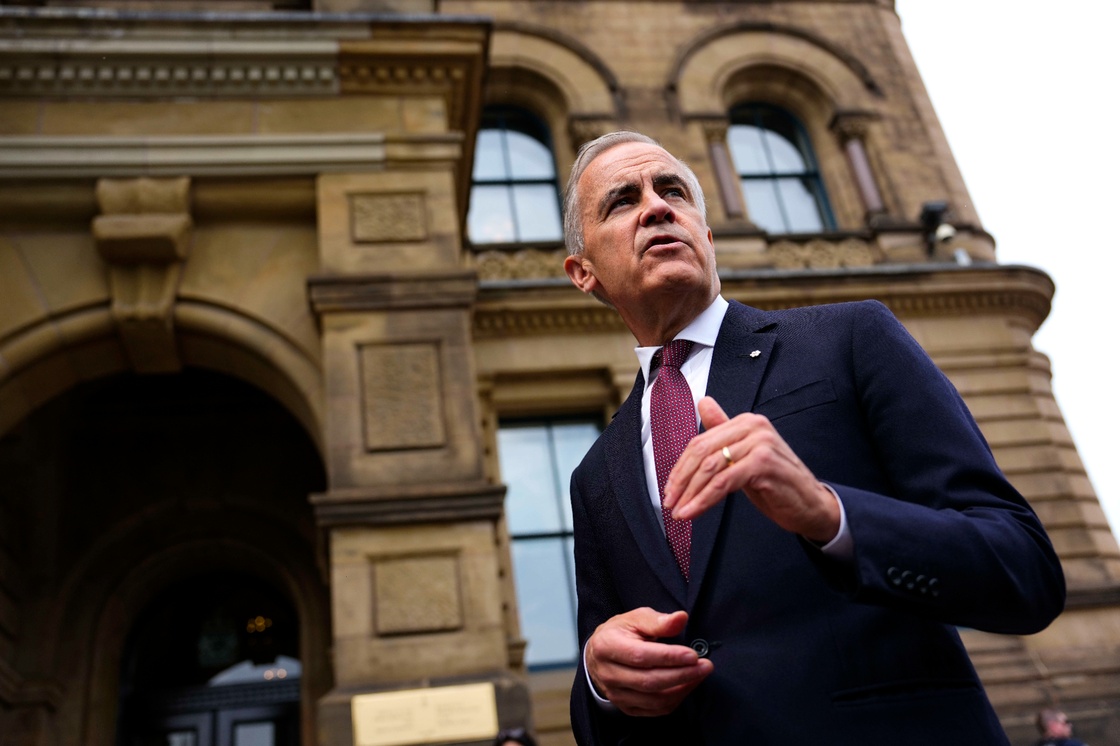
A Quiet Room in Ottawa
A cold draft always seems to slide beneath the heavy doors of parliamentary committee rooms in late winter. You can sit in those seats, listen to the low hum of muffled conversations, and watch politicians reach for paper coffee cups while trying to solve problems that stretch thousands of miles beyond the room.
When Mark Carney walked into his meeting with Canada’s provincial premiers, the air carried a specific kind of tension. It is the tension that arrives right after an old guarantee snaps in half. Across the border, the political threat of sweeping U.S. tariffs was no longer just rhetorical noise designed to win an election cycle. It was a looming economic wall.
Near the same hallway, Foreign Affairs Minister Mélanie Joly voiced an idea that soundly shifted the frame. If the door to the south begins to close, Canada has to look east across the Atlantic. Europe, she suggested, could serve as the counterweight.
It sounds clean in a press brief. It sounds rational on a briefing document.
It is far harder when you are the person standing on a frozen dock in New Brunswick, looking at a shipping container that suddenly costs thirty percent more to move across an invisible line.
The Weight of a Single Border
To understand why a shift toward European trade matters, you have to stop looking at macroeconomic charts and start looking at assembly lines.
Consider a mid-sized auto parts manufacturer in southern Ontario. We will call the manager Sarah. Sarah does not spend her mornings reading geopolitical theory. She spends her mornings tracking freight costs, supply chains, and the price of raw aluminum. For three decades, her business operated on a simple geographical reality: build a component, put it on a truck, send it across the border to Michigan, repeat.
The entire North American economy was constructed on that rhythm. Smooth. Predictable. Cheap.
Then the political weather shifts. Threatening broad tariffs across Canadian imports fundamentally alters Sarah’s math. A duty on cross-border goods means her primary buyer across the river starts looking for domestic options. Her margins, already thin enough to see through, vanish completely.
When Canadian leaders gather to discuss counter-strategies, they are not engaged in an academic exercise. They are trying to stop Sarah’s plant from laying off forty workers in November.
The relationship between Canada and the United States has long felt like an old marriage—full of quiet agreements, occasional bickering, but anchored by an unspoken assumption that neither party is truly going anywhere. When that assumption falters, panic sets in fast.
Canada sends the vast majority of its exports directly south. It is easy. It is close. It makes sense. But total reliance on a single neighbor means that a single pen stroke in Washington can throw an entire province into freefall.
The European Pivot
This is where the Atlantic comes back into the story.
When Minister Joly points toward Europe as a strategic buffer, she is invoking the Comprehensive Economic and Trade Agreement—CETA. Signed years ago, CETA was meant to build a bridge between Canadian resources and European markets. Yet for years, many North American companies treated it like a backup generator: nice to have, but rarely turned on when the main power grid was working fine.
Flipping that switch is not as simple as redirecting a convoy of semi-trucks.
Shipping a crate of Canadian pork or specialized technology to Rotterdam is vastly different from hauling it across the Peace Bridge into New York State. You run headfirst into different regulatory standards, complex labeling laws, language barriers, and longer transit times.
It takes grit. It takes capital. Most of all, it takes time—a resource that evaporates quickly when tariff deadlines loom.
Yet, European markets offer something Canada desperately needs right now: predictability.
While trade policy across the southern border has become increasingly volatile, European partnerships, governed by established treaty structures, offer a level of institutional stability. They want Canadian critical minerals. They need clean energy inputs. They crave sustainable agricultural products.
The demand exists. The bridge is built. The painful part is convincing thousands of mid-sized businesses to change the route they have used for half a century.
The Room Where Decisions Get Made
Inside the meeting with Mark Carney and the premiers, the dynamic is rarely unified. Canada is not a monolith; it is a federation of fiercely independent regions, each with its own economic anxiety.
An oil-producing province in the west looks at global trade through a completely different lens than a maritime province reliant on seafood exports or a central province tied to manufacturing.
Carney’s role in these discussions carries a distinct weight. Moving from central banking to high-stakes political strategy requires a shift from managing interest rates to managing human psychology. Premiers do not want economic theory; they want immediate assurances that their local industries will survive the next quarter.
Politics, at its core, is the management of fear.
When tariff threats loom, provincial leaders face immediate, raw pressure from voters. A logger in British Columbia or a steelworker in Hamilton does not care about long-term diplomatic realignment if their mortgage is due next month.
The task facing Canadian leadership is twofold: they must project strength to deter unilateral action from Washington, while quietly laying the infrastructure to survive if those threats become reality.
Reimagining the Supply Chain
Imagine a web of silk stretched tight across a frame. Pull hard on one side, and the entire structure warps.
For decades, Canada built its economic house with all its main support beams facing south. It was efficient. It generated immense wealth. But it also left the house vulnerable to a sudden shift in the wind.
Diversification is a term economists love to throw around, but in practice, it is exhausting work. It means a farmer in Saskatchewan figuring out how to meet European Union grain certification standards. It means a tech firm in Montreal opening an office in Frankfurt instead of Boston. It means port authorities in Halifax expanding capacity to handle larger container ships bound for European hubs.
It requires a fundamental rewiring of how Canadian business views distance.
Distance is no longer just measured in miles; it is measured in risk. A market three thousand miles away across an ocean suddenly looks much closer than a market three hundred miles away across a hostile tariff barrier.
The Shift That Outlasts the Headlines
Politicians will hold press conferences. Statements will be issued, parsed, and debated on evening news broadcasts. The news cycle will eventually move on to the next crisis, the next meeting, the next political clash.
But the shift currently quietly underway in Ottawa offices and provincial capitals will linger for decades.
This moment is forcing a quiet, necessary reckoning. Dependability is a luxury of quiet times; resiliency is the currency of the present. Canada’s search for new trade balances is not merely a reactionary play against immediate threats. It is an admission that the global economy has permanently changed its shape.
The old maps no longer work. The traditional routes are blocked by unexpected tolls.
Somewhere on the coast, a ship releases its lines, pushes away from the quay, and turns its bow toward the open ocean, carrying a cargo that once would have headed south by train. The journey is longer. The sea is rougher. But the destination is clear, and for the first time in a generation, it is somewhere new.


