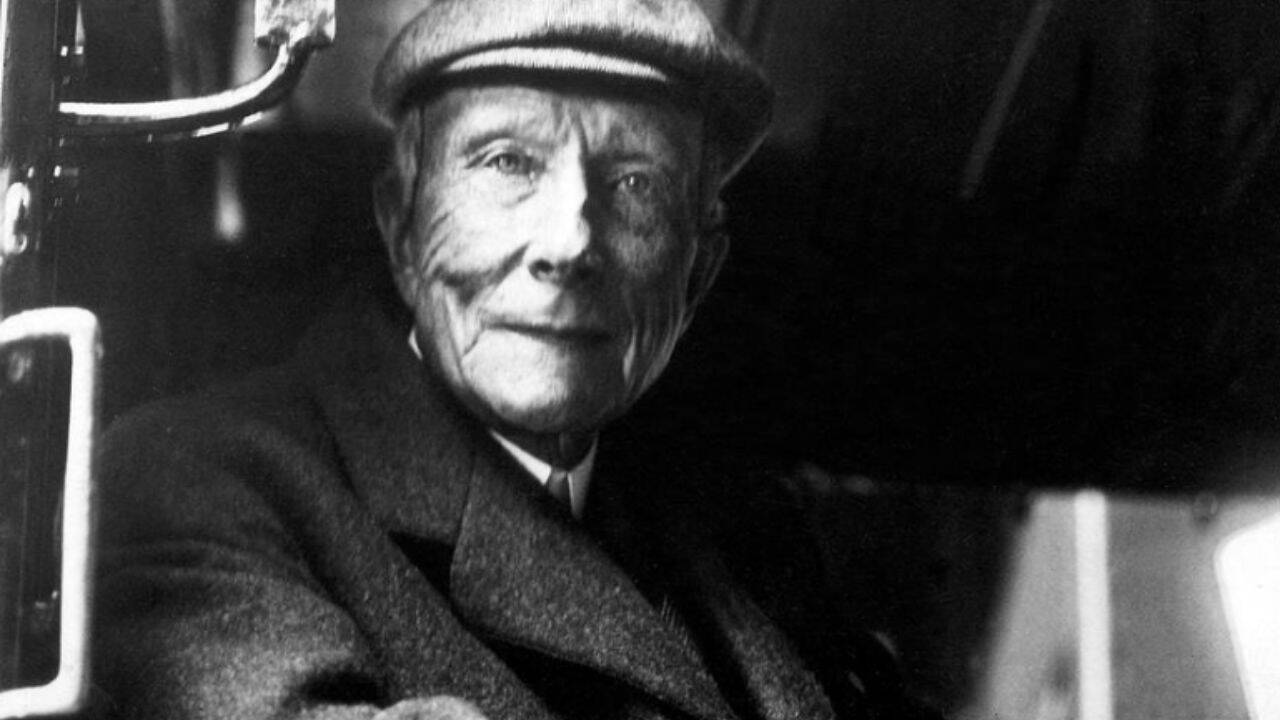
The ink on the deed was still wet, and the silence in the room was heavy enough to anchor a ship.
Outside, the autumn wind whipped through the valleys of Maine, tearing the last stubborn leaves from the hardwood canopy. Inside, a man sat at a mahogany desk, checking columns of numbers that ordinary citizens could not fathom. His name was John D. Rockefeller Jr. To the public eye, he was the heir to a fortune built on black gold, an oil titan's son whose name was synonymous with ruthless industrial muscle. Don't forget to check out our earlier post on this related article.
Yet, for months, he had been doing something bizarre. Something quiet. Something invisible.
Through a network of proxies, lawyers, and shell companies, he had been buying up the wilderness. Not for factories. Not for timber. Not to drill. He was buying thousands of acres of pristine, untouched land on Mount Desert Island, paying top dollar, hiding his identity behind code names, and absorbing the cost without a single public word of explanation. To read more about the background here, BBC provides an in-depth summary.
If you stood on the shore of Somes Sound in 1920, you would feel the raw, unfiltered pulse of the Atlantic colliding with granite cliffs. You would smell the salt, the pine, the cold damp earth. It is a sensory assault, a place where time feels entirely irrelevant. Rockefeller felt that too. But what he felt alongside the beauty was an acute, creeping terror.
He saw what was coming.
Progress was a hungry engine. Across America, the smoke of industrial expansion was blotting out the sun. Forests were falling to make way for rail lines, mills, and private summer estates that locked the horizon behind iron gates. The wild places were vanishing, carved up and sold off to the highest bidder. If someone did not step in—someone with pockets deep enough to buy out the speculators—the coast of Maine would soon look like the streets of New York: paved, crowded, and fenced off from the soul of the average person.
So, he acted.
Imagine walking those same ridges today. As a hiker stepping onto the granite crest of Cadillac Mountain, you are experiencing a landscape preserved precisely because one man decided that ownership should be a temporary stewardship rather than an eternal cage. Rockefeller did not just buy land; he bought time. He bought breathing room for generations yet unborn.
Between 1909 and the 1940s, he quietly acquired over 35,000 acres. Think about the scale of that ambition. Thirty-five thousand acres is not a backyard garden. It is an expanse large enough to lose yourself in, to let the noise of the modern world strip away from your skin until nothing is left except the crunch of gravel underfoot and the cry of a peregrine falcon overhead.
He did not stop at buying the dirt. He engineered it.
Rockefeller was a perfectionist. He hired legendary landscape architects and master stonemasons to carve fifty-seven miles of carriage roads through the dense forests. He wanted these roads to be accessible to horses and hikers, but completely hidden from the scars of heavy automotive traffic. Every bridge was hand-chiseled from local granite. Every curve was designed to frame a view of the ocean like a living painting. He spent millions of his own dollars—equivalent to hundreds of millions today—on a project that bore no return on investment.
There were no dividends. No stock tickers. No public adulation. In fact, for a long time, the locals hated him.
Rumors festered in the coastal towns. Fishermen and loggers scratched their heads, spitting tobacco into the dirt, wondering what the billionaire oil heir was up to. Was he building a private fortress? Was he hoarding timber rights? In tight-knit communities where everyone's business is open to the salt air, a stranger buying up the mountain in total secrecy breeds a deep, visceral suspicion. People distrust what they cannot name.
Rockefeller stayed silent. He took the criticism, the gossip, and the cold glares. He let the mystery build because he knew that if his identity were leaked too early, land prices would skyrocket, pricing the project out of existence, or local opposition would mobilize to block his vision.
Patience is a brutal virtue.
He waited until the parcels were unified, until the ecosystem was secure, until the blueprint was complete. And then, he gave it all away.
Chunk by chunk, tract by tract, he handed the land over to the federal government, creating what is now Acadia National Park. He did not want his name plastered on the visitor center. He did not want a bronze statue gazing out over the harbor. He wanted the land to belong to everyone, and simultaneously, to no one.
This is the part of the story where history textbooks usually offer a tidy summary, a pat on the back for the benevolent philanthropist. But real life is rarely that clean. Philanthropy at this scale is an exercise in immense power. It begs an uncomfortable question: Should a single individual have the unilateral authority to reshape the geography of a state just because they have the capital to do it?
Rockefeller understood that paradox. He was a product of the Gilded Age, a time of staggering wealth inequality where men played god with industries and nations. Yet, he chose to use that concentrated power to undo the very destruction that industrialization wrought. He used the tools of capitalism to carve out a sanctuary safe from capitalism.
Consider what happens when you step onto those carriage roads today. You are walking on a ghost story. Every paved turn, every moss-covered wall, every engineered drainage ditch was placed there by men working through the Great Depression, earning a wage funded by a billionaire who believed that nature was a public right, not a luxury good.
We live in an era obsessed with frictionlessness, with digital footprints and instant gratification. We measure value in quarterly reports and engagement metrics. We forget what it feels like to stand before something that took a century to grow and a fortune to protect, asking nothing in return except that you leave it as you found it.
The wind still whips through the valleys of Mount Desert Island. The granite still holds the warmth of the afternoon sun long after the tourists have gone back to their hotels. Down by the water, the tide rolls in, indifferent to the names carved on deeds or the fortunes spent in secret.
The trees do not remember John D. Rockefeller Jr. The mountains do not keep ledger books. But every time a traveler stands on the edge of a cliff, breathes in the salt and pine, and feels the sudden, overwhelming expansion of their own small heart against a vast horizon, they are feeling the echo of a quiet man in a dark room, making a choice that changed the shape of the world.