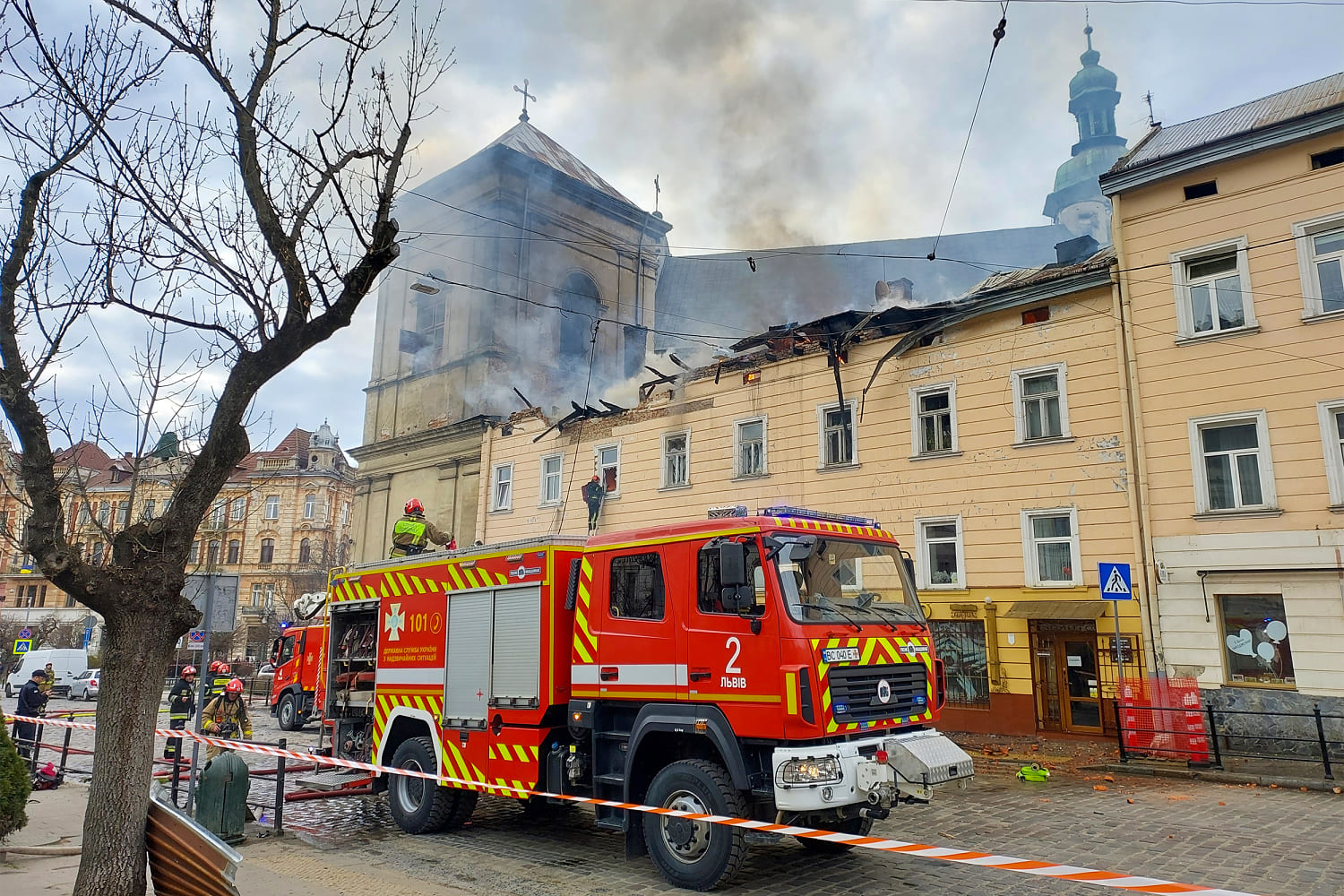
The headlines are always the same. "Russian drones attack downtown Lviv." "Tragedy in the cultural capital." "Daylight strikes on civilians." The media treats these events as spontaneous eruptions of malice, disconnected from the cold, mathematical reality of modern electronic warfare. They frame Lviv as a sanctuary violated, a "safe" rear-wide city that should, by some unwritten rule of gentlemanly conduct, be off-limits.
That narrative is a lie. It is a dangerous, comforting delusion that ignores the physical mechanics of the Shahed-136 and the systemic failure of European integrated defense. Lviv isn't being targeted because it is a cultural hub; it is being targeted because it is a logistics bottleneck that the West refuses to properly shield.
If you are surprised that drones are hitting Western Ukraine in broad daylight, you haven't been paying attention to the telemetry.
The Myth of the Rear
For two years, the "Lazy Consensus" has been that Lviv is the gateway for Western aid and therefore a semi-protected space. This is a strategic hallucination. In a war of attrition defined by $GMLRS$ and long-range $loitering munitions$, there is no "rear." There is only the front line and the supply chain. Lviv is the most critical node in that chain.
When a swarm of Geran-2 (Shahed) drones enters Lviv’s airspace at 2:00 PM, it isn't a "terror attack" in the vacuum-sealed way the BBC likes to report it. It is a calculated stress test of Ukraine’s dwindling $S-300$ and $Buk$ interceptor stocks. Every time a million-dollar $IRIS-T$ missile is fired to bring down a twenty-thousand-dollar fiberglass lawnmower over a town square, the math of the war shifts toward Moscow.
We keep talking about "civilians under fire," which is true and tragic, but we miss the industrial reality. Lviv is the repair shop for Leopard tanks. It is the transit point for Polish electricity. It is the brain of the Western rail network. To expect it to remain a pristine museum while it functions as a workshop for the Ukrainian military is peak Western cognitive dissonance.
Why Daylight Attacks Work
Standard military doctrine suggests that slow-moving drones should be easy pickings during the day. At night, you need thermal optics and acoustic sensors. During the day, any soldier with a $PKM$ machine gun and a pair of eyes should be able to track a drone flying at 120 mph.
So why are they hitting the city center at high noon?
- Saturating the Visual Spectrum: When you fly a swarm during peak hours, you aren't just evading radar; you are creating chaos in the civil-military coordination. Air raid sirens in a city of 700,000 people during a workday create a different kind of friction than they do at 3:00 AM.
- The "Shadow" Problem: Radar performance in urban environments is notoriously poor due to ground clutter. Skyscrapers and hills around Lviv create "blind alleys." By the time a drone is spotted visually by a mobile fire group, it is often already over a populated district where firing a heavy machine gun upward carries the risk of "friendly" casualties on the way down.
- Information Warfare: Nothing screams "we can touch you anywhere" like smoke rising over the Rynok Square while people are drinking their midday coffee. It’s a psychological reset button designed to break the sense of normalcy that Lviv has fought so hard to maintain.
The Logistic Heart Attack
Stop asking "Why Lviv?" and start asking "How did it get through?"
Lviv sits roughly 70 kilometers from the Polish border. This is the "Suwalki Gap" of the Ukrainian theater. If the Russian Federation can consistently penetrate the airspace of a city this close to NATO territory, it exposes the structural rot in European air defense.
We’ve seen companies and governments blow billions on high-altitude missile defense systems like the $Patriot$ (PAC-3), which are brilliant at hitting Iskander ballistic missiles. But they are essentially useless against a swarm of 50 drones. Using a $Patriot$ on a Shahed is like trying to kill a mosquito with a sniper rifle. You might hit it, but you'll go broke before you clear the room.
The "brutally honest" answer to the "People Also Ask" query—Is Lviv safe for travel?—is a resounding no. Not because the Russian army is at the gates, but because the technical intercept rate for low-flying, low-RCS (Radar Cross Section) targets over dense urban centers is nowhere near 100%. If you are in Lviv, you are in a combat zone. Treat it as such.
The Counter-Intuitive Truth: We Need More "Dumb" Tech
The obsession with "cutting-edge" (excuse the banned term—let's say "complex") tech is killing the defense of Lviv. To save the city, we need to go backward in time.
I’ve watched Western defense contractors try to sell Ukraine "AI-powered drone jamming bubbles" that cost more than the city’s annual budget. They don't work in a dense urban environment because of frequency hopping and the sheer kinetic momentum of the drones. If you jam a drone over a city, it doesn't disappear; it just falls on a different building.
The solution isn't more $NASAMS$. It’s more $Gepard$ anti-aircraft guns. It’s 1940s-style flak upgraded with modern fire control. It’s "dumb" lead in the air.
- Fact: A single $35mm$ burst from a $Gepard$ costs less than $1,000.
- Fact: A $Patriot$ interceptor costs $4 million.
- Reality: Russia produces approximately 500 drones a month.
You do the math. The West is currently losing the economic war of air defense by a factor of 4,000 to 1.
The Problem with the "Heritage" Argument
The competitor article focuses heavily on the "threat to UNESCO heritage sites." This is a sentimental trap. While Lviv’s architecture is stunning, the Kremlin doesn't care about 16th-century cathedrals. They care about the fact that those cathedrals sit next to the regional power substations and the railway switches that move Western artillery shells.
By centering the narrative on "culture," we distract from the urgent need for technical hardening. We need to stop complaining about the "barbarism" of attacking a cultural city and start asking why the electrical grid in Western Ukraine still doesn't have physical reinforced concrete shielding (cages) over its most sensitive transformers.
We are fighting a 21st-century industrial war with a 19th-century "sacred city" mindset. It’s a recipe for a blackout that lasts all winter.
What No One Admits
The harsh reality is that some of these strikes are "successful" because of the sheer density of the target environment. Lviv is a bottleneck. Everything—refugees, wounded soldiers, Starlink terminals, humvees—must pass through this funnel.
If I were a Russian commander, I wouldn't stop attacking Lviv. I would increase the frequency. Why? Because every drone that hits Lviv forces Ukraine to pull air defense assets away from the front lines in the Donbas. This is the "Internal Displacement" of defense. By threatening the "safe" rear, Russia thins out the shield at the front.
It is a classic diversionary tactic that the Western media falls for every single time, reporting on the "shock" of the strike instead of the strategic thinning of the front-line umbrella.
Stop Praying, Start Hardening
The advice for the "industry insiders" and the policy-makers is simple but unpalatable:
- Acknowledge the Loss of Sanctuary: Stop telling NGOs and diplomats that Lviv is a "Green Zone." It is a Tier 1 target.
- De-centralize the Hub: Move the logistics nodes out of the city center. If you put a military repair shop 500 meters from a historic opera house, you are gambling with history.
- Invest in Kinetic, Low-Cost Interception: Abandon the hope that "cyber" or "jamming" will solve the drone problem. It requires projectiles. Lots of them.
The attack on Lviv wasn't a failure of Russian restraint—it was a demonstration of Ukrainian vulnerability. Until we stop treating these strikes as anomalies and start treating them as the new baseline of European warfare, we are just waiting for the next siren.
Build the cages. Move the trains. Buy the flak guns. The sun is out, and the drones are coming back tomorrow.