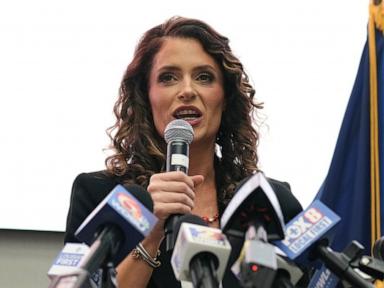
Representative Julia Letlow won the Louisiana Republican Senate runoff on Saturday, defeating state Treasurer John Fleming and cementing the total political displacement of incumbent Senator Bill Cassidy. Letlow secured the victory following a bitter campaign cycle defined by an explicit demand for absolute alignment with the White House. Her win ensures that she will enter the November general election as the overwhelming favorite in this deeply conservative state. By capturing the nomination, Letlow gives President Donald Trump his latest victory in a coordinated campaign to systematically replace independent-minded Republican lawmakers with loyalists.
The outcome was decided long before voters cast their ballots in the sweltering June heat. It was decided when Cassidy, a low-key institutionalist who spent years securing infrastructure money for his home state, chose to vote to convict the president during the 2021 impeachment trial. In the modern Republican ecosystem, that single action carried a permanent political death sentence. Cassidy became the first sitting senator to lose a primary since 2017 when he finished a distant third in the May primary.
Saturday's runoff between Letlow and Fleming was not an ideological battle. Both candidates rushed to demonstrate total obedience to the executive branch. Instead, the race transformed into a raw demonstration of structural dominance, fueled by multi-million-dollar outside expenditures and ruthless gatekeeping by the state's dominant political machines.
The Engineering of an Endorsement
Political survival in Louisiana requires understanding who controls the channels of communication. Fleming, a co-founder of the House Freedom Caucus and a veteran of the first Trump administration, discovered this the hard way. He spent months trying to reach the president to secure an endorsement, believing his long record of ideological conservatism would carry weight.
He was systematically blocked. Louisiana Governor Jeff Landry and House Majority Leader Steve Scalise had already built a protective wall around Letlow. Landry began pitching Letlow to the White House long before she even announced her candidacy. By January, the endorsement was delivered, catching other potential contenders off guard and effectively flattening the primary field.
Fleming later told voters about a frantic, late-stage phone call where he finally managed to bypass the gatekeepers and reach the president directly. According to Fleming's account, he reminded the president of his years of service and unyielding defenses of the administration. The response he received was polite but hollow. The decision had been made months prior in closed-door meetings involving Landry, Scalise, and national strategists who valued institutional discipline over ideological independence.
This gatekeeping strategy highlights a significant shift in national primary politics. Local execution matters just as much as national influence. Ideological purity is no longer enough if a candidate lacks the backing of the dominant regional apparatus capable of securing the executive's signature. Fleming ran ads proclaiming he was part of the populist movement long before it was fashionable. Voters did not care because the official stamp of approval belonged to someone else.
The Industrial Scale of Outside Cash
An investigative look at the financial disclosures reveals the sheer asymmetry of the runoff period. While both campaigns spent roughly equal amounts from their official accounts, approximately one million dollars each, the real damage was inflicted by outside entities.
Super PACs poured more than five million dollars into the state within a six-week window. The Accountability Project and other aligned political action committees ran unrelenting attack campaigns designed to completely disqualify Fleming. They weaponized his age, noting that at seventy-five, he would be the oldest freshman senator ever sworn into office. They labeled a former Freedom Caucus founder an unhinged fraud.
Louisiana Senate Primary Financial Layout (Post-May Primary)
+-------------------------------------------------------+
| Aligned Super PACs: $5.1 Million                      |
+-------------------------------------------------------+
| Letlow Campaign:    $1.0 Million                      |
+-------------------------------------------------------+
| Fleming Campaign:   $1.0 Million                      |
+-------------------------------------------------------+
This massive financial injection paid for absolute saturation on television, radio, and digital feeds across the state. It successfully shifted the narrative away from Letlow's legislative record and focused attention entirely on her status as the chosen candidate. The money did not just persuade voters. It exhausted them, driving down turnout in rural areas where Fleming needed a massive surge of populist resentment to overcome Letlow's institutional advantage in population centers.
The strategy worked perfectly. High-information voters in suburban and urban parishes broke heavily for Letlow, viewing her as the stable choice. Rural voters who might have leaned toward Fleming's harder edge stayed home or voted based entirely on the simple instruction they received from national conservative media to support the endorsed candidate.
The Systematic Removal of Insurgent Voices
The results in Louisiana cannot be analyzed in isolation. This race marks the conclusion of a highly effective spring cleaning of the legislative branch. Over the course of a single primary season, multiple lawmakers who demonstrated even minor streaks of independence have been stripped of their nominations.
In Kentucky, Representative Thomas Massie lost his primary after clashing with leadership over foreign aid and procedural hurdles. In Texas, Senator John Cornyn fell to a challenger after decades in leadership. In Indiana, five state senators were purged in a single evening for failing to align with the party's populist wing. The message sent to Capitol Hill is clear and unambiguous.
Institutional power, seniority, and committee chairmanships provide no protection against a targeted primary challenge. Cassidy was the chairman of the Senate Health, Education, Labor, and Pensions Committee. He possessed deep relationships with industry leaders and could steer billions of dollars toward Louisiana medical centers and universities. None of it mattered to an electorate that defines success not by legislative output, but by defensive loyalty to a singular figure.
The Last Stand of a Defeated Senator
As his political career wound down, Cassidy appeared to lose the internal filter that keeps most lawmakers compliant. This friction exploded into public view during a closed-door Senate Republican lunch in Washington.
Witnesses described a tense, elevated exchange between Cassidy and the president regarding foreign policy in the Middle East. Cassidy openly questioned the strategic objective of prolonged military engagements, challenging the administration's long-term planning. The argument grew so loud that staffers outside the room could hear the shouting.
Days later, a temporary truce was manufactured. Vice President JD Vance and special envoy Steve Witkoff held private briefings with Cassidy to pacify his concerns. In a telling turn of events, Cassidy later voted against a war powers resolution that would have restricted executive military authority, reversing his previous policy positions.
This cycle of public defiance followed by quiet capitulation illustrates the total leverage the executive branch now holds over the legislature. Even a defeated senator with nothing left to lose politically felt the immense pressure to conform before leaving office.
Redefining the Scope of Representation
Letlow will now face a nominal challenge from Democrat Jamie Davis in November, but in a state that voted conservative by twenty-two percentage points in the last cycle, the general election is an afterthought. The real transformation has already occurred.
Letlow has built her platform on specific cultural flashpoints, focusing heavily on national legislation regarding transgender athletes and social conservative priorities. This represents a fundamental shift away from the traditional Louisiana senatorial model, which historically focused on oil and gas regulation, coastal restoration, and maritime trade infrastructure.
The new model of representation prioritizes national cultural combat over regional economic carve-outs. When Letlow takes her seat in the chamber, she will do so not as an independent advocate for a unique maritime state, but as a disciplined vote for a national agenda.
The political infrastructure that once protected independent actors in the Senate has been dismantled. Lawmakers who wish to survive now observe Louisiana as a warning. The price of survival is total alignment, and the penalty for deviation is total political erasure.