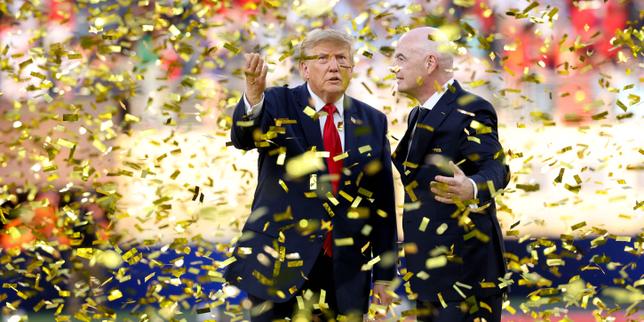
The roar of seventy thousand voices does strange things to a man’s hearing. Inside MetLife Stadium, packed to the rafters for the final match of the World Cup, the noise wasn't just sound. It was physical. A wall of thunder built from bass drums, plastic horns, and raw human adrenaline.
Then the screens changed.
For weeks, Donald Trump had kept a surprisingly low profile. The news cycles, usually choked with his late-night posts and fiery rallies, had drifted toward other headlines. He had retreated into the quiet rhythm of private meetings, high-stakes court preparation, and calculated public absences. He was, by all accounts, resting in the shadows of the political arena.
But shadow is not a natural habitat for a man who feeds on the spotlight.
When his face flashed onto the massive jumbotrons suspended above the pitch, the energy in the stadium didn't shift slowly. It snapped.
Boos.
Not a scattered chorus from a few disgruntled fans in the upper deck, but a deep, guttural cascade of disapproval that tore through the celebratory air. It collided directly with the polite applause of his supporters, creating a bizarre, tension-thick atmosphere right in the middle of international soccer’s grandest spectacle.
To understand why a stadium full of sports fans suddenly turned into a fierce political trial, you have to look past the scoreboards. You have to look at what happens when two entirely different worlds clash without a buffer.
Global soccer is a specific kind of ecosystem. It is chaotic, intensely international, and fiercely defensive of its neutral ground. Fans spend thousands of dollars to escape the daily grind, to submerge themselves in ninety minutes of pure, unscripted drama where the only thing that matters is a white ball crossing a white line. They don't buy tickets to be reminded of domestic politics, diplomatic friction, or partisan posturing.
When a political figure steps onto that grass—or even onto the big screen above it—the illusion shatters.
Trump’s team likely saw the World Cup final as an effortless win. A massive audience. A global stage. The ultimate photo opportunity to signal a grand return after weeks spent out of the public eye. On paper, the logic seemed solid. Gather the attention of millions in a single instant, project power, and let the sheer scale of the event elevate the brand.
Instead, the moment laid bare a fundamental miscalculation about human attention.
Crowds are not passive receivers of messaging. They are living, breathing organisms with their own mood and instinct. When you step into their domain, you play by their rules. In a campaign hall, every seat is filled by someone who chose to be there for you. The air is warm, friendly, and predictable. But in a stadium, you are an uninvited guest crashing someone else's festival.
The immediate turn from quiet political retreat to a very public, unscripted reaction was a stark reminder of the risks that come with high-visibility drops. Silence builds anticipation, yes. But if the grand return happens in the wrong room, the echo can be deafening.
The whistles eventually faded back into the rhythm of the match. The game went on, players ran, and the crowd returned to the passion that brought them there in the first place. But as the stadium emptied into the cool night air, the memory of that sudden, sharp rejection remained hovering over the field long after the lights went dark.