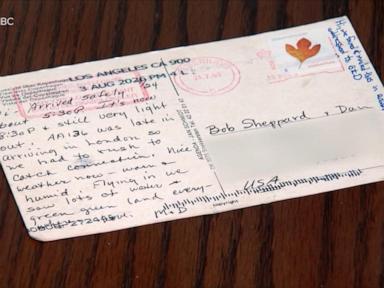
A Long Beach man recently received a postcard mailed by his parents twenty-six years ago, a staggering delay that highlights the unpredictable nature of postal routing and the fragile mechanics of global mail distribution.
The Journey of a Ghost Letter
Mail does not simply vanish when it goes missing. It settles. It migrates into hidden cracks of massive sorting facilities, slips behind immovable industrial machinery, or lodges inside forgotten storage bins during regional sorting facility transitions. When a Long Beach resident finally opened a postcard sent by his parents over a quarter of a century prior, the public reaction split neatly down the middle. Half the audience viewed it as a heartwarming, cinematic miracle straight from a scriptwriter's desk. The other half saw it as an indictment of bureaucratic incompetence.
Both reactions miss the structural reality of how physical logistics actually function.
Decades ago, processing mail relied heavily on manual sorting alongside early-generation optical character recognition systems. A misplaced tray, a misread zip code label that fell into a dead-letter sweep, or an envelope wedged beneath a conveyor belt motor could easily suspend a piece of mail indefinitely. Modern facilities process billions of items annually. Yet, human error and mechanical quirks still conspire to create anomalies. This particular postcard did not float through the ether for twenty-six years. It sat quietly in the dark underbelly of a municipal facility or an old regional hub, waiting for a maintenance crew to finally dismantle a legacy sorting machine during a modernization sweep.
The Anatomy of Postal Failures
To understand how a piece of paper remains lost for an entire generation, we have to look past the romantic notion of the wandering letter and examine the physics of national logistics networks.
Postal systems are massive, sprawling monoliths. They operate on relentless volume rather than delicate precision. When a letter enters the stream, it passes through multiple checkpoints:
- Local collection boxes
- Regional processing and distribution centers
- Transit trucks and cargo holds
- Secondary sorting facilities
- Final-mile carrier routes
At any of these junctions, failure points exist. A barcode gets smeared. A sorting bin gets skipped during a shift change. An automated arm kicks an irregular piece of mail into a reject bin labeled for manual review, where it slips beneath a stack of discarded manuals or broken plastic trays.
Once an item enters a dead-letter status or a physical blind spot, standard tracking protocols cease to apply. Regular mail lacks the digital breadcrumbs of modern parcel tracking. Without a barcode readable by current high-speed sorters, a piece of old cardstock becomes invisible to the network. It requires an accidental physical discovery by a worker with a broom or a wrench to reintroduce it into the wild.
The Human Element Behind the Delay
The emotional weight of receiving a message from the past creates a jarring psychological experience. The parents who penned those words two decades ago may have changed drastically, moved away, or passed on. The recipient is living an entirely different life in a different era. Time collapses in an instant when physical proof of a long-gone Tuesday arrives in the mailbox.
We tend to anthropomorphize the postal service. We expect it to act with the intentionality of a courier who cares about the message inside the envelope. In reality, the postal network is an indifferent machine of weight, volume, and scheduling windows. It does not know what a postcard means. It only knows that a piece of paper needs to move from Point A to Point B. When the machine fails, it fails silently.
Modern Updates and Persistent Vulnerabilities
Technology has transformed sorting accuracy. High-speed cameras capture every square millimeter of an envelope, translating cursive handwriting into digital routing instructions in milliseconds. Automated multi-line optical character recognition reads addresses that would baffle human eyes.
Despite these advancements, anomalies persist. As postal networks upgrade their infrastructure, contractors uncover historical backlog caches buried in historical facilities slated for closure or consolidation. Every time a regional hub gets gutted for a system-wide overhaul, workers unearth forgotten bins of mail from the 1990s and early 2000s. These items are rarely delivered with fanfare. Usually, they are quietly stamped with an explanatory apology label or simply dropped back into the local stream, letting the sudden delivery speak for itself.
The Long Beach postcard reminds us that physical infrastructure retains a memory. Long after digital messages dissolve into server deletions and broken cloud links, paper persists. It hides in the corners of industrial warehouses, waiting for decades to pass before someone flips a switch, looks down, and decides to finish the delivery.


