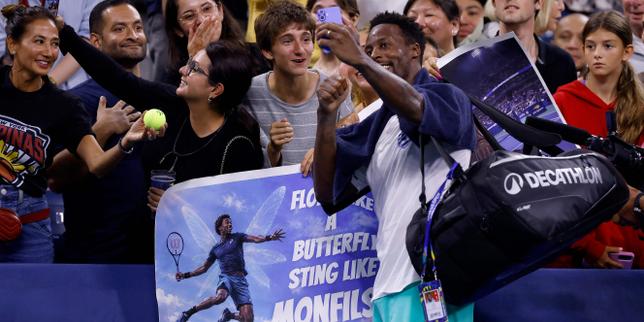
Elite athletic longevity defies traditional biological decline models through specialized workload management, technical adaptation, and strategic tournament selection. When Gaël Monfils secures a hard-court victory at Flushing Meadows while reaching his fortieth year, the achievement represents an operational anomaly within professional tennis. Most athletes in racquet sports experience a steep performance depreciation curve past the age of thirty-two, driven by cumulative soft-tissue degradation, diminishing recovery speeds, and the compounding velocity of younger competitors. Monfils subverts this trajectory not through sheer physiological preservation, but via a structural transformation of his energy expenditure matrix.
The standard analytical approach to veteran athletes focuses almost exclusively on physical preservation. This lens is fundamentally flawed. Longevity at the elite tier requires a systemic reengineering of risk, tactical efficiency, and biomechanical conservation. By examining the operational mechanisms behind the longevity of Monfils, we can deconstruct the exact variables that allow a hyper-athletic player to remain competitive across two decades of professional play. If you liked this article, you should look at: this related article.
The Workload Optimization Function
Professional tennis operates as a high-frequency, high-stress endurance circuit. The traditional junior-to-professional pipeline encourages high tournament volume, which accelerates structural wear. To survive into a fourth decade, an athlete must alter their participation coefficient.
The primary adjustment involves aggressive tournament pruning. Monfils curates his schedule to maximize match-win probability per unit of travel fatigue. Lower-tier events are systematically excised, concentrating physical capital exclusively on Grand Slams and high-value Masters 1000 tournaments. This preserves the central nervous system from the chronic micro-traumas associated with continuous weekly travel, jet lag, and fluctuating court surfaces. For another look on this event, see the recent coverage from The Athletic.
Total Athletic Output = (Match Intensity * Tournament Volume) - Recovery Deficit
When tournament volume approaches zero past a certain threshold of diminishing returns, recovery deficit approaches baseline levels. Younger competitors frequently violate this equation by over-indexing on volume, mistaking match practice for physical development. Monfils treats matches as finite capital investments. Every hour spent on court must yield a proportional return in ranking points or financial stability, reducing extraneous physical exposure.
Biomechanical Efficiency and Energy Conservation
Early-career Monfils relied on chaotic, high-variance athleticism. His movement profile featured explosive lateral recoveries, sliding on hard courts from extreme defensive positions, and high-g-force rotational shots. This style generates massive shear stress on the knees, ankles, and lumbar spine.
Sustaining this career trajectory demanded a total rewrite of his kinematic chain. Older elite players reduce energy loss by shortening backswings, improving court positioning, and utilizing opponent pace rather than generating raw linear force from scratch.
- Positional Economy: Minimizing baseline recovery distance by anticipating opponent shot selection through statistical pattern recognition.
- Kinetic Substitution: Replacing explosive lateral lunges with early racquet-head preparation, thereby shortening the physical distance required to reach a ball.
- Surface Adaptation: Managing slide frequency on hard courts to protect joint cartilage from acute friction shocks.
This transition shifts the athletic profile from reactive recovery to proactive positioning. By reading patterns two shots ahead, the veteran decreases total distance covered per point, offsetting declining maximal sprint speed with superior spatial awareness.
The Psychological Capital of Variance Control
Mental endurance in tennis is inextricably linked to tactical discipline. Young players often suffer from high emotional volatility, leading to unforced error clusters during critical game phases. Monfils historically battled this variance, but maturity has introduced a strict cost-benefit analysis to shot selection.
High-risk shots, such as jumping smashes or unexpected underhand serves, are no longer deployed out of emotional impulsivity. They function as tactical disruption tools. Introducing unpredictable geometry breaks the rhythm of baseline grinders who rely on metronomic rally structures.
The economic value of this variance control lies in opponent disruption. Younger players thrive against predictable depth and spin. When a veteran introduces high-variance shots backed by exceptional defensive retrieval, the opponent's cognitive load increases. The opponent begins over-thinking simple tactical patterns, creating unforced errors that the veteran absorbs without expending physical energy.
The Recovery Infrastructure Variable
Physical longevity past thirty-five is impossible without institutionalized recovery protocols. While talent dictates entry into the professional tier, recovery velocity dictates exit timing.
The modern training paradigm for veteran athletes relies on data-driven physiological monitoring. Sleep architecture analysis, heart rate variability tracking, and precise nutritional timing dictate daily training loads. Rather than adhering to a rigid weekly regimen, the training schedule is dynamic, scaling up or down based on biometric feedback.
Cryotherapy, soft-tissue manipulation, and targeted muscular deactivation protocols prevent chronic inflammation from crystallizing into tendonitis or tears. The body of a veteran athlete is treated as a high-performance machine requiring constant diagnostic maintenance rather than a self-healing biological organism.
Strategic Forecast and Market Implications
The success of older competitors at major tournaments alters how sports science agencies value tennis talent. Historically, talent scouts heavily discounted players over twenty-eight, assuming a cliff-edge decline. The Monfils case study proves that technical adaptability and intelligent workload management can extend peak window viability by five to seven years.
Sports science departments across professional circuits will increasingly adopt longitudinal workload tracking for junior prospects, attempting to preserve cartilage and neural pathways before wear occurs. This shifts the competitive advantage from raw physiological endowment to systemic longevity engineering.
To maintain competitiveness in late-career phases, athletes must decouple physical age from tactical output. The final operational takeaway is clear: longevity is not a gift of genetics, but the byproduct of ruthless workload management, tactical simplification, and systemic biomechanical conservation.