The weight of a handshake
Imagine standing on a balcony in Algiers, where the white buildings spill down toward a sea that looks like a sheet of hammered silver. To the north, just over the horizon, lies Marseille. To the south, the vast, silent memory of the Sahara. Between these two points sits a relationship so fractured, so thick with the ghosts of the past, that every diplomatic gesture feels less like statecraft and more like an exorcism.
Emmanuel Macron is a man who believes in the power of the "grand gesture." Since he first took office, he has approached the relationship between France and Algeria not as a balance sheet of imports and exports, but as a psychic wound that needs to be stitched shut. He has only a short time left on his clock. The sand is slipping through the hourglass of his final mandate, and he is still reaching for a hand that often pulls away at the last second.
This isn't about trade deals or visa quotas, though those are the tools the diplomats use. It is about a haunting.
The ghost in the room
When French officials fly to Algiers, they aren't just bringing dossiers. They are bringing 132 years of colonial history and a brutal eight-year war that ended in 1962 but never truly stopped echoing.
In the corridors of the Élysée Palace, there is a palpable sense of urgency. Macron wants to be the president who finally settles the "memory wars." He has made unprecedented moves: acknowledging the assassination of lawyer Ali Boumendjel, returning the skulls of Algerian resistance fighters, and admitting the state-sanctioned torture and murder of Maurice Audin.
But for every step forward, there is a staggering lurch backward.
Consider the "Great Chill" of 2021. A few offhand comments about the Algerian "politico-military system" and a questioning of whether an Algerian nation existed before French rule sent the relationship into a deep freeze. It took months of back-channel whispering and careful phrasing to thaw the ice. This is the volatility of the situation. It is a house built on a fault line. One wrong word, one poorly translated idiom, and the walls begin to crack.
The two audiences
Every move Macron makes must satisfy two groups of people who want entirely different things.
In France, he faces a political right and far-right that views any apology as a betrayal of national pride. They see the "harki" community—Algerians who fought for France—and the "pieds-noirs"—settlers who fled in 1962—as a voting bloc that demands a different kind of recognition. To them, the past is a closed book that Macron keeps trying to rewrite.
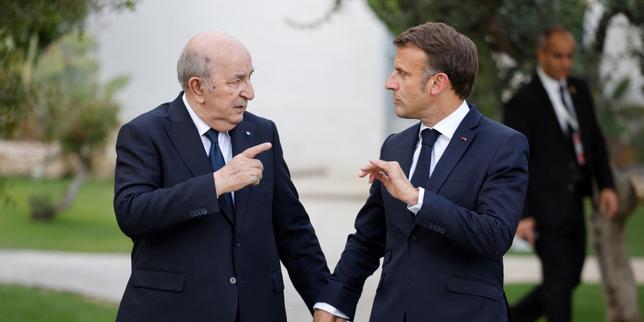
Across the water, the Algerian leadership, headed by President Abdelmadjid Tebboune, operates under a different pressure. For the Algiers government, "memory" is the foundation of their legitimacy. They demand a full, formal apology for colonial crimes. Without it, they argue, any talk of "reconciliation" is just a fresh coat of paint on a rotting structure.
It is a stalemate of pride.
The invisible stakes of the present
While the presidents argue over 1954, the people in the streets are looking at 2026.
A young student in Oran wants to know if they can get a visa to study in Lyon. A baker in Paris wonders if the price of gas—much of it flowing from Algerian pipes—will spike because of a diplomatic spat. This is the reality behind the rhetoric. Security in the Sahel, the management of migration flows, and the energy security of Europe are all tied to this one, agonizingly difficult friendship.
If France and Algeria cannot find a way to coexist, the entire Mediterranean basin loses its anchor. We see this play out in the smallest details. When diplomatic ties fray, the flow of intelligence on extremist groups in North Africa slows down. When the border of the mind closes, the families split between the two countries find themselves trapped in a bureaucratic nightmare of cancelled flights and rejected paperwork.
The metaphor of the bridge
Think of this reconciliation as a bridge being built from both sides of a canyon.
France has sent out its engineers. They have laid the stones of "recognition" and "shared history." They have opened archives that were sealed for decades. But the bridge hasn't met in the middle. The Algerian side is waiting for a specific kind of stone—an apology—that the French political system is currently unable or unwilling to quarry.
The tragedy of the situation is that both sides know they need the bridge.
France needs Algeria as a gateway to Africa and a partner in the Mediterranean. Algeria needs French investment and a stable relationship with its largest diaspora home. They are like two siblings who have inherited a house they both hate, yet neither can afford to leave.
The clock is the enemy
Macron's strategy has been one of "small steps." He believes that by addressing specific, painful points of history one by one, he can create a momentum that eventually leads to a grand reconciliation. It is a logical, Cartesian approach.
But history isn't logical. It is emotional.
As 2027 approaches, the window for a historic breakthrough is closing. There is a fear in Paris that if a different kind of leader takes the reins after Macron—someone less inclined toward the "devoir de mémoire" (duty of memory)—the progress made will be erased overnight. The progress is fragile. It is a sandcastle built between tides.
The human cost of silence
The real story isn't found in the joint communiqués or the stiff photos of presidents sitting in ornate chairs. It is found in the kitchens of Nanterre and the cafes of Algiers. It is found in the grandmothers who still have the keys to houses in cities they haven't seen in sixty years. It is found in the third-generation immigrants who feel like foreigners in both lands.
They are the ones waiting for the reconciliation. Not because they care about the nuances of diplomatic protocol, but because they want the ghosts to stop screaming. They want to be able to carry their dual identities without it feeling like a tug-of-war.
Macron's gamble is that he can fix a century of pain with five years of diplomacy. He is trying to force a harvest in a field that hasn't been properly cleared of mines.
He continues to hope. He continues to plan for a state visit that keeps getting postponed, a symbolic journey that remains just out of reach. He is reaching for a version of the future where the Mediterranean is a lake that joins people together rather than a graveyard of missed opportunities.
The tragedy is not that they are fighting. The tragedy is that they are so close, yet so profoundly far apart. The coastline of Algiers is still visible from the heights of the soul, but the water between them remains deep, cold, and filled with the wreckage of everything they have failed to say.
The sun sets over the Casbah, casting long, jagged shadows that stretch toward the French shore, waiting for a dawn that hasn't yet found its way across the waves.