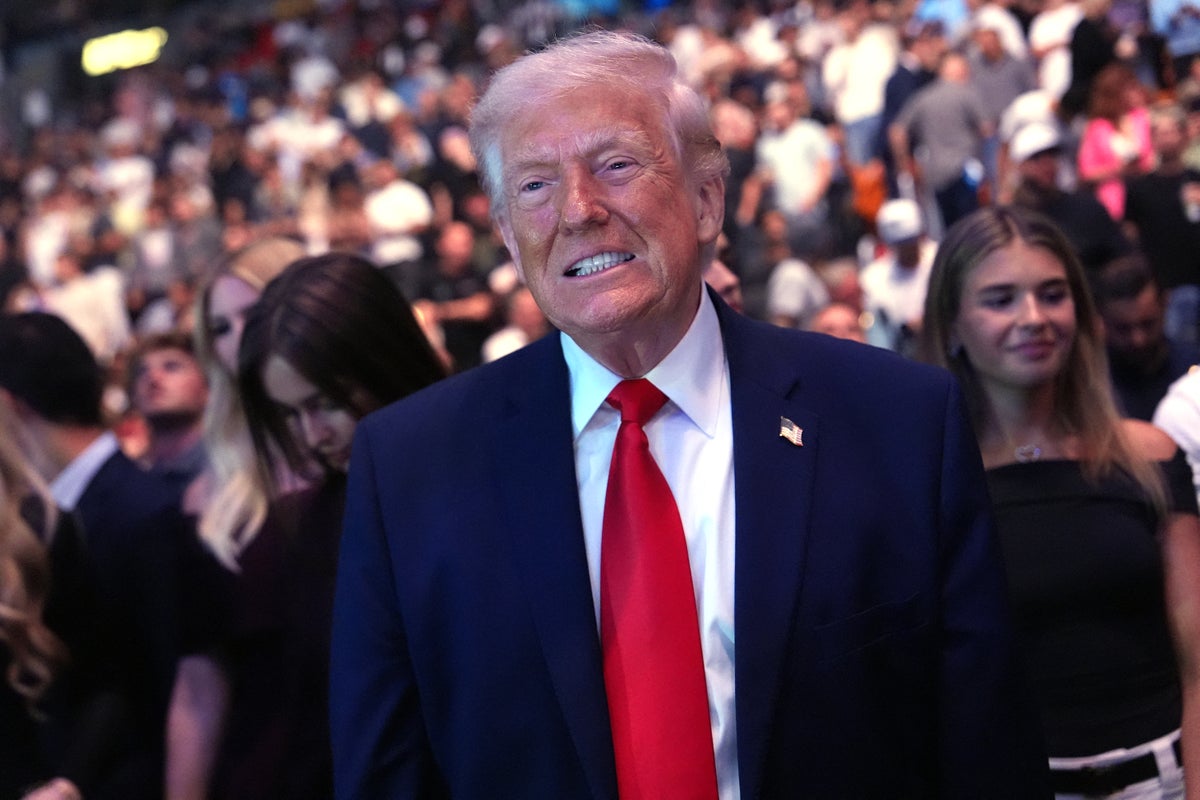
A sitting United States president has never attended an NBA Finals game. This historical precedent faces disruption following Donald Trump’s declaration during a May 27 White House cabinet meeting that he intends to accept an invitation from Madison Square Garden Company chairman James Dolan to attend an upcoming championship game. With the New York Knicks having secured their spot by sweeping the Cleveland Cavaliers in the Eastern Conference Finals, they await the Western Conference champion—either the Oklahoma City Thunder or the San Antonio Spurs.
The intersection of a modern presidential security apparatus and a tier-one metropolitan sporting event introduces severe structural friction. Evaluating the true impact of this event requires moving past superficial political commentary and analyzing the hard logistical, economic, and security variables that dictate arena operations in high-density urban environments. Don't miss our recent coverage on this related article.
The Strategic Triad of Arena Disturbance
When a head of state enters a high-capacity urban venue, operations shift from standard event management to a strict military-grade security posture. This transition can be quantified across three distinct operational dimensions.
                  [ Presidential Attendance ]
                              │
         ┌────────────────────┼────────────────────┐
         ▼                    ▼                    ▼
[ Perimeter Contraction ]  [ Throughput Decay ]  [ Asset Reallocation ]
 - Hard/soft zones          - Magnetometers       - Secret Service
 - Road closures            - ID verification     - Local NYPD units
 - Rooftop oversight        - 30+ min delays      - Event staff shift
1. Perimeter Contraction
The United States Secret Service operates via concentric zones of protection. In an open stadium, this is complex; at Madison Square Garden, built directly over Penn Station—one of the busiest transit hubs in North America—it is an operational bottleneck. To read more about the history of this, The Athletic provides an informative summary.
- The Hard Zone: The immediate area surrounding the president's luxury suite or courtside seat. Access requires specialized federal clearance, restricting standard movement for high-net-worth ticket holders and arena staff.
- The Soft Zone: The broader arena concourse. To secure this space, federal agents must sweep the venue hours before doors open to the public, locking down food and beverage logistics and merchandise operations.
- The External Buffer: Midtown Manhattan transit infrastructure. Implementing road closures along 7th and 8th Avenues, combined with restricting specific entrances to Penn Station directly beneath the arena floors, forces a dramatic restructuring of commuter traffic flows.
2. Throughput Decay
Standard arena screening relies on a balanced ratio of metal detectors to expected fan arrival rates to maintain steady ingress. Introducing presidential screening protocols alters this equation.
Every attendee entering Madison Square Garden during a presidential visit must pass through enhanced security checkpoints managed by federal personnel rather than private event staff. This creates a significant drop in screening throughput. Historical data from Trump’s attendance at the men's singles final at the US Open reveals that these identical protocols induced an ingress delay of approximately 30 minutes, directly bottlenecking the outer plaza and delaying the event start time.
3. Tactical Asset Reallocation
A presidential visit demands an immediate pivot in local law enforcement deployment. The New York City Police Department must shift hundreds of personnel from standard precinct duties to specialized counter-assault, traffic management, and intelligence units concentrated entirely around the Midtown core. This creates a temporary but sharp resource deficit in secondary municipal sectors.
Economic and Fractional Friction
The assertion that a presidential appearance provides pure upside to an arena or a sports league ignores the microeconomics of venue operations. The total economic footprint of this visit is governed by an adversarial relationship between promotional exposure and operational costs.
The total cost expansion can be modeled conceptually by analyzing the variable inputs required for heightened security posture:
$$C_{\text{total}} = L_{\text{nypd}} + S_{\text{oss}} + D_{\text{throughput}} - V_{\text{lift}}$$
Where:
- $L_{\text{nypd}}$ represents local law enforcement overtime costs.
- $S_{\text{oss}}$ represents internal arena specialized security staff expenses.
- $D_{\text{throughput}}$ represents lost concession and merchandise revenue due to crowd stagnation.
- $V_{\text{lift}}$ represents the marginal spike in long-term brand equity and broadcast viewership.
Because NBA Finals games at Madison Square Garden are already guaranteed to operate at maximum capacity with peak advertising rates, the marginal utility of a presidential visit ($V_{\text{lift}}$) is heavily minimized. Conversely, the operational cost penalties scale exponentially.
When fans spend an extra 30 to 45 minutes trapped in external security lines due to throughput decay, their dwell time inside the arena concourse drops. This reduction in internal dwell time correlates directly with a decline in per-capita spending on high-margin items like food, beverages, and merchandise. The venue essentially trades highly profitable retail hours for expensive, non-revenue-generating security processing time.
Evaluating the Operational Probability Matrix
While the administrative statement of intent is public, execution remains contingent on external athletic and geopolitical variables. Strategic analysts must evaluate the probability of this appearance across three core factors.
The Western Conference Duration Factor
The Knicks concluded their conference series early via a sweep, establishing a firm home-game schedule for the Finals: Games 3 and 4 are locked for June 8 and June 10 at Madison Square Garden. If the Western Conference Finals between the Thunder and the Spurs extends to a grueling seven-game series, the turnaround time for league logistics shrinks. A shorter rest window alters team travel timelines, media availability availability, and the precision window required for the Secret Service to advance-sweep the arena.
The Regional Security Density Cap
Manhattan and the surrounding metropolitan area face an unprecedented concentration of high-security events. Beyond the NBA Finals, regional law enforcement assets are already committed to securing infrastructure for eight upcoming World Cup matches scheduled at MetLife Stadium in nearby New Jersey.
The compounding demand on federal and regional counter-terrorism and crowd-control units creates a resource ceiling. If intelligence assets indicate that the simultaneous management of World Cup site preparation and an active presidential movement within Manhattan risks breaking operational thresholds, administrative pressure may force a cancellation of the appearance.
The Friend-of-the-Owner Variable
A primary driver of this potential visit is the personal relationship between Trump and James Dolan, a prominent political donor and executive chairman of Madison Square Garden. This connection streamlines corporate cooperation, giving federal advance teams immediate, friction-free access to the venue's architectural blueprints, internal cameras, and proprietary communication networks.
This access eliminates the bureaucratic delays that typically occur when federal agencies interface with municipal or corporate entities that are hesitant to alter their standard operating procedures.
Tactical Execution Requirements
If the appearance proceeds, Madison Square Garden management and the NBA must execute a precise, three-part tactical playbook to avoid catastrophic operational failure on broadcast television.
First, standard gate opening times must be shifted forward by at least 90 minutes. This expansion of the ingress window is the only viable mechanism to counteract throughput decay and prevent massive, unsafe fan pile-ups on the streets of Midtown Manhattan.
Second, the broadcast partner must introduce a variable buffer into the pre-game television window. Because the physical movement of the presidential motorcade and the subsequent lockdown of the arena tunnel can delay team warmth-ups or tip-off by up to 30 minutes, the network must have pre-produced content ready to fill unexpected broadcast airtime without losing ad-revenue pacing.
Finally, internal arena logistics must transition to a segmented zone model. Concourse traffic near the courtside areas must be physically partitioned using temporary architectural barriers. This prevents standard ticket holders from drifting into the federal hard zone, allowing internal arena security to police the crowd via micro-perimeters rather than attempting to monitor the entire 19,500-seat bowl as a single entity.