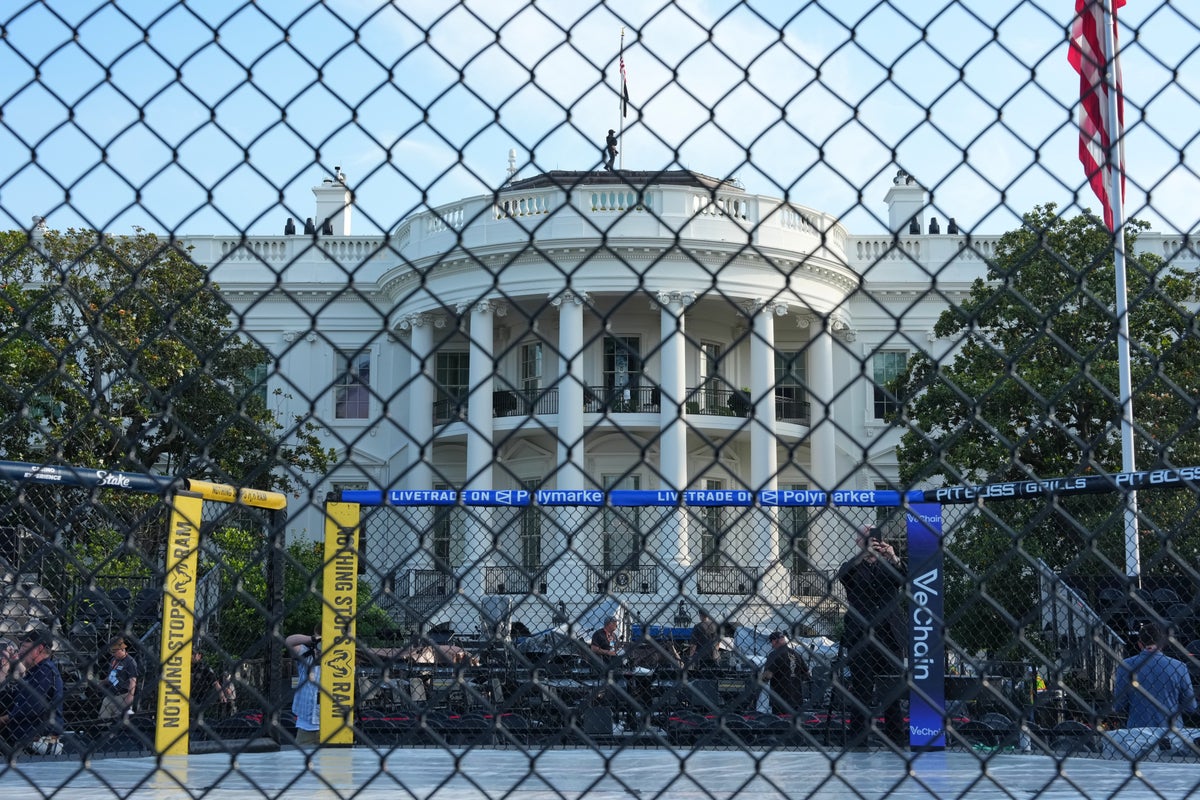
Outdoor sporting events executed outside traditional stadium infrastructure operate under a compounding risk model where meteorological disruptions directly degrade financial yields. The realization of UFC Freedom 250 on the South Lawn of the White House represents an unprecedented intersection of state protocol, private enterprise, and high-stakes athletic entertainment. However, framing the primary threat to this event merely as "rain washing out a birthday fight" miscalculates the structural architecture of the operational and economic variables at play.
The viability of a live broadcast event of this scale depends on three interconnected systems: structural infrastructure stability, broadcast signal integrity, and athlete performance safety. When an open-air venue lacks a retractable canopy or permanent drainage infrastructure, a single meteorological vector can trigger a cascading failure across all three systems. Deconstructing these vulnerabilities reveals why temporary combat sports architectures face distinct financial and logistical bottlenecks when exposed to adverse weather. You might also find this connected article useful: The Anatomy of Tower Ride Stall Interventions: An Operational Analysis of High-Angle Extrication.
The Structural Mechanics of The Claw
The physical footprint of the event is dominated by a 92-foot-tall, 600-ton temporary steel superstructure known as "The Claw." This engineering asset anchors the lighting rigs, audio arrays, and broadcast cameras directly above the red, white, and blue Octagon. In a traditional arena, these components are suspended from permanent, load-tested roof trusses protected from environmental wind shear and precipitation.
The structural risk profile of a temporary outdoor asset like The Claw is governed by two primary physical variables: As highlighted in detailed coverage by The Economist, the results are notable.
- Soil Bearing Capacity Degradation: The South Lawn consists of natural turf over engineered soil layers. Saturation from sustained rainfall alters the soil mechanics, rapidly decreasing its shear strength and load-bearing threshold. When 600 tons of dead weight are distributed across temporary footings on compromised ground, the risk of differential settlement rises. A variance of even a few inches across the support bases introduces asymmetric structural loads, forcing immediate operational shutdown.
- Wind Shear and Surface Area Drag: At 92 feet in height, the superstructure acts as a massive sail. Wind vectors accompanying summer precipitation fronts exert lateral kinetic energy against the steel framework. Because the structure supports heavy, sensitive electronic equipment at its highest points, high wind velocity increases the overturning moment, testing the engineering tolerances of the temporary anchoring systems.
The Broadcast Micro-Climate and Signal Economics
UFC Freedom 250 is configured as a high-density monetization vehicle designed for global distribution via Paramount+ and CBS. While live gate revenue from the restricted 4,300 to 5,000 invitation-only spectators represents significant political and corporate capital—with private VIP packages priced at $1.5 million—the core financial engine is the digital broadcast.
Precipitation introduces severe friction to the technical infrastructure required to deliver this signal. The primary bottleneck resides in the micro-climate directly inside and above the cage. Traditional pay-per-view events rely on a dense array of high-definition cameras mounted at specific angles, including overhead zip-lines and ringside positions. Raindrops hitting camera lenses create immediate visual distortion, breaking the fidelity required for premium sports products.
Furthermore, high-intensity canvas lighting generates significant thermal output. When cool rain impacts high-wattage lighting elements, the sudden thermal contraction can cause bulb failure or electrical short-circuits. While modern outdoor production rigs utilize ingress-protected (IP-rated) cabling and enclosures, the sheer volume of temporary connections required for an arena-grade broadcast increases the statistical probability of a localized power grid failure. If the main production truck experiences a signal interruption due to water intrusion or emergency power switching, the financial penalty per minute of dead air time escalates exponentially due to contractual obligations with global advertisers and distribution platforms.
The Micro-Friction Cost Function of Athlete Performance
The core asset of the promotion is the physical performance of the athletes, headlined by the lightweight title unification bout between Ilia Topuria and Justin Gaethje, alongside the interim heavyweight clash between Alex Pereira and Ciryl Gane. Combat sports metrics demonstrate that victory or defeat is determined by micro-adjustments in footwork, angles, and explosive leverage.
Outdoor exposure introduces environmental variables that directly alter the physics of the fight canvas.
$$F_{\text{friction}} = \mu \cdot F_{\text{normal}}$$
The equation dictating an athlete's movement is bounded by the coefficient of friction ($\mu$) between the fighter's bare feet and the canvas material. Standard UFC canvases are made of a heavy-duty canvas blend painted with sponsor logos. When this surface becomes wet, the coefficient of friction drops precipitously.
This reduction in surface friction alters the mechanics of engagement in two distinct ways:
- Biomechanical Insufficiency: Striking disciplines require a rigid anchor point to transfer kinetic energy from the ground through the hips and into the strike. A slippery canvas causes micro-slips during weight transfers, reducing punching power and rendering explosive combinations mechanically unviable.
- Grappling Dynamics Asymmetry: In wrestling and grappling transitions, moisture accumulation on the canvas eliminates tactile control. It accelerates sweat saturation, preventing fighters from securing submissions or maintaining positional control. The sport fundamentally changes from a calculated tactical contest to a high-variance, chaotic environment where injury rates elevate due to unpredictable slipping.
Unlike traditional sports like football or baseball, where modified footwear (cleats) can mitigate turf saturation, mixed martial arts regulations mandate bare feet. Consequently, there is no equipment modification available to compensate for a compromised canvas. If moisture levels cross a critical threshold, the referee or commission must halt the bout to dry the surface, breaking the pacing of the broadcast and cooling down the athletes' metabolic conditioning.
Strategic Contingencies and Operational Limitations
Organizers of premium outdoor events deploy specific tactical frameworks to manage these meteorological liabilities, though each option carries clear operational trade-offs.
The Canopy Isolation Protocol
The most common mitigation strategy is the deployment of a localized canopy directly attached to the internal frame of The Claw, shielding the 30-foot Octagon. While this protects the immediate playing surface from vertical rainfall, it fails to neutralize driving, wind-blown rain that enters horizontally. This setup also restricts specific overhead camera tracking angles, degrading the visual quality of the broadcast.
Schedule Compaction and Buffer Management
The broadcast is scheduled to commence its main card at 8:00 p.m. EDT. If a localized storm cell is detected via radar, production leads can utilize a compression strategy—shortening the intermission periods between preliminary fights to push the main championship bouts into a clear weather window. The limitation of this strategy is the rigid nature of television broadcast windows; pulling forward main events disrupts synchronized global pay-per-view starts and linear television programming schedules.
Decentralized Venue Redundancy
For an event tied directly to the geography of the White House South Lawn, true venue redundancy is non-existent. Moving the event inside to a nearby arena like the Capital One Arena remains a theoretical backup, but the logistical friction of relocating a 600-ton custom superstructure, security clearing thousands of dignitaries, and resetting a complex broadcast grid within a 24-hour window makes complete relocation practically unviable.
The operational reality of UFC Freedom 250 is that the event is locked into its geographic and structural coordinates. The financial and strategic upside of the historic venue choice is structurally paired with an absolute exposure to environmental volatility. Management cannot eliminate the risk; they can only absorb the operational costs of friction as they occur.