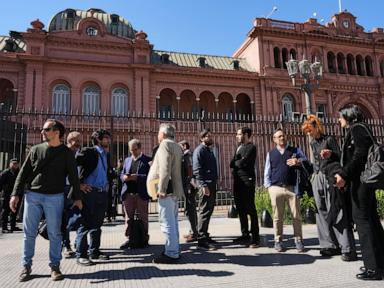
The Pink House stands at the edge of the Plaza de Mayo like a sunset frozen in stone. To most, the Casa Rosada is a backdrop for postcards or a stage for historic speeches. But for a select group of people, those who carry notebooks and wear out the soles of their shoes chasing the truth, it is a workplace. Or at least, it was.
Imagine a journalist named Elena. She has spent fifteen years walking the tiled corridors of the government headquarters. She knows which floorboards creak near the press room. She knows the specific, bitter scent of the coffee served in the basement cafeteria where aides whisper secrets. Elena isn’t a character from a movie; she represents the institutional memory of a nation’s accountability. When she walks into the Casa Rosada, she isn't just a visitor. She is the eyes of the public.
Today, the door didn't open.
The administration of Javier Milei recently shifted the bolts. New regulations now dictate who is "qualified" to ask questions within those salmon-colored walls. Journalists who have spent decades covering the presidency suddenly found their credentials revoked or stalled. The government argues this is about professionalization and space. Critics, however, see something far more ancient at play: the slow, deliberate cooling of a democracy’s heartbeat.
The Weight of a Dead Microphone
Freedom isn't always lost in a singular, explosive moment. It often disappears in the small, quiet inconveniences. It dies when a press conference is scheduled with five minutes' notice. It fades when a "technical error" mutes a reporter’s microphone during a live stream.
In Argentina, the tension between the press and the presidency has reached a fever pitch. The new restrictions require journalists to prove a level of "professionalism" that remains vaguely defined by the very people they are meant to scrutinize. Think about that dynamic. It is like a student being given the power to decide which teachers are allowed to grade their exams.
When the government decides who gets to be a journalist, the "news" stops being a report and starts being a script.
The stakes are not abstract. Argentina is a country that knows the price of silence. The history of the 20th century in the Southern Cone is a bloody map of what happens when the halls of power become echoes chambers. When the Casa Rosada stops being a place of inquiry and starts being a fortress, the distance between the leader and the led grows. That gap is where corruption breathes.
The Digital Fortress
The battle isn't just happening in the physical hallways of the Pink House. It has migrated to the digital arena. Milei, a leader who rose to power on the back of viral clips and aggressive social media campaigns, views traditional media with a skepticism that borders on hostility.
To the current administration, the "accredited journalist" is a relic of an old world—a "caste" that stands between the leader and his followers. They prefer the directness of a tweet or a live stream, where there is no one to ask a follow-up question. There is no one to point out that the numbers in the budget don't quite add up. There is no one to ask about the human cost of austerity measures while looking the President in the eye.
This is the hidden cost of the locked door. When you remove the Elenas of the world from the building, you remove the friction. Friction is annoying. It slows things down. But friction is also what keeps a car from sliding off a cliff.
The government claims the press room was overcrowded. They say they are simply bringing order to chaos. Yet, the reporters who have been barred are often the ones who ask the most uncomfortable questions. It is a strange coincidence that "order" looks exactly like "compliance."
The Anatomy of an Empty Chair
Walk through the press gallery now and you will see the gaps. An empty chair in a briefing room is a silent protest. It represents the questions that weren't asked.
- Who is benefiting from the latest currency devaluation?
- What are the specific protections for the millions falling below the poverty line?
- Why were the credentials of a veteran reporter from a major international outlet suddenly "under review"?
The answers to these questions belong to the people in the suburbs of Buenos Aires, the farmers in the pampas, and the students in Córdoba. But those people cannot walk into the Casa Rosada. They rely on the proxy of the press.
When the government bars a journalist, they aren't just insulting a person with a badge. They are effectively telling the citizen: "You don't need to know. Just trust us."
Trust is a dangerous currency when it is demanded rather than earned. In the streets of Argentina, inflation is a physical weight. People feel the economy in their empty pockets and their shrinking grocery bags. In times of such profound uncertainty, the need for clear, unbiased reporting isn't just a professional preference—it's a survival tool.
The Long Shadow of the Pink House
The sun sets over the Plaza de Mayo, casting long, thin shadows from the palms. The protesters have mostly gone home. The police lines remain. And behind the windows of the Casa Rosada, the lights stay on late into the night.
Inside, decisions are being made that will echo for a generation. Outside, on the sidewalk, a reporter stands with a smartphone, trying to get a signal, trying to catch a glimpse of an official leaving through the side gate.
There is a specific kind of loneliness in being a journalist who is told they no longer belong in the room where history happens. It is the loneliness of the watchman who has been locked out of the tower.
We often think of press freedom as a grand, philosophical concept discussed in university halls. We forget that it is actually made of very small things. It is made of plastic ID cards. It is made of the right to stand in a hallway and wait for a quote. It is made of the ability to look at a powerful person and ask, "Why?"
The door to the Casa Rosada remains pink, beautiful, and heavy. It is a masterpiece of architecture. But a door is only as good as its hinges. If it doesn't swing open for those whose job it is to watch the powerful, it isn't a door at all.
It's a wall.
And walls, no matter how historic or beautifully painted, have a way of making people on both sides feel very, very small.