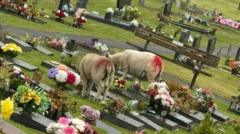
The headlines are predictable. They scream about "desecration" and "disrespect" because a few woolly lawnmowers dared to nibble on a plastic-wrapped bouquet or tread upon a patch of grass. Local residents are up in arms, clutching their pearls because sheep are roaming through the local graveyard. They see a PR disaster. I see the only logical solution to a multi-billion dollar maintenance crisis that is currently rotting our civic budgets from the inside out.
The outrage is rooted in a fundamental misunderstanding of what a cemetery is supposed to be. We have traded the "garden of rest" for a sterile, high-maintenance museum of grief. We demand golf-course precision in places meant for eternal decay. It is time to stop pretending that a loud, carbon-spewing John Deere is more "respectful" to the dead than a biological process that has governed the earth for millennia.
The Industrialization of Grief
Modern cemetery management is a logistical nightmare masquerading as a service. To keep a standard five-acre plot looking like a suburban lawn, a municipality spends thousands of dollars annually on fuel, labor, and equipment repairs. This doesn't even account for the damage caused by heavy machinery.
If you are worried about sheep "trampling" graves, you haven't seen what a 1,500-pound zero-turn mower does to soft earth after a rainstorm. It compacts the soil, creates ruts, and chips away at the bases of Victorian headstones with every pass. We are literally grinding our history into dust so we can keep the grass at exactly 2.5 inches.
Sheep are light. They are nimble. They don't have blades that catch on a loose piece of granite and send a shard flying. More importantly, they don't care about "curb appeal." They perform a service called conservation grazing, a practice used by organizations like the National Trust to manage delicate ecosystems where machines would be too destructive.
The Plastic Flower Delusion
The biggest complaint in these viral stories? "They ate my flowers."
Let’s be brutally honest: most of the "flowers" left at modern gravesites are environmental toxins. They are polyester, plastic, and wire. They don't biodegrade; they just fade, fray, and eventually get sucked into a mower's intake, where they are shredded into microplastics and sprayed across the soil.
When a sheep eats real, organic flowers, it is participating in a nutrient cycle. When a sheep refuses to eat your plastic peonies, it’s highlighting the absurdity of our modern mourning rituals. We want the appearance of life without the messy reality of biology.
If we want to honor the dead, we should be planting native wildflowers that support local pollinators, not buying $10 bundles of chemically treated roses from a grocery store. If a sheep eats the vegetation, it returns those nutrients to the ground in the form of natural fertilizer. It is the literal embodiment of "ashes to ashes."
The Economics of Ecological Maintenance
Let's look at the numbers. A single commercial mower costs between $10,000 and $20,000. It requires a trailer, a truck to pull it, insurance for the operator, and constant fuel.
Sheep require a fence and water.
In the UK, councils like those in West Wales have already experimented with using sheep to manage "overgrown" churchyards. The result? A 70% reduction in maintenance costs and a massive spike in local biodiversity. By allowing sheep to graze, we allow rare grasses and wildflowers to seed. We create a habitat for ground-nesting birds and insects that have been driven out by the relentless drone of the two-stroke engine.
| Maintenance Method | Annual Cost (Est.) | Ecological Impact | Structural Risk |
|---|---|---|---|
| Mechanical Mowing | $5,000 - $12,000 | High Carbon / Low Biodiversity | High (Vibration/Impact) |
| Sheep Grazing | $500 - $1,500 | Carbon Neutral / High Biodiversity | Low (Low PSI/No Blades) |
The "lazy consensus" says that sheep are a sign of neglect. The data says they are a sign of intelligence. We are currently facing a global crisis in "death care" funding. Perpetual care funds are drying up. Choosing sheep isn't just an "eccentric" move; it’s the only way to ensure these spaces remain viable for the next century without bankrupting the local taxpayer.
The Silence of the Graveyard
The most jarring thing about a modern cemetery isn't the headstones—it’s the noise.
People visit cemeteries for reflection, for silence, and for a connection to something beyond the daily grind. Nothing shatters that faster than the high-pitched whine of a weed-whacker. It is the ultimate irony: we go to the "silent city" and find it filled with the roar of internal combustion.
Sheep provide a background hum of life. They are quiet. They move slowly. They don't have a 4:00 PM shift to finish, so they don't rush. There is a psychological benefit to seeing animals in a space dedicated to death. It reminds the living that life continues. It strips away the sterile, clinical atmosphere of the modern memorial park and replaces it with a landscape that feels lived-in and cared for.
Addressing the "Dignity" Argument
Critics argue that having livestock defecate near graves is undignified.
I've spent twenty years looking at how we manage land. I can tell you that there is nothing "dignified" about a neglected cemetery where the weeds are five feet tall because the city can't afford the gas for the mowers. There is nothing "dignified" about chemical herbicides like glyphosate being sprayed over the resting places of your ancestors to kill a few dandelions.
We have sanitized death to the point of absurdity. We want the grass to look like a carpet and the air to smell like exhaust, all to maintain a facade of "order." Sheep bring a different kind of order—a natural one.
The real "desecration" isn't an animal eating a flower. It’s the fact that we have turned our cemeteries into ecological dead zones. We have paved over the earth, poisoned the soil, and priced ourselves out of being able to maintain the very sites we claim to hold sacred.
The Uncomfortable Truth
The outcry against sheep in cemeteries is a symptom of our disconnection from the land. We want nature, but only if it's "manicured." We want peace, but only if it's "industrialized."
If you truly want to honor your loved ones, stop demanding that the city spend your tax dollars on a fleet of mowers. Demand a flock of sheep. Demand a space that breathes, that grows, and that functions as a part of the local ecosystem rather than a drain on it.
The sheep aren't the problem. Our ego is. We are so obsessed with controlling the appearance of the grave that we’ve forgotten the purpose of the ground. It’s time to move past the outrage and embrace the flock.
Buy the sheep. Save the cemetery. Stop worrying about the plastic flowers.