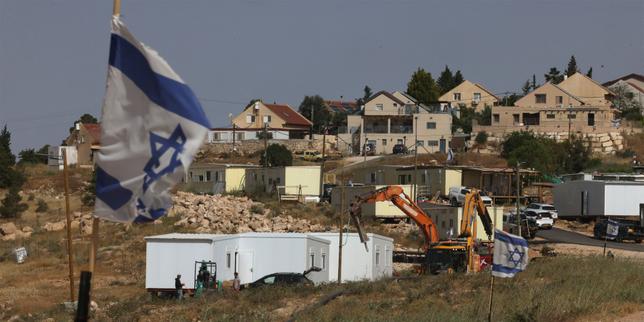
The olive tree did not care about the paperwork.
It had stood on the rocky hillside just outside Ramallah for three generations, its roots twisted deep into the dry West Bank soil, yielding the same bitter, green fruit every autumn. To the family who owned it, the tree was a living ledger of their ancestry. But to the bulldozer that arrived on a damp Tuesday morning, it was merely an obstacle.
When the metal blade bit into the trunk, the sound was not a clean snap. It was a groan. A heavy, splintering protest that echoed across the valley, signaling yet another shift in a landscape defined by invisible boundaries.
Across Europe, four Ministers of Foreign Affairs sat in climate-controlled offices, staring at maps that tracked these very groans. In Paris, Rome, Berlin, and London, the data translated into a stark, urgent consensus. The expansion of Israeli settlements in the West Bank had reached a tipping point, prompting France, Italy, Germany, and the United Kingdom to issue a joint, forceful demand: stop.
This is not a story about abstract real estate. It is about what happens when the geopolitical tectonic plates shift, and ordinary lives are caught in the crush.
The Friction of Expanding Horizons
To understand the weight of the European joint statement, one must look past the diplomatic jargon of "demographic shifts" and "territorial contiguity." Look instead at the asphalt.
Consider a hypothetical resident named Daoud. For decades, his drive to visit his sister in a neighboring village took fifteen minutes. Today, that same journey takes two hours. The road is severed by a checkpoint, re-routed around a newly gated community perched on the hilltop above his home. The new neighborhood features red-tiled roofs, manicured lawns, and a heavily guarded perimeter.
From the hilltop, the perspective is entirely different. For the families moving into the settlements, these hills represent historical connection, affordable housing, and a sense of pioneer defiance. They see security barriers where Daoud sees a cage.
This dual reality creates a friction that heats the entire region. The four European powers did not intervene out of a sudden burst of idealism. They acted because the math of peace is running out of room.
The internationally backed solution to this decades-old conflict has long been simple to state but agonizing to execute: two states for two peoples, living side-by-side. But a state requires contiguous land. It requires roads that connect cities rather than bypass them. Every new housing unit approved, every outpost retroactively legalized, chips away at the physical possibility of that future.
The joint statement from Paris, Rome, Berlin, and London was explicit. The accelerated pace of settlement approvals, coupled with rising settler violence, is actively dismantling the foundations of a viable Palestinian state. It is a slow-motion erasure of a political horizon.
The Weight of Four Capitals
Why does the collective voice of these four nations matter now?
Historically, European nations have often chosen distinct paths in Middle Eastern diplomacy. Germany, carrying the profound weight of its 20th-century history, traditionally balances its fierce commitment to Israel’s security with its support for international law. France often positions itself as a champion of Mediterranean stability and Palestinian self-determination. Italy prioritizes regional commerce and diplomatic mediation, while the United Kingdom maneuvers through its own complex colonial legacy in the region.
When these four distinct diplomatic traditions speak with a single, unyielding voice, the global community listens. It signifies that the situation on the ground has breached the threshold of standard diplomatic concern.
The joint communique did not mince words. It highlighted that the current trajectory threatens not only regional stability but the very framework of international law that Europe has spent eight decades trying to fortify. If boundaries can be continuously rewritten by force and bureaucratic persistence, the concept of international law becomes a luxury item—applied only when convenient.
The Ministers pointed directly to a terrifying feedback loop. As settlements expand, tensions flare. Radical elements on both sides find fresh fuel for their narratives. The cycle of retaliation spins faster, leaving moderate voices isolated and powerless.
The Arithmetic of Containment
The tragedy of the West Bank is that the conflict is fought in inches, but the consequences are measured in generations.
Imagine a classroom in Hebron. The children inside do not read geopolitical analyses. They watch the world through the grid of window bars. They learn early which streets they are forbidden to walk down, which neighbors look at them with suspicion, and which soldiers hold the power to disrupt their morning routine.
This environment breeds a specific kind of exhaustion. It is a quiet, corrosive weariness that settles into the bones of everyone involved. It affects the Israeli soldier stationed at a checkpoint, tasked with policing a civilian population, just as deeply as it affects the Palestinian family waiting in line for hours under the midday sun to return home.
The European intervention is an attempt to break this arithmetic of containment. The four nations are acutely aware that a flare-up in the West Bank would not remain confined to the valley. The geopolitical ripples would wash over a Europe already grappling with the fallout of the war in Ukraine and shifting energy dependencies.
Western leaders are terrified of a multi-front escalation. With Gaza already scarred by devastating conflict, a systemic collapse of order in the West Bank would create a humanitarian and security vacuum that could drag the entire Middle East into prolonged chaos.
The Vanishing Horizon
What happens when a population loses its belief in tomorrow?
When the four European powers demand a halt to settlement expansion, they are not merely asking for a freeze on construction cranes. They are trying to preserve a psychological asset: hope.
Without the belief that a fair, negotiated settlement is possible, the alternative is not a peaceful status quo. The alternative is a perpetual pressure cooker. When young people look at the map and see their future fragmented into isolated enclaves, the appeal of radicalization grows. The moderate path requires a destination, and right now, that destination is being paved over.
The joint statement represents a line drawn in the diplomatic dust. It is a reminder that while power can alter facts on the ground, it cannot alter the fundamental human need for dignity, sovereignty, and recognition.
The bulldozer eventually moved on from the hillside outside Ramallah, leaving behind a scarred patch of earth and a stump bleeding sap into the dirt. The family gathered the broken branches, intending to use the wood for fuel. They did not shout. They did not protest to the empty sky. They simply sat on the stone wall, watching the new road carve its way through the valley below, wondering how much narrower their world would become before the rest of the world decided to look.