The scent of burning sandalwood always clings too tightly to wool. You walk into a crowded hall, the air thick with the murmur of a thousand prayers, and suddenly the distinction between devotion and theatre blurs until you cannot tell which one is breathing.
A microphone stands alone on a raised wooden stage. A man in saffron robes leans forward, his voice cutting through the humid afternoon like a blade. Words are dangerous things when they are amplified. They bounce off concrete walls, escape through open windows, and spill out into the dusty streets where ordinary people are trying to figure out how to afford their next meal. For an alternative look, see: this related article.
When Bageshwar Baba spoke about food, about what belongs on a plate and what belongs in a ritual, he probably thought he was just preaching to his choir. He likely expected the usual nods of agreement, the rhythmic clapping of believers who treat every sentence from a charismatic figure as absolute law. But microphones have a way of carrying farther than intended. They cross the invisible boundary of the tent flap. They reach the ears of people who do not care about spiritual ranks, people who only heard a direct insult hurled at their plates, their traditions, and their daily survival.
He called us hypocrites. Related analysis on this matter has been provided by Reuters.
The silence that followed that declaration did not last long. In West Bengal, a state where political blood runs as hot as summer tea and cultural identity is defended with a ferocious pride, those words acted as a match dropped into dry brush.
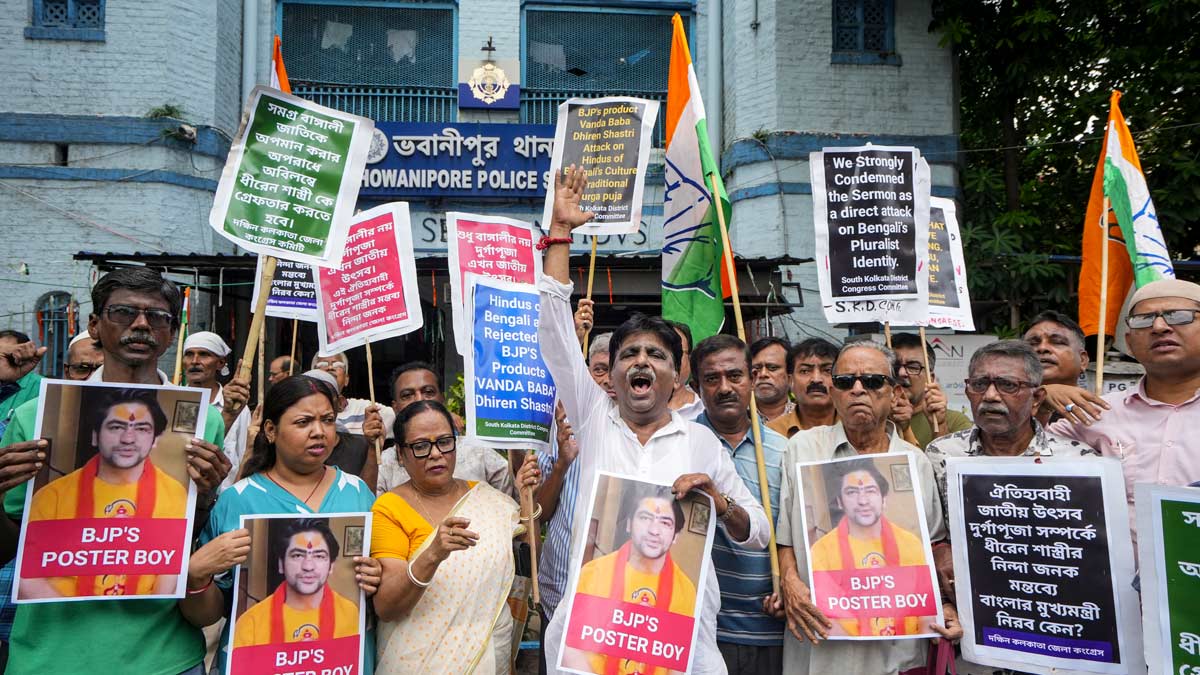
Consider what happens next. A statement is uttered on a stage. Within hours, it is a pixelated video on a cracked smartphone screen. By the next morning, political offices are stirring. The Bengal Congress, an organization fighting to reclaim its footing in a shifting political topography, did not issue a polite press release expressing mild concern. They marched straight to the police station. They demanded an FIR. They wanted a formal, legal stamp of criminality attached to a sermon.
We live in an era where theology and jurisprudence are constantly tripping over each other. Every time a religious figure makes a provocative claim about diet, morality, or lifestyle, the automatic reflex is to call the cops. As if a courtroom could settle a theological debate. As if a penal code could rewrite centuries of dietary customs across a diverse nation.
Let us step back for a moment and look at the anatomy of this outrage.
Food in India is never just fuel. It is an autobiography. It tells you where a family came from, which gods they bow to, what financial bracket they occupy, and what histories they carry in their bones. When someone with a massive following starts dictating the moral hierarchy of the kitchen, they are stepping onto very volatile ground. They are telling a factory worker in Howrah or a fisherman in the Sundarbans that their daily meal is somehow spiritually deficient.
Naturally, the backlash was fierce. Critics pointed out the glaring irony of spiritual leaders lecturing the public on austerity while traveling in luxury motorcades. That is where the accusation of hypocrisy found its footing. It is easy to preach detachment from material wealth when your followers ensure your pockets are lined. It is entirely another to stand in a queue for subsidized rations and listen to a man on a dais tell you that your lifestyle is the root of societal decay.
Yet, calling for police action creates a different kind of danger. When political parties use the machinery of the state to police speech—even offensive, arrogant, or polarizing speech—they open a door that is nearly impossible to close. Today, it is a godman making controversial remarks about food. Tomorrow, it is a dissenting journalist, a campus activist, or an ordinary citizen complaining about potholes. The tools of censorship are bipartisan. Once forged, everyone eventually uses them.
The controversy refuses to die down because it touches a raw nerve about authority in modern public life. Who gets to define culture? Who gets to police the plate?
We have watched this script play out before. A charismatic figure makes a sweeping generalization. The media amplifies it. The opposition reacts with moral fury. Legal complaints are filed. Headlines churn for forty-eight hours until a new storm arrives to wash the old one away. Nothing changes in the streets, but the walls of division grow a little higher, a little thicker, and a little colder.
Walk down any street in Kolkata as the evening fog rolls off the Hooghly River. You will smell fried street food mingling with the incense drifting from neighborhood temples. People of every background are sitting side by side on plastic stools, sharing space, sharing air, sharing the simple, unglamorous burden of living. They are not thinking about FIRs. They are not calculating the spiritual purity of their onions and garlic. They are just trying to get home before dark.
The men in the air-conditioned political offices and the gurus on their elevated stages operate in a stratosphere far removed from those plastic stools. They trade in symbols, outrage, and influence. They turn the sacred act of eating into a culture war battleground because division pays dividends.
When the police eventually review the complaints and the television anchors move on to the next manufactured crisis, the core issue will remain untouched. The fundamental tension between institutionalized orthodoxy and the messy, pluralistic reality of everyday life cannot be solved by a police report. It requires something much harder to achieve. It requires a willingness to listen to the people on the other side of the microphone, rather than just telling them how wrong they are.
Until that happens, the microphones will stay turned up, the crowds will keep clapping, and the distance between the stage and the street will continue to widen until no one can hear the quiet voices anymore.