Saltwater does not simply clean a coastline; it claims it.
Ask anyone who has ever owned a house perched on the very edge of the Long Island Sound where the water meets the sky in an endless, slate-gray smear. The wood learns to swell. The glass learns to weep salt. And the people who live there learn to listen to the tide the way a doctor listens to a heartbeat. They know when the water is restless. They know when it is coming for them.
Most waterfront real estate sells itself on convenience. A thirty-minute commute. A manicured lawn. A dock for a boat you will use twice a year. But there is a different breed of property out there—properties built not for convenience, but for isolation. Monuments of glass and steel thrust into the open air, daring the weather to do its worst.
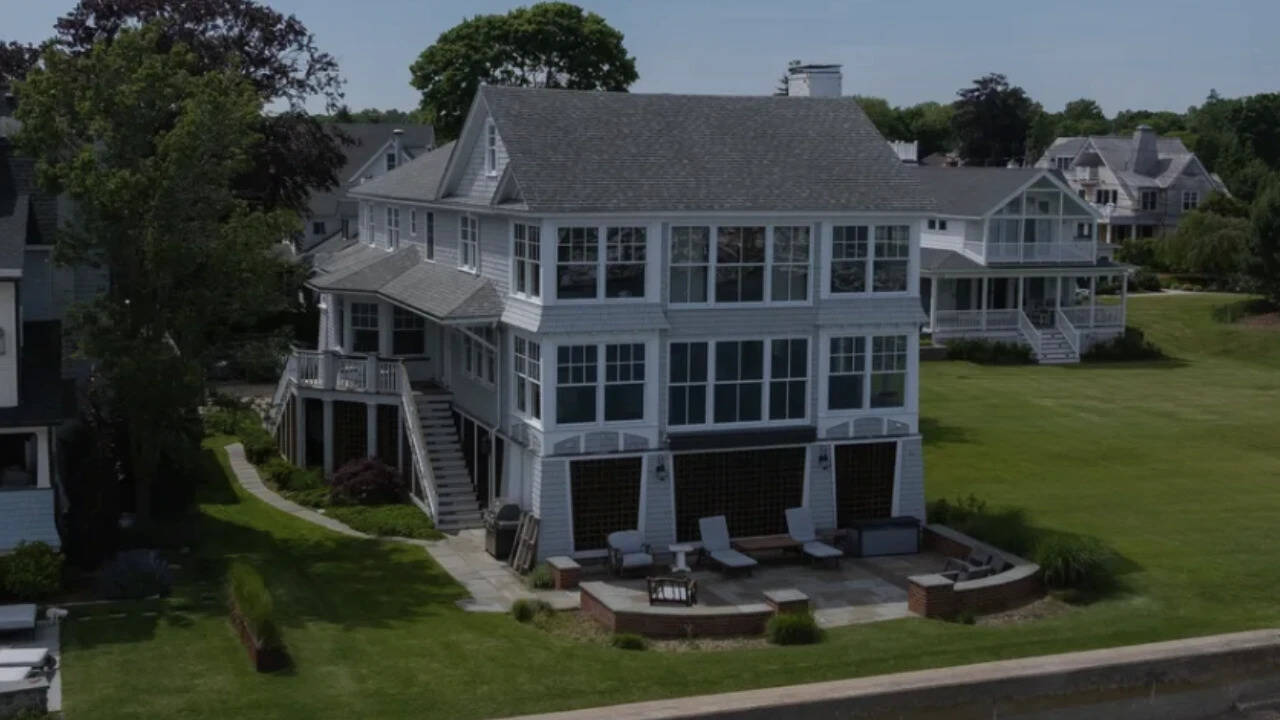
Consider the glass-wrapped sanctuary rising out of the Connecticut shore, a structure so unapologetically bold it looks less like a home and more like a navigational warning. It is a house designed with the proud, solitary silhouette of a nineteenth-century lighthouse. And soon, it will belong to someone else.
For $2.1 million, the keys to this beacon are heading to the auction block. But numbers on a listing sheet tell you nothing about what it actually feels like to stand inside a cylinder of glass while a nor'easter howls across the water at midnight.
The Architecture Of Exposure
Glass is a fragile arrogance.
When architects wrap an entire home in floor-to-ceiling panes, they are making a bet against the elements. They are wagering that the view—the uninterrupted, 360-degree theater of sunrise and storm—is worth the absolute erasure of privacy.
This particular home on the Connecticut waterfront makes that bet and doubles down. Its lighthouse-like geometry means there are no dark corners to hide in, no traditional rectangular rooms where you can forget where you are. You are exposed. The sky is your ceiling; the sound is your wallpaper.
Imagine standing on the upper level as the sun dips below the horizon, turning the water into molten copper. The light floods the room from every direction. You aren't just looking at the landscape; you are suspended inside it. There is a vertigo to it, a dizzying sense of floating above the earth.
Yet, beauty like this always exacts a toll.
The maintenance alone requires a specific kind of devotion. Every storm leaves a film of salt that crusts the glass, blurring the world until the windows are washed clean again. The wind pushes against the curved walls with a physical weight, groaning through the joints of the frame. To live here is to accept that nature is an uninvited roommate who refuses to take off her muddy boots.
Why We Crave The Edge
Why do we do it? Why do humans feel an irresistible urge to build our shelters on the most precarious, wind-lashed edges of the continent?
Psychologists call it prospect-refuge theory. We crave a safe, protected space (the refuge) combined with an expansive view of the surrounding terrain (the prospect). It is an evolutionary leftover from the days when our survival depended on spotting predators across the savanna before they spotted us.
A lighthouse home takes that ancient instinct and cranks the volume to maximum. It satisfies our deepest, quietest desire to escape the noise of the crowded mainland without actually having to live in a cave. It offers sovereignty. When you lock the door of a glass tower overlooking the water, the rest of the world simply ceases to exist. The politics, the traffic, the endless ping of notifications—they dissolve into the rhythmic crash of the waves against the bulkhead.
For $2.1 million, the winning bidder is not buying square footage. They are buying silence. They are buying the rare, vanishing luxury of watching the world turn in absolute solitude.
The Auction Block Drama
Real estate is usually a polite negotiation. Agents drink iced coffee in air-conditioned sedans. Contracts pass back and forth across mahogany tables with redlines and counter-offers.
An auction is different. An auction strips away the polite fiction.
When a property goes to the auction block, the gloves come off. There is no time to ponder, no luxury of sleeping on a decision for three weeks while you inspect the gutters. There is only the ticking clock, the rise of the paddle, and the sudden, terrifying realization that someone else wants your dream just as badly as you do.
Picture the room on auction day. The hum of nervous energy. The quiet whispers between bidders who are trying to read each other's posture. Every raise of the hand is a silent declaration: I want this life more than you do.
At $2.1 million, the bidding will likely open a conversation about value versus vanity. Is a glass lighthouse on the Connecticut shore worth a king's ransom? To an investor looking at spreadsheets, maybe not. But to the romantic who has spent twenty years staring at spreadsheets in a Manhattan high-rise while dreaming of the salt air—it is priceless.
It is the physical manifestation of an exit strategy from the ordinary.
The View From The Top
The auctioneer's hammer will fall. The checks will clear. The new owner will walk up the steps, unlock the door for the first time, and hear the acoustic resonance of a curved glass room catching the ocean breeze.
They will walk to the edge of the glass, press their palm against the cool surface, and look out over the water. The horizon will stretch out forever, indifferent to who owns the land beneath it.
The wind will pick up. The light will change from gold to indigo. And for a moment, standing there in the round room at the edge of the world, they will understand exactly why they paid the price.
Some places don't just shelter you. They wake you up.