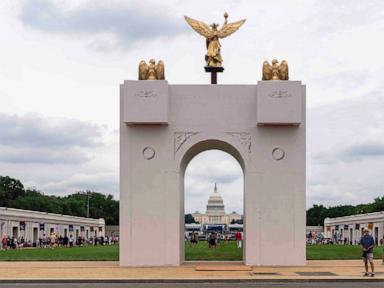
Public debates over national monuments frequently reduce complex questions of administrative law, federal land management, and historical preservation into partisan morality plays. Recent reporting on legal efforts by members of the Kennedy family to halt a proposed memorial arch near Arlington National Cemetery illustrates this pattern. Standard media coverage tends to frame the dispute as a clash of political dynasties or a simple question of aesthetic taste.
That framing overlooks the foundational legal and institutional issues actually at stake. When private citizens, historic families, and executive branch officials clash over the physical layout of the National Capital Region, the outcome rarely hinges on sentiment. Instead, it turns on statutory authority, congressional appropriations, environmental review mandates, and the strict boundaries separating executive initiative from legislative control over federal property.
The Architecture of Federal Monument Authority
To understand any legal challenge involving federal memorials in the Washington, D.C. metropolitan area, one must examine the Commemorative Works Act of 1986. Congress enacted this statute specifically to prevent ad hoc, unilateral alterations to the monumental core of the capital and its surrounding federal lands.
Under the Commemorative Works Act, neither a sitting president nor a private foundation can simply erect a permanent structure on federal parkland or near hallowed ground like Arlington National Cemetery without navigating a multi-agency gauntlet. Key statutory requirements include:
- Congressional Authorization: The Act generally requires specific legislative authorization from Congress before a commemorative work can be established on federal land administered by the National Park Service or the General Services Administration.
- Site and Design Approval: Proposals must undergo rigorous review by the National Capital Planning Commission (NCPC) and the U.S. Commission of Fine Arts (CFA). These bodies evaluate everything from sightlines and traffic impact to historical context and architectural compatibility.
- Funding Restrictions: Federal funds typically cannot be used to construct new commemorative works unless explicitly appropriated by Congress, meaning proponents often rely on private fundraising mechanisms that trigger separate ethics and procurement rules.
When plaintiffs seek an injunction to block a monument project, their strongest legal weapons are rarely emotional appeals to legacy. Rather, plaintiffs rely on the Administrative Procedure Act (APA), arguing that federal agencies acted arbitrarily, bypassed mandatory public comment periods, or failed to conduct required reviews under the National Environmental Policy Act (NEPA) and Section 106 of the National Historic Preservation Act.
The Sightline and Sacred Space Debate
Arlington National Cemetery and the adjacent Memorial Bridge corridor occupy a uniquely sensitive position in American civic architecture. Designed in the early twentieth century to physically and symbolically link the Lincoln Memorial on the National Mall with Arlington House across the Potomac River, the corridor relies on unobstructed axial views.
Critics of new monumental additions in this zone—including members of the Kennedy family, whose relatives President John F. Kennedy and Senator Robert F. Kennedy are buried at Arlington—argue that introducing a massive new arch disrupts an intentional, completed historical design. Preservationists point out that the Memorial Avenue corridor was conceived as a unified ceremonial approach, not an open gallery for continuous additions.
Conversely, proponents of new commemorative architecture argue that national memory is not static. Throughout American history, major additions to the capital's monumental core—including the Vietnam Veterans Memorial, the World War II Memorial, and the Dwight D. Eisenhower Memorial—faced intense initial opposition from preservationists, neighboring stakeholders, and aesthetic critics who claimed the new structures would ruin existing sightlines or overwhelm sacred spaces.
Standing and the Limits of Legacy Litigation
A critical legal hurdle in any lawsuit brought by descendants of historical figures is Article III standing. In federal court, a plaintiff cannot sue simply because they dislike a government policy or feel a proposed structure diminishes the aesthetic dignity of a relative's resting place.
To establish standing, plaintiffs must demonstrate:
- Injury in Fact: A concrete, particularized, and actual or imminent harm—not a generalized grievance shared by the public at large.
- Causation: A direct causal link between the challenged government action and the alleged injury.
- Redressability: A likelihood that a favorable court decision will actually remedy the harm.
In historic preservation litigation, courts sometimes recognize standing for individuals who regularly visit a site and suffer direct aesthetic or recreational injury from a procedural violation under NEPA or the National Historic Preservation Act. However, courts routinely reject claims based solely on familial association with a public site, as federal cemeteries and national parks belong to the public trust rather than private estates.
Executive Ambition vs. Institutional Guardrails
Presidents across the political spectrum have sought to leave lasting physical marks on the capital's landscape, whether through presidential libraries, garden redesigns, or new national monuments. Yet the American system deliberately slows down monumental construction to ensure that permanent alterations to public spaces reflect broad, enduring consensus rather than the priorities of a single administration.
According to legal scholars and former officials from the National Capital Planning Commission, the tension between executive vision and statutory review is a feature, not a bug, of federal land law. When an administration attempts to accelerate a major architectural project using executive orders or existing discretionary funds, it invites immediate judicial scrutiny under the APA. Conversely, when opponents rely on procedural delays to run out the clock on an administration's term, they use the exact same statutory mechanisms that have stalled infrastructure and conservation projects nationwide.
The Broader Precedent for Public Land
The dispute over the Arlington memorial arch ultimately tests whether existing federal preservation statutes still function as intended when confronted with high-profile political initiatives. If a court finds that agencies bypassed mandatory environmental, historical, or planning reviews, an injunction becomes a standard enforcement of statutory text. If, however, the agencies followed every procedural step required by Congress, judicial intervention becomes far harder to justify, regardless of how controversial the design may be.
The outcome will not settle debates over presidential legacies or artistic merit. Instead, it will clarify how strictly federal courts enforce the procedural guardrails governing who gets to reshape America's most symbolic public spaces—and how much unilateral power any president actually holds over the nation's physical memory.