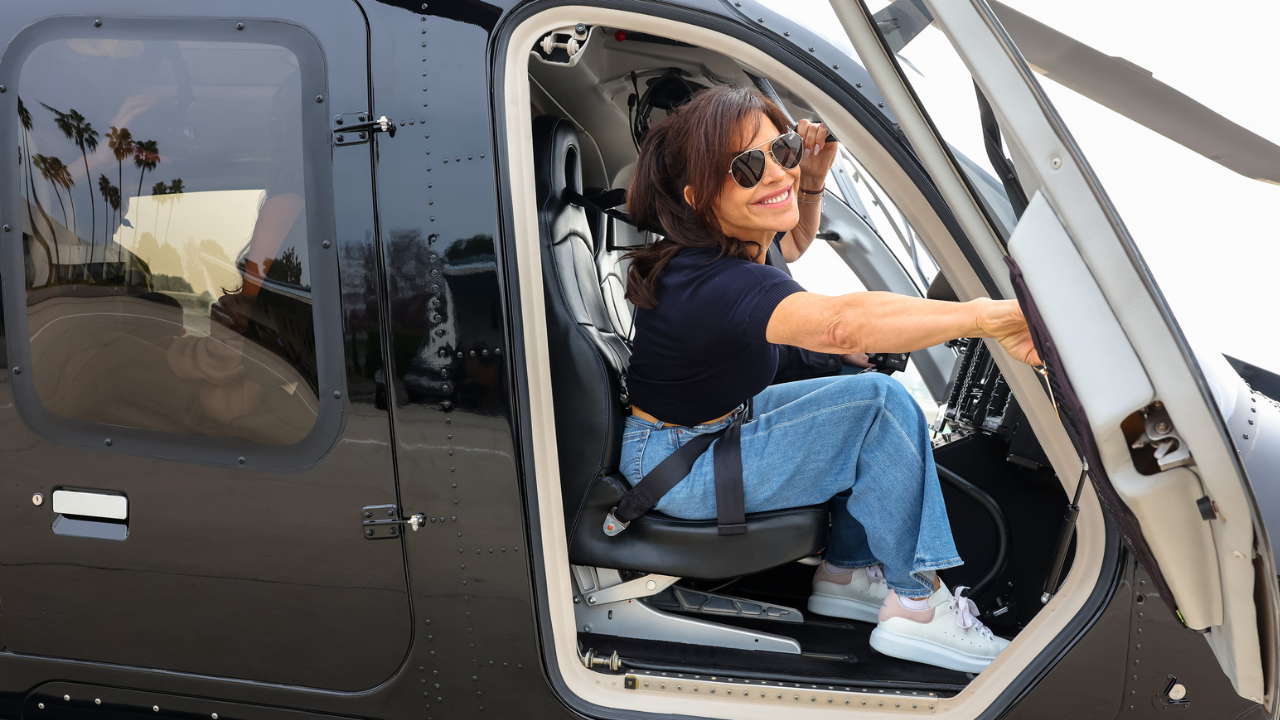
Lauren Sánchez transitioned from a high-profile career in broadcast television to founding Black Ops Aviation, an aerial film and production company that has captured rocket launches for Blue Origin. She obtained her helicopter pilot license in 2016, establishing a specialized enterprise focused on stabilized aerial cinematography for major studios and aerospace ventures. By combining decades of television production instincts with aviation certification, she positioned herself as a rare female owner in a male-dominated sector, moving from reading scripts on morning shows to operating complex camera platforms in restricted airspace.
Most profiles treat this career arc like a fairy tale. They frame it as a sudden, glamorous reinvention spurred by a billionaire romance. That narrative misses the actual mechanics of how television veterans survive industry contraction and how modern aerospace companies market themselves. Local television news has been shedding talent and budgets for twenty years. Meanwhile, private spaceflight companies like Blue Origin desperately needed cinematic, broadcast-grade visuals to compete with the relentless media machine of SpaceX. Sánchez did not simply stumble onto a helipad; she executed a calculated pivot from depreciating media real estate into a high-barrier-to-entry technical niche.
The Economics of Leaving the Anchor Desk
To understand why an Emmy-winning anchor walks away from network television, you have to look at the balance sheet of broadcast media in the mid-2010s.
Sánchez spent years building a recognizable brand on Good Day LA, Extra, and So You Think You Can Dance. On paper, it was a stable, lucrative run. In reality, daytime and local syndication were hitting a ceiling. Advertising dollars were migrating to digital platforms, networks were tightening talent contracts, and the shelf life for female anchors in Los Angeles television remained notoriously unforgiving. Staying in front of the camera meant accepting diminishing returns and zero equity.
Aviation offered the exact opposite equation.
Obtaining a commercial helicopter license requires significant capital, hundreds of flight hours, and rigorous Federal Aviation Administration testing. Those requirements act as a natural moat. Unlike digital media, where anyone with a smartphone and a ring light can claim to be a producer, aerial cinematography is heavily regulated. You cannot fake your way through airspace clearances or gyro-stabilized gimbal operations. By earning her rating in 2016 and launching Black Ops Aviation, Sánchez moved from being an employee whose value was tied to on-air visibility to an owner-operator controlling scarce, high-value equipment.
Her father, Ray Sánchez, was a flight instructor and mechanic. Aviation was never an abstract hobby for her; it was a familiar trade. Yet knowing how to fly a Robinson R44 or an Airbus H125 is only half the equation. The real commercial value lies in understanding what a director needs inside the frame. Most career pilots think in terms of vectors, fuel burn, and wind shear. Most television producers think in terms of lighting, focal length, and narrative tension. Bridging those two languages on a live set saves production companies tens of thousands of dollars per day.
Inside the Business of Aerial Cinematography
Aerial production is an unforgiving logistical puzzle. When Black Ops Aviation takes on a project—whether for a Christopher Nolan film or a commercial launch—the company is not merely renting out an aircraft. They are selling precision.
Modern aerial filming relies on stabilized camera systems, such as the Shotover or GSS platforms, mounted to the nose of a helicopter. These rigs house cinema-grade cameras like the RED or ARRI Alexa, suspended on multi-axis gimbals that counteract the violent vibration of the rotor blades. Even a microscopic tremor ruins a telephoto shot from two miles away.
Operating this machinery requires tight choreography between the pilot and the camera operator:
- Airspace Coordination: Filming near urban centers or launch complexes requires Temporary Flight Restrictions, waivers from the FAA, and constant communication with air traffic control.
- Aircraft Positioning: The pilot must fly sideways, backward, or in tight orbits while accounting for rotor wash and sun angles, ensuring the skids never creep into the wide-angle frame.
- Fuel and Payload Math: Heavy cinema rigs, high-capacity batteries, and multiple crew members drastically reduce fuel capacity, limiting flight windows to tight, high-pressure bursts.
When Sánchez founded Black Ops Aviation, female-owned aerial production houses were virtually nonexistent. The industry has historically been an old boys' club populated by former military aviators and veteran Hollywood stunt pilots. Entering that space required more than just a business license; it required surviving the skepticism of line producers and insurance underwriters who default to familiar names when millions of dollars are on the line.
Filming Rocket Launches in West Texas
The intersection of Sánchez's aviation company and Blue Origin brought intense public scrutiny, largely because of her personal relationship with founder Jeff Bezos. Critics quickly dismissed her work at the West Texas launch site as a vanity project enabled by proximity to power. That assessment ignores the operational reality of aerospace media.
Rocket launches are notoriously difficult to film. Standard ground-based tracking cameras are often obscured by exhaust plumes, atmospheric heat haze, or terrain features. Once a booster like New Shepard clears the tower, ground cameras look straight into the blinding glare of the engines. To get clean, dramatic angles of stage separation or booster landings, you need an airborne platform positioned at a precise altitude outside the hazard zone.
Blue Origin, historically far more secretive and slow-moving than SpaceX, struggled for years to generate public excitement. While Elon Musk turned every static fire test and booster recovery into a viral livestream event, Blue Origin often released sterile, delayed footage that felt more like an engineering report than a historic milestone.
Bringing in an experienced television producer who also happened to pilot the camera ship changed the visual grammar of those broadcasts. Aerial footage gave Blue Origin scale. Seeing a suborbital rocket pierce the desert sky from the vantage point of a hovering helicopter humanized the hardware and created the kind of high-definition assets that network news programs eagerly air for free.
Of course, the proximity to Bezos remains an undeniable factor. In Hollywood and aerospace alike, access is the ultimate currency. Having a direct line to the owner of the rocket company removes the bureaucratic friction that typically stalls outside vendors. Yet access only gets you on the manifest; it does not keep a helicopter steady in high desert winds while tracking a vehicle moving at supersonic speeds. If the footage were unusable, it would never make the broadcast cut, regardless of who was at the controls.
The Reality of the Celebrity Founder Narrative
Modern media loves a clean transformation story, especially one that pairs a recognizable face with a rugged, technical skill. When Sánchez flew on Blue Origin's all-female NS-31 mission in 2025, the press coverage framed the flight as the ultimate culmination of her journey from news anchor to aviator to spaceflight participant.
Industry veterans view this trajectory with a mix of respect and pragmatism. On one hand, earning a commercial rotorcraft rating in your forties and building a functional production company from scratch is genuinely difficult. Aviation does not care about your IMDb page or your net worth; physics applies equally to everyone in the cockpit. Completing the training and logging the hours to operate safely in complex environments demands real discipline.
On the other hand, the narrative often glosses over the massive structural advantages that smooth the runway for celebrity entrepreneurs. Most independent aerial operators spend decades grinding out low-margin utility work—power line inspections, agricultural spraying, real estate photography—just to pay down the debt on a single used turbine helicopter. They do not start out with immediate access to A-list directors, major studio budgets, or private spaceports.
Acknowledging both truths does not diminish the work; it simply puts it in honest perspective:
- The Skill is Real: You cannot outsource a checkride. Passing FAA exams and managing emergency procedures like autorotations requires personal competence.
- The Leverage is Asymmetric: High-level connections accelerated the client acquisition phase in ways that ordinary small-business owners could never replicate.
- The Brand Value is Mutual: Studios and aerospace firms gain free publicity simply by hiring a high-profile pilot, turning a standard vendor contract into a press release.
This dynamic is increasingly common across the entertainment and tech sectors. Legacy media figures recognize that traditional salaries are shrinking, so they use their visibility to launch specialized service companies, then use their personal networks to secure anchor clients.
What Aerospace Media Actually Needs
As commercial spaceflight matures from an experimental novelty into a routine logistics business, the role of specialized aerial production is shifting. The novelty of watching a booster land vertically has worn off for the general public. Today, companies like Blue Origin, Rocket Lab, and SpaceX use video not just for public relations, but for engineering telemetry, investor reassurance, and regulatory compliance.
Long-range optical tracking from airborne platforms provides critical data on vehicle performance during phases of flight where ground radar loses fidelity. Cameras mounted on aircraft can capture thermal anomalies, structural flexing, and parachute deployment sequences with a clarity that ground sensors miss.
For a company like Black Ops Aviation, the long-term viability depends on evolving alongside those technical demands. Celebrity novelty has a short half-life. Once the press cycle moves on from the novelty of a former TV anchor flying helicopters in West Texas, the business survives entirely on reliability, safety records, and the raw quality of the visual data delivered to the client.
Sánchez successfully navigated one of the hardest transitions in modern media. She recognized early that the broadcast model she grew up in was eroding, identified an adjacent industry with steep barriers to entry, and acquired the credentials necessary to own the means of production rather than merely appearing in front of it. Whether filming a Hollywood action sequence or tracking a suborbital capsule descending through the desert haze, her career shift proves a fundamental rule of both aviation and business: control of the trajectory matters far more than how you look in the passenger seat.


