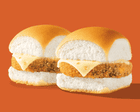
The neon sign buzzes with a low, comforting hum at 2:15 AM. It is a specific shade of blue and white, casting a stark glow over a wet asphalt parking lot. Inside, the air smells precisely as it has for decades—a heady, unmistakable cocktail of grilled onions, steam, and toasted buns. For generations, this place has been the ultimate equalizer. Shift workers with grease under their fingernails sit booths away from college students blurring the edges of a weekend. Drunk, sober, exhausted, or celebratory, everyone comes to the castle.
But tonight, something is fundamentally different about the cardboard box sliding across the stainless steel counter.
For nearly a century, the blueprint of the American fast-food slider remained untouched. It was a holy trinity of cheap beef, onions, and pickles, engineered during the Great Depression to provide affordable calories to a struggling nation. To alter the formula was to risk sacrilege. Yet, a quiet shift in the American kitchen has forced the hands of the traditionalists.
Consider a hypothetical customer named Marcus. He is twenty-four, working a grueling schedule in logistics, and trying desperately to reconcile the food he loves with the body he wants to keep healthy. He grew up on these square burgers. His grandfather bought them by the sackful for five cents a piece back in the day. But Marcus hasn’t eaten red meat in two years, a choice driven by a mix of doctor’s warnings about cholesterol and a nagging sense of environmental dread. For twenty-four months, the late-night run with his friends meant sitting in the passenger seat, nursing a cup of soft drink while the car filled with the scent of memories he could no longer taste.
Tonight, Marcus bites into a slider. It yields with the same familiar, pillowy steam. The onions crunch exactly right. But the patty inside never walked on four legs.
White Castle has officially introduced a veggie burger to its permanent nationwide menu.
To the casual observer, this is just another corporate press release, a dry blip on a financial ticker tape. Another brand chasing a trend. But beneath the corporate strategy lies a massive, tectonic shift in how we define comfort food, and a sudden realization by a fast-food pioneer that the future belongs to those who adapt, even if it means rethinking their very identity.
The Steaming of an Empire
To understand why a vegetable patty at a fast-food chain is a cultural pivot, you have to understand the sheer weight of history pressing down on that flat top grill. Founded in Wichita, Kansas, in 1921, White Castle did not just sell hamburgers; it invented the fast-food industry. At the time, Americans viewed ground beef with massive suspicion, associating it with the filthy conditions exposed in Upton Sinclair’s The Jungle.
The founders built their restaurants out of white porcelain and stainless steel to project an almost clinical cleanliness. They created a supply chain where none existed. They proved that predictability and speed could create a multi-generational obsession.
For ninety-three years, that obsession relied on the exact same flavor profile. Fast food thrives on nostalgia, a sensory time machine that promises yesterday will taste exactly like today. When you change the ingredient list of a cultural touchstone, you aren't just changing a menu; you are tinkering with the emotional architecture of your customer base.
The corporate risk was immense. Die-hard purists—the "Cravers"—are notoriously vocal. Introduce something green, and you risk looking like you are lecturing your audience. Fast food is supposed to be an escape, not a lecture on dietary fiber.
Yet, the data tracking American eating habits began flashing a warning light that no executive room could ignore. The traditional meat-and-potatoes demographic was shrinking, not because people suddenly stopped liking beef, but because the definition of a standard diet was fracturing into a dozen different philosophies.
The Rise of the Flexitarian
We often view dietary choices through the lens of tribal warfare. On one side stand the hardcore carnivores, fiercely loyal to the grill; on the other, the strict vegans, scanning ingredient labels with the intensity of a diamond cutter. But this binary view gets the reality completely backward.
The real driver behind the plant-based boom isn't a sudden, massive wave of strict veganism. It is the rise of the casual balancer. The person who eats a steak on Friday night but chooses oatmeal on Monday morning. The parent trying to slip more vegetables into a teenager's diet. The doctor-ordered lifestyle change that doesn't completely erase the craving for a midnight snack.
Market research reveals that the vast majority of people purchasing plant-based alternatives are actually meat-eaters looking to cut back. They want the experience of indulgence without the physical or environmental toll. They want the burger, but they want to feel a little lighter the next morning.
When a legacy brand nods to this crowd, it acknowledges a collective vulnerability. Eating in America has become complicated. It is fraught with guilt, health anxieties, and conflicting nutritional advice that changes every Tuesday. By introducing a vegetable patty that actually tries to taste good—rather than acting as a dry, punitive punishment for vegetarians—the brand removes the friction from the group dinner. Nobody has to veto the drive-thru because there is nothing on the menu they can eat.
The Chemistry of Comfort
Creating a plant-based burger that can survive the unique cooking environment of a fast-food kitchen is a nightmare of food science.
Standard veggie burgers of the past were notoriously dense, packed with visible chunks of black beans, corn, and peas. They were designed to taste like vegetables. But that texture fails completely when subjected to the classic steam-grilling method. A White Castle patty cooks on a bed of onions, never actually touching the hot steel directly. The meat cooks through the moisture rising from the onions, which requires a specific density and thermal conductivity.
The development team had to find a formulation that could absorb that onion steam, maintain its structural integrity without crumbling, and still deliver that savory, umami hit that triggers the brain's pleasure centers.
They settled on a patty loaded with carrots, zucchini, peas, broccoli, and spinach. It doesn't pretend to bleed like some of the high-tech, lab-grown meat replacements making headlines elsewhere. Instead, it aims for a different kind of alchemy: a savory, seasoned profile that complements the specific geometry of the bun and pickle.
It is a compromise with tradition. It recognizes that while we might want to eat better, our brains still crave the specific salt, fat, and acid balance of a classic diner meal.
The Empty Seat at the Table
Every restaurant franchise is haunted by the ghost of the veto vote.
Imagine a group of four coworkers finishing a late shift. Three of them want sliders. The fourth is a vegetarian. In the old days of fast food, that fourth person meant the entire group went somewhere else. The financial loss to a business isn't just the price of one missed meal; it is the compounding loss of the entire party's ticket.
By widening the gate, a corporate entity ensures its survival in a changing neighborhood. It isn't an act of progressive charity; it is cold, calculated, brilliant business survival. The brands that refuse to offer an alternative are slowly watching their demographics age out, replaced by a younger generation that views plant-based options not as an exotic luxury, but as a basic baseline of hospitality.
The transition isn't always smooth. Traditionalists grumble on internet forums, claiming the soul of the establishment is being diluted. There are logistical hurdles in the kitchen, ensuring that the vegetable patties are handled with the same speed and efficiency as the core product without causing chaos behind the counter during a Friday night rush.
But walk into any location at three in the morning now, and you see the quiet success of the experiment play out in real time.
You see it in the couples sharing a sack of burgers where one box is marked with a green stamp. You see it in the older customer who had to give up red meat after a heart scare, rediscovering a flavor they thought was lost to them forever. You see it in the sheer normalcy of the transaction. The cashier doesn't blink. The kitchen doesn't stutter. The slider slides across the counter, hot and wrapped in paper, entirely ordinary and completely revolutionary.
The blue and white neon sign continues to flash against the dark sky, a lighthouse for the hungry, the tired, and the searching. The world outside the glass windows keeps moving faster, twisting into new shapes and demanding new ways of living. But inside, under the bright fluorescent lights, the castle proves that it can grow a new set of walls without tearing down the foundation that kept it standing for a century.