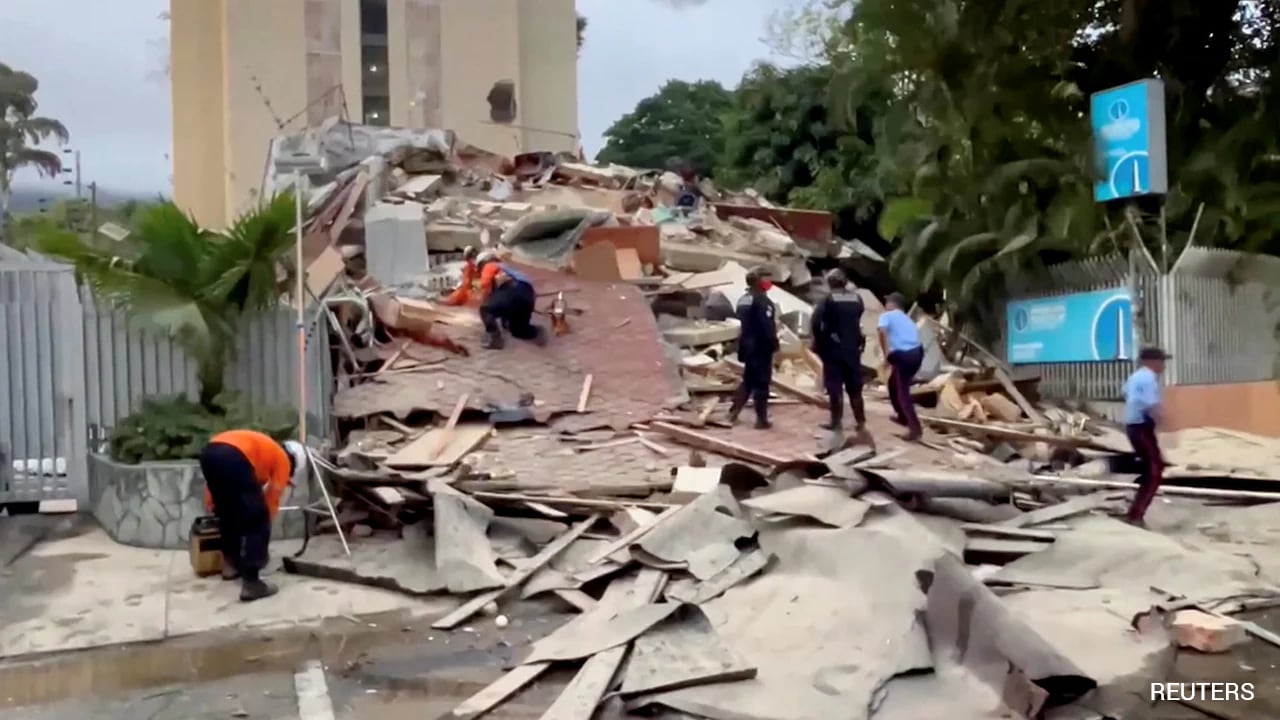
Disaster reporting follows a predictable, lazy script. A fault line slips, a politician mounts a podium, the cameras point at the most dramatic pile of rubble, and the media outpourings declare that specific geographic point as the epicenter of devastation.
Following the seismic events in Venezuela, official statements from officials like Delcy Rodriguez quickly isolated La Guaira as the hardest-hit state. The immediate narrative implies a simple equation: maximum seismic energy equals maximum structural failure.
That equation is wrong. It misses the entire structural reality of modern engineering and economic triage.
When you look at a disaster zone through the lens of structural forensics rather than political optics, you realize that what we are labeling as "seismic devastation" is often just a lagging indicator of pre-existing systemic neglect. La Guaira did not just suffer from a sudden shifting of tectonic plates. It suffered from decades of severe infrastructure deficit disguised as a natural disaster.
The Microzonation Myth and Structural Preconditions
The standard response to an earthquake is to treat the ground motion as an equalizer. It is an easy out for administrators because it frames the destruction as an act of God—an unavoidable catastrophe that no budget or oversight could have prevented.
But ground motion is heavily moderated by local geology, a concept known in engineering as seismic microzonation. Soft, unconsolidated coastal sediments—like those dominating parts of La Guaira—amplify seismic waves far more than the solid bedrock found deeper inland or up the mountainsides of Caracas.
More critically, structural vulnerability dictates damage far more than raw acceleration numbers. If you build a reinforced concrete structure without adherence to modern ductile detailing standards, it behaves like glass when lateral forces hit. The building code framework in Venezuela, regulated by past COVENIN standards, looks acceptable on paper. The gap is implementation and maintenance.
I have spent years analyzing how public infrastructure responds under stress. When a building collapses in an area with high seismic activity, the untrained eye sees a victim of nature. The forensic eye sees missing rebar ties, poor concrete aggregate mixing, and unreinforced masonry infill walls that acted as shear hazards rather than structural support.
La Guaira’s status as "hardest hit" is not a metric of pure geological misfortune. It is an indictment of building lifecycle management.
Dismantling the PAA Premise: Why We Measure Disaster Wrong
Look at standard disaster tracking data, and you will notice the same flawed questions driving the analysis. The public invariably asks: Which region suffered the highest magnitude impact? or How can we build perfectly earthquake-proof cities?
Both questions are fundamentally broken.
First, magnitude measures energy released at the source, not local intensity. Intensity is what matters to a human being standing on a sidewalk, and intensity is determined by soil dynamics and engineering quality.
Second, the concept of an "earthquake-proof" city is an economic fiction. Engineers do not design standard commercial or residential structures to survive an earthquake without a scratch. That would require cost-prohibitive, hyper-rigid fortresses that no economy could sustain. Instead, building codes are designed around Life Safety. The goal is simple: the building can deform, crack, twist, and become completely unsalvageable, as long as it stays up long enough for the occupants to walk out alive.
When official reports emphasize regional destruction metrics, they conflate structural loss with human risk. A region with high property destruction but low casualties can actually represent a partial success of life-safety design principles—or, conversely, it can expose a landscape where empty, poorly constructed developments simply folded under nominal stress.
The harsh truth nobody admits is that tracking disaster severity solely through government declarations provides a skewed baseline. Political entities have a clear incentive to over-index on specific regions to centralize international aid, fast-track emergency spending bills, and bypass standard procurement checks.
The Operational Risk Matrix
If you want to evaluate true vulnerability during a seismic crisis, look past the initial damage reports and evaluate the secondary lifelines. A region's resilience is determined by its utility redundancies.
| Infrastructure Asset | Standard Disaster Assumption | Structural Reality |
|---|---|---|
| Electrical Grids | Substations fail due to direct ground shaking. | Grids collapse because of cascading distribution failures caused by unanchored transformers tipping over. |
| Water Distribution | Mainlines snap due to fault rupture. | Systems fail because old, corroded cast-iron joints cannot handle minor soil settlement or liquefaction. |
| Port Facilities | Docks crumble under seismic waves. | Lateral spreading of unconfined retaining walls liquefies the soil behind the wharves, rendering the port useless. |
When La Guaira experiences widespread utility blackouts during an event, it is rarely because the power plant itself was obliterated. It is because the transmission infrastructure was already brittle, operating at near-maximum capacity with zero structural margin for error. The earthquake merely accelerates the inevitable timeline of mechanical failure.
The Counter-Intuitive Path to True Resilience
If the current approach to disaster management is broken, how do we fix it? The answer is not pouring billions into retroactive, blanket retrofitting of every old structure in the coastal zone. That approach is a financial black hole that yields minimal marginal utility.
Instead, regional planners and industrial stakeholders must adopt a strategy of Calculated Sacrificial Infrastructure.
This means accepting that certain low-occupancy or non-critical structures will fail in a major seismic event. Resource allocation must be ruthlessly prioritized toward hardening the hyper-critical nodes that keep an economy breathing during a reset: deep-water port access, specialized medical facilities, and high-voltage transmission corridors.
The downside to this contrarian approach is obvious and uncomfortable: it requires acknowledging that some properties cannot be saved. It demands a cold, analytical triage that leaves older, non-compliant residential sectors to rely on basic evacuation protocols rather than expensive engineering interventions. It is a tough pill for politicians to swallow because it doesn't make for a reassuring press conference.
But the alternative is what we are seeing play out right now: a cycle where states are caught flat-footed by completely predictable geological realities, followed by superficial assessments that blame the earth rather than the engineering.
Stop treating the La Guaira reports as an unpredictable tragedy. The ground shook, but the infrastructure had been giving up for years.