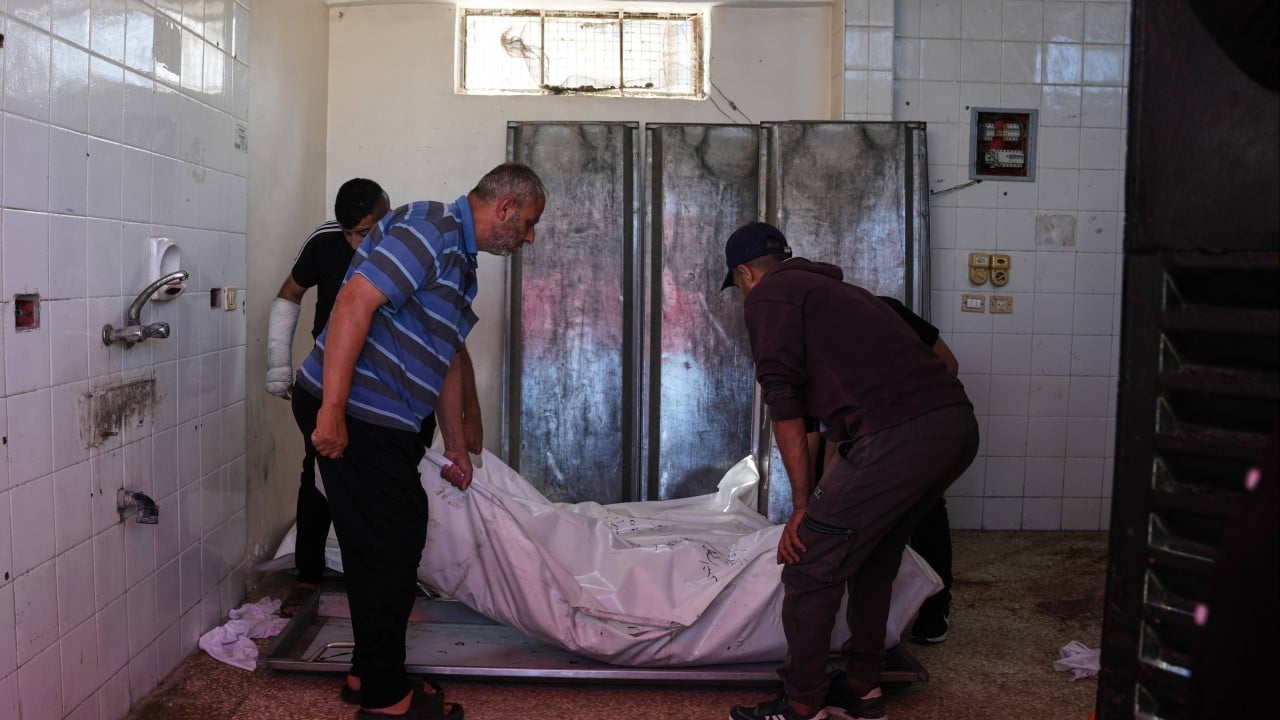
The death of a nuclear family unit—two parents and an infant—in the Nuseirat refugee camp serves as a primary data point for analyzing the structural failure of precision targeting within hyper-dense urban environments. While tactical reports focus on the strike's immediate casualty count, a more rigorous analysis reveals a systemic "Density-Precision Gap." This gap occurs when the effective kill radius of standard aerial munitions exceeds the structural spacing of civilian infrastructure, making collateral damage a mathematical certainty rather than a statistical outlier.
The Geometry of Urban Lethality
Urban warfare in the Gaza Strip, specifically within the Nuseirat camp, is governed by a set of spatial constraints that redefine the concept of "surgical" strikes. To understand why a single kinetic event results in the eradication of a family unit, one must deconstruct the theater into three distinct variables: structural proximity, material integrity, and the overpressure gradient.
- Structural Proximity: In refugee camps, the horizontal distance between residential units often approaches zero. Shared load-bearing walls mean that kinetic energy applied to a military target is transferred directly to civilian domiciles via conduction.
- Material Integrity: The prevalence of unreinforced cinderblock and corrugated metal creates a secondary fragmentation effect. When a missile strikes a target, the building itself becomes a weapon, shattering into high-velocity projectiles that penetrate adjacent rooms.
- The Overpressure Gradient: Modern thermobaric or high-explosive munitions rely on a blast wave. In narrow alleyways, this wave is channeled rather than dissipated, amplifying the pressure felt by occupants in nearby structures. For an infant, the threshold for fatal pulmonary barotrauma is significantly lower than that of an adult, meaning "non-lethal" distances for combatants remain lethal for pediatric populations.
The Asymmetry of Intelligence and Execution
The failure to prevent family-level casualties indicates a breakdown in the "Targeting Cycle," a multi-step process involving Find, Fix, Track, Target, Engage, and Assess (F2T2EA). When the objective is the neutralization of a mobile or embedded asset, the intelligence window often shrinks, forcing a trade-off between "Target Opportunity" and "Collateral Risk Assessment" (CRA).
The CDE (Collateral Damage Estimation) methodology used by modern militaries utilizes software to predict the number of non-combatant casualties. However, these models often rely on outdated census data or static assumptions about building occupancy. In Nuseirat, the influx of internally displaced persons (IDPs) has increased population density by orders of magnitude. A building marked "vacant" or "single-occupancy" in a database from six months ago may now house multiple families. This "Data Lag" is a primary driver of the discrepancy between projected and actual casualty rates.
Kinetic Energy vs. Civilian Safeguards
Military doctrine often cites "roof knocking" or SMS warnings as mitigation strategies. These are psychological operations intended to clear a strike zone, yet their efficacy is negated by three specific friction points:
- Temporal Latency: The time between a warning and a strike is often insufficient for multi-generational families—including the elderly and infants—to egress a multi-story structure.
- The Lack of "Safe Vector": In a saturated bombardment environment, civilians often perceive the act of moving into the street as higher risk than remaining sheltered, leading to a "shelter-in-place" bias that proves fatal.
- Communication Blackouts: Intermittent cellular service and power outages ensure that a significant percentage of the target population never receives the digital warning.
The Economics of Munition Selection
A critical yet overlooked factor in the Nuseirat strike is the "Munition-to-Target Mismatch." To ensure the destruction of a hardened target or a tunnel segment, forces may deploy 1,000lb or 2,000lb Joint Direct Attack Munitions (JDAMs). While these are "smart" bombs in terms of guidance, their yield is "dumb" in terms of area of effect.
The use of a high-yield weapon in a low-clearance zone suggests a tactical priority on "Certainty of Destruction" over "Containment of Effect." When the objective is to eliminate a high-value target (HVT) or a weapon cache, the military logic dictates a threshold of "Acceptable Collateral," which is scaled based on the perceived value of the target. The death of the parents and their child in Nuseirat is the physical manifestation of this threshold being reached.
Structural Failures in International Humanitarian Law (IHL)
The principle of Proportionality under IHL requires that the anticipated civilian loss must not be excessive in relation to the concrete and direct military advantage anticipated. This creates a subjective "Value Equation":
$$V_m > C_c$$
Where $V_m$ is the military value and $C_c$ is the collateral cost. The Nuseirat incident highlights the inherent flaw in this equation: $V_m$ is determined by the attacker’s classified objectives, while $C_c$ is measured in human life. Because $V_m$ is hidden, the proportionality of the strike cannot be independently verified in real-time. This lack of transparency allows for the gradual expansion of "acceptable" loss, leading to the normalization of family-unit eradication.
The Logistics of Displacement and Vulnerability
The family’s presence in a refugee camp—areas historically designated as zones of relative safety—points to the total collapse of the "Safe Zone" construct. When a geographic area is designated for IDPs, it becomes a high-density node. If combatants then utilize that same node for cover or logistics, the civilian population becomes a "Human Buffer."
This creates a tactical paradox:
- Concentration: Civilians concentrate in camps for aid and perceived safety.
- Saturation: The density makes it impossible for combatants and civilians to remain physically separated.
- Targeting: The military treats the presence of a combatant as a "validating" factor for the entire site, regardless of the civilian-to-combatant ratio.
The result is a "Kinetic Trap" where the very structures intended to provide refuge become the primary mechanism of death via structural collapse.
Strategic Implementation: Shifting the Targeting Paradigm
To mitigate the recurrence of family-level casualties in urban centers, a shift from "Yield-Based Targeting" to "Effect-Based Targeting" is required. This involves:
- Micro-Munition Adoption: Prioritizing Small Diameter Bombs (SDBs) with focused lethality and low-fragmentation carbon-fiber casings.
- Real-Time Occupancy Verification: Integrating thermal imaging and high-revisit satellite telemetry to update CDE models seconds before trigger release.
- Strict Proportionality Audits: Implementing third-party or automated "Kill-Chain" reviews that halt strikes when predicted civilian density exceeds a pre-defined threshold, regardless of the HVT’s importance.
Without these adjustments, the Nuseirat incident will not remain an isolated tragedy but will continue to serve as the standard operating outcome of 21st-century urban siege warfare. The strategic failure lies not just in the individual strike, but in the continued application of high-yield kinetic logic to a high-density human environment.


