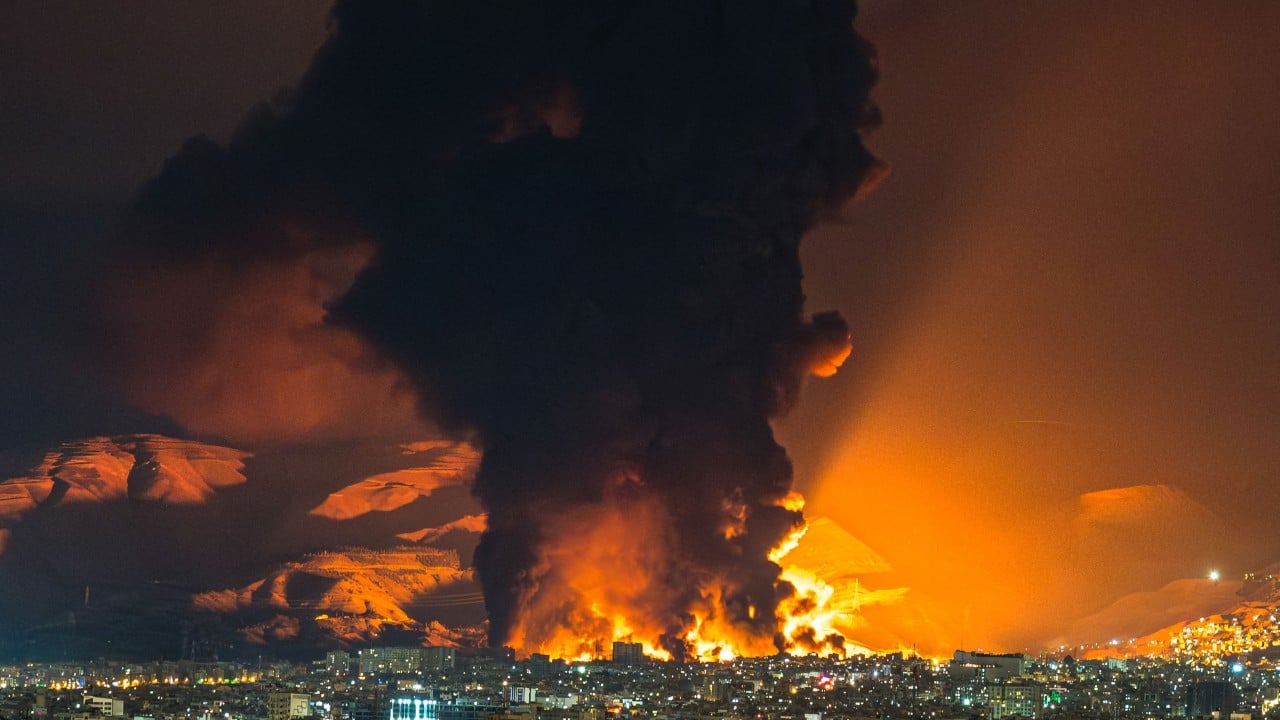
The duration of a US-Israel kinetic engagement against Iranian infrastructure is not a singular timeline but a function of three distinct operational phases: the suppression of Integrated Air Defense Systems (IADS), the degradation of the "Forward Defense" missile network, and the subsequent management of a fractured regional security architecture. Conventional analysis often focuses on the "start" of hostilities while ignoring the specific physical and economic bottlenecks that dictate the "end." Chinese military strategists, viewing this through the lens of maritime silk road stability and energy security, identify a protracted attrition cycle rather than a "surgical strike" success.
The Triad of Conflict Duration
Determining how long a war lasts requires mapping the interaction between offensive capacity and the target’s "strategic elasticity." In the Iranian context, this elasticity is maintained by a subterranean military-industrial complex and a decentralized command structure.
1. The IADS Suppression Window (72 to 120 Hours)
The initial phase is defined by the electronic and physical neutralization of Iranian radar, surface-to-air missile (SAM) sites, and command-and-control nodes. This is the only phase with a predictable, short-term duration. The technical bottleneck here is the "sorter" capacity—the speed at which US and Israeli intelligence can confirm the destruction of mobile units like the Bavar-373 and Khordad-15.
Until air superiority is absolute, high-value strike assets cannot loiter to perform Battle Damage Assessment (BDA). This creates a lag in the targeting cycle. If the IADS remains partially functional, the conflict duration expands instantly as the coalition must revert to stand-off munitions, which are finite in inventory and high in unit cost.
2. The Missile Attrition Phase (30 to 90 Days)
The core of Iranian strategy is the "Missile Forest"—thousands of mobile launchers hidden in hardened silos (missile cities) across the Zagros Mountains. Unlike a traditional army, this force does not need to "win" a battle; it only needs to survive and intermittently launch.
- Launch-to-Storage Ratio: Iran’s ability to cycle launchers from deep storage to firing positions determines the tempo of the war.
- The Interception Deficit: US and Israeli missile defense systems (Aegis, Arrow-3, David’s Sling) operate on an unfavorable cost-exchange ratio. Each Iranian drone or short-range ballistic missile costs a fraction of the interceptor used to stop it.
- Industrial Replacement Cycles: Conflict duration in this phase is dictated by how quickly the US can surge interceptor production. Once magazines are depleted, the "war" continues as a one-sided bombardment of regional energy hubs, regardless of whether the US still holds the initiative.
3. The Proxy Persistence Cycle (Indefinite)
The most significant miscalculation in western duration-modeling is the assumption that a decapitation strike on Tehran ends the kinetic phase. Iranian influence is "containerized" within groups like Hezbollah and various militias in Iraq and Yemen. These entities possess autonomous supply chains. Even if the Iranian center of gravity is neutralized, the peripheral conflict—targeting global shipping and Israeli borders—remains active until the localized stockpiles are physically exhausted.
The Economic Limit of Kinetic Action
Strategy consultants often use the "marginal cost of conflict" to predict when a state will seek an exit. For the US and Israel, the limit is not found in military defeat, but in the systemic failure of regional insurance markets and energy pricing.
Chinese analysts focus heavily on the Strait of Hormuz Risk Multiplier. Iran does not need to close the Strait permanently to "win" a duration game. A "soft closure"—defined by a 400% spike in maritime insurance premiums and the deployment of smart mines—effectively removes 20% of global oil supply. At this point, the conflict duration becomes a political liability for the US executive branch. The war ends when the global economic contraction outweighs the perceived security gains of continued strikes.
The Chinese Strategic Calculus: Stability as a Weapon
Beijing’s perspective is rooted in the "Comprehensive National Power" (CNP) framework. They view a US-Iran war not through the lens of regime change, but through the depletion of US precision-guided munition (PGM) stockpiles.
The Munition Bottleneck
The US defense industrial base is currently optimized for low-volume, high-tech production. A high-intensity conflict with Iran would consume "the first-tier PGM inventory" within weeks. Chinese strategists calculate that every month the US remains bogged down in a Middle Eastern attrition war is a month where the "Pacific Pivot" is functionally paused. This creates a strategic incentive for Iran's partners to provide "non-lethal" technical assistance, such as electronic warfare suites or satellite telemetry, specifically designed to extend the war’s duration.
Energy Diversification
China has spent a decade building the Power of Siberia 2 pipeline and increasing overland energy imports from Central Asia. This reduces their vulnerability to the Hormuz Risk Multiplier. By being the last major economy capable of absorbing high energy costs, China gains relative power as the US and Europe deal with the inflationary shocks of a prolonged Persian Gulf conflict.
The Logistics of Iranian Resilience
The geography of Iran is a force multiplier for duration. The central plateau is surrounded by mountain ranges that act as natural fortifications.
- Distributed Manufacturing: Iran has decentralized its drone and missile production into small, civilian-adjacent workshops. There is no single "factory" to destroy that stops the flow of weapons.
- Hardened Infrastructure: Deep-burying technology has progressed to the point where standard bunker-busters may require multiple hits on a single coordinate to achieve a breach. This increases the "Sortie-per-Target" requirement, effectively doubling the time required to clear a target list.
- The Asymmetric Naval Doctrine: Instead of a blue-water navy, Iran utilizes hundreds of fast-attack craft and midget submarines. Clearing these from the Persian Gulf's complex coastline is a slow, "mowing the grass" operation that cannot be rushed without risking significant naval assets.
Modeling the Culmination Point
In Clausewitzian terms, the "culmination point" is where the attacker’s strength no longer exceeds the defender’s. In a war against Iran, this point is reached when the coalition's logistical tail is overstretched.
The US must maintain a "Minimum Deterrent Load" in other theaters (the South China Sea and Eastern Europe). If the Iran conflict consumes more than 40% of available carrier strike groups or 50% of theater ballistic missile defense assets for longer than 60 days, the US faces a "Global Readiness Gap." This gap is the hard ceiling on conflict duration.
Structural Constraints on Israeli Operations
Israel faces a different set of duration constraints. Unlike the US, Israel has no strategic depth. The domestic economy is highly sensitive to the mobilization of reservists.
- Labor Market Paralyzation: A war lasting longer than 30 days puts immense pressure on the Israeli tech and agricultural sectors as the workforce remains in uniform.
- The Iron Dome Saturation Point: Missile defense is a finite resource. If Iran and its proxies launch 1,000+ projectiles per day, the interceptor inventory becomes the primary clock. Once the "protection ceiling" drops, the political pressure to end the war—regardless of whether Iranian nuclear or military goals were met—becomes overwhelming.
The Final Strategic Calculation
The duration of a US-Israel-Iran war is not determined by the speed of the opening "shock and awe" campaign, but by the resilience of the Iranian subterranean logistics and the global tolerance for energy instability. Any model suggesting a conflict shorter than six months ignores the physical reality of the Zagros fortifications and the autonomous nature of the regional proxy network.
The strategic play for a coalition is to avoid a general kinetic war in favor of a "Horizontal Escalation" strategy—targeting the financial and logistical nodes that enable the "Forward Defense" while maintaining a credible threat of force. If kinetic action is initiated, it must be coupled with an immediate, pre-negotiated global energy release from the Strategic Petroleum Reserve and a rapid-deployment "Mine Countermeasure" (MCM) task force to prevent the soft closure of the Strait of Hormuz. Failure to secure these two economic flanks ensures that the conflict duration will be dictated by Tehran's willingness to endure, rather than the coalition's power to destroy.
Would you like me to model the specific interceptor-to-missile cost ratios for a 30-day high-intensity exchange?